Kansas and Missouri both top 10 for most legislative seats flipped by Democrats
Published in Political News
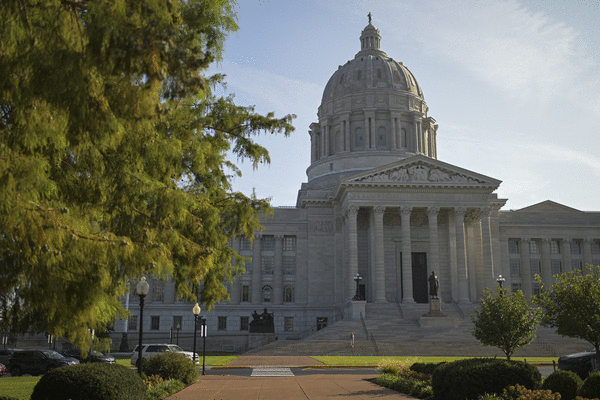
A tidal wave of legislative gains for Democrats in statehouses across the country was especially pronounced in Kansas and Missouri, where Republican incumbents were ousted in droves earlier this month.
GOP supermajorities that have dominated state politics in Missouri since 2013 and Kansas since 2011 were shattered, although Republicans retain a firm grasp on both legislatures.
In a year that saw Republicans lose ground in all 46 states with legislative seats on the ballot, a Star analysis of unofficial election results found that Kansas and Missouri are both firmly in the top 10 for most seats flipped from red to blue.
Democrats are in line to pick up 20 seats in Kansas and at least 18 in Missouri, where another Republican incumbent is clinging to a 67-vote lead based on unofficial results.
“The GOP had supermajorities in both states, and so when you’re starting from that point, that’s going to mean that when there’s a wave, there’s just a lot of seats that are available to be flipped,” said Matt Harris, a political science professor at Park University.
New Hampshire Democrats flipped 95 seats — the most of any state this cycle — including 88 seats in the 400-member House of Representatives, which is the largest state-level legislative chamber in the country.
Other standout performances included in North Carolina, where Democrats picked up 23 seats and hold slim leads in five other races. Democrats are also in line to pick up at least 20 seats in Indiana, Connecticut and Texas, based on unofficial results.
But the Republican losses in Missouri and Kansas were among the most sizable, The Star’s analysis found.
Harris said Missouri Democrats seized on the opportunity to mount campaigns in districts that had gone uncontested in previous cycles.
“Part of it is just sort of deciding to challenge some seats and make a concentrated effort,” Harris said.
In Kansas, even though state senators didn’t have to run for reelection this year, Democrats might have extended their gains in the House of Representatives if they had fielded candidates in other races, Harris said.
“Democrats in Kansas are probably sitting there saying, ‘We should have contested some more seats. We probably had more opportunities than we thought we did,’” Harris said.
The balance of power
Breaking the Republican supermajority in Kansas could prove to be especially consequential because voters also narrowly selected Democratic state Sen. Cindy Holscher of Overland Park to succeed two-term Democratic Gov. Laura Kelly.
“What it means is that the governor’s veto power is actually going to mean something,” Harris said. “If you look at the veto sessions in Kansas, particularly the last couple years. Republicans could just take the governor’s veto, and if they were unified, it meant nothing.
“Now, if Democrats are unified, you’re going to have a veto that actually means something because the override is going to be not automatic,” he said. “So that may mean that on some of these things, there’s room for negotiating.”
Some of Kelly’s longtime priorities that Republicans have thwarted over the last eight years, including marijuana legalization and Medicaid expansion, could be back on the table, he said.
In Missouri, Republicans still control the governorship and both legislative chambers, although their margins have narrowed considerably.
At a ribbon-cutting ceremony in Kansas City on Monday, Gov. Mike Kehoe told reporters that, despite losses, he believes Missouri is a conservative state and he’ll continue to push policies that resonate with those voters.
Koehoe’s remarks came after a devastating year for his legislative agenda that saw Missouri voters reject a near-total abortion ban, as well as efforts to repeal the state income tax, gerrymander Kansas City and curb the state’s most prominent form of direct democracy.
“The question is where does the Missouri GOP decide to push, because I think they’ve lost a lot of political capital in the last year or so,” Harris said.
“Do you keep pushing on some of these things that voters have said repeatedly, ‘We don’t like’? Or do you try to push on some other things that are maybe more in-line with what voters want or are more moderate?”
_____
©2026 The Kansas City Star. Visit kansascity.com. Distributed by Tribune Content Agency, LLC.















































Comments