These California lawmakers are positioned to reshape Washington's climate agenda
Published in Political News
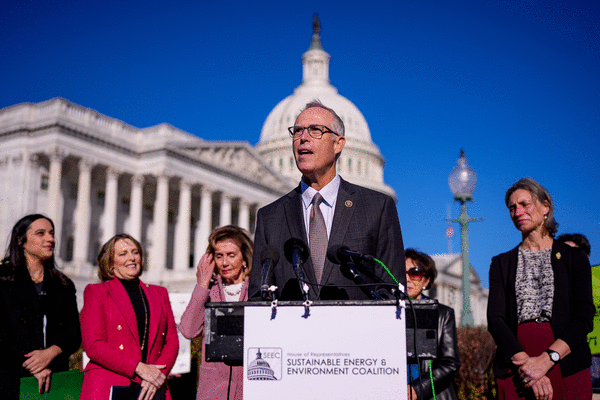
Lawmakers from California are poised to lead two of Congress’ most consequential energy and environment committees, putting the Golden State at the forefront of efforts to scrutinize the Trump administration’s sweeping changes to federal climate policy.
Reps. Zoe Lofgren, D-San José, and Jared Huffman, D-San Rafael, have served as the top Democrats on the House Committee on Science, Space and Technology and the House Natural Resources Committee, respectively, since Republicans took control of the chamber in January 2023. With Democrats now set to control the next Congress, both are the likely choice for chair.
The committees oversee major areas of federal science and energy research, public lands, water, wildlife and natural resources policy. While neither directly controls federal agencies, their leaders hold significant authority over oversight and legislation.
Both committees have advanced bipartisan legislation under Republican leadership, such as the Fix Our Forests Act from Natural Resources chair Bruce Westerman, R-Ark., and Calif. Rep. Scott Peters (D-San Diego). But they have also pursued efforts to reverse Biden-era environmental priorities — such as narrowing the Endangered Species Act— and advance President Trump’s domestic energy agenda, which favors oil and gas production.
Lofgren said the change represents a real opportunity to restore faith in science after two years of policies that have undermined it. The committee under Republican leadership launched a probe into the National Academies of Sciences over a report reaffirming the evidence for climate change.
“We’re not confused that climate change is going on. Neither are most Americans,” Lofgren said. “Ask any farmer in my district, and they’ll tell you climate change is going on.”
It’s also a chance to put California’s embattled environmental ambitions back in the congressional spotlight. The White House has challenged the state’s climate goals, slashing $1.2 billion in funding for its nascent hydrogen hub, moving to restart oil drilling off the coast and striking deals with offshore wind developers to abandon their projects and invest instead in fossil fuels.
“Much of what the administration has done the past two years has moved forward simply because there was no congressional check and balance,” Huffman said, pointing to a long list of executive orders, no-bid contracts and spontaneous announcements from the president. “I think you’re going to see a dramatic shift when we begin to have a check in the form of Congress that does its job.”
Though committees cannot prevent the president from issuing executive orders, they can hold hearings, subpoena documents, investigate whether agencies are complying with existing laws, and draft legislation to protect specific programs or funding.
This might not have prevented some of the administration’s most consequential actions — such as the payouts to offshore wind developers, which effectively killed three of the five projects off the coast of California — but would have brought greater public scrutiny and accountability to the process.
The same is true of the administration’s use of the Defense Production Act to restart oil pumping operations at the Sable Platform off the coast of Santa Barbara, which the White House said is a matter of national security.
“We are awash in oil and gas production,” Huffman said, adding that the president has “relied on fake emergency declarations that no one has questioned or challenged.”
Lofgren said she would look into the administration’s dismantling of scientific agencies and cancellation of research grants. The U.S. Department of Energy — whose research and development programs fall under the Science Committee’s purview — recently acknowledged in court documents that the termination of $7.6 billion in funding for clean energy projects was targeted at blue states.
On the legislative side, Huffman said he would pursue a Democratic permitting reform proposal aimed at addressing soaring energy costs. Lofgren said she would push to reauthorize the Energy Act of 2020 and renew federal programs established by the CHIPS and Science Act, which together boosted spending for emerging technologies, clean energy and supply chains.
She would also advance laws supporting fusion research, quantum computing, next-generation nuclear and geothermal technologies, along with greater guardrails around artificial intelligence. The Science Committee’s current chair, Republican Rep. Brian Babin of Texas, has also supported some of these emerging technologies, including fusion and quantum research.
In fact, Lofgren was optimistic that cross-party cooperation would prevail. Nearly all of the committee’s bills adopted this year passed unanimously, or close to it, although many never made it to the House floor, she said.
“I’m not going to compromise on oversight, and I know that the Republicans may not agree with us on some of the oversight issues,” she said. “But when it comes to legislation, we have a long history of bipartisan collaboration, which I anticipate would continue.”
©2026 Los Angeles Times. Visit at latimes.com. Distributed by Tribune Content Agency, LLC.
















































Comments