Can DC's new delegate get Congress to care about statehood?
Published in Political News
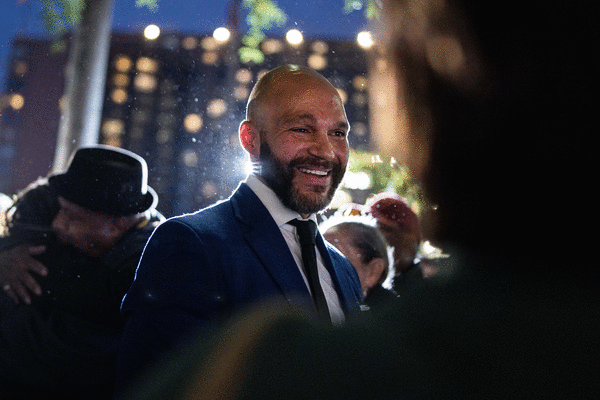
WASHINGTON — When Robert White gets sworn into Congress on Jan. 3, he’ll have one thing on his mind: convincing the rest of his party that D.C. statehood belongs on the priority list.
As Democrats look forward to life in the majority, they’ve got big plans as they try to deliver on their affordability campaign promises and conduct oversight of the Trump administration. White, a 44-year-old former council member who was born and raised in the District, has his pitch ready.
“The agenda gets done if you have the votes — and D.C. statehood gives you more votes,” he said.
His election marks a new chapter for the District’s nonvoting delegate. As Eleanor Holmes Norton retires after more than three decades, he’ll be just the third person to hold the seat in modern times. It also comes as President Donald Trump has tried to exert more control over local affairs in the nation’s capital.
White has the delicate task of paying homage to the legacy of his former boss (he once worked as her legislative counsel) while also putting some distance between them. Norton was known as a fierce advocate for the District but lately appeared to struggle through prepared remarks as her influence diminished. Earlier in her time in Congress, she pushed through both concrete and symbolic incremental wins, such as securing delegates the right to vote in what’s known as the committee of the whole.
He said Norton “built powerfully” on the work of Walter Fauntroy, who served as delegate from 1971 to 1991. “And my job is to build on top of what Norton built.”
At a Monday event, White’s father, Robert White Sr., wore a shirt with a slogan to that effect: “FAUNTROY & NORTON & WHITE.”
A crowd was assembled outside the John A. Wilson Building that night to mark White’s departure from the D.C. Council, after a last-minute uproar over a provision in the 1970 law establishing D.C.’s delegate position. Although he had hoped to serve on the council until January, the law states a delegate must hold “no other paid public office” on the date of his election, and White ultimately decided to resign before Election Day. As he stepped up to the podium, someone shouted a rallying cry that has only grown louder after Trump deployed National Guard troops to patrol the streets last year: “Free D.C.”
White won’t be the only freshman member next Congress who can’t cast a vote on the House floor — Alicia Limtiaco is another newcomer, after beating incumbent Del. James Moylan in Guam.
One way White thinks he can further his cause is by boosting his own name recognition.
“I need to make sure I’m developing a national profile for this seat,” he said. “I’ve got to hire the right comms director with the experience to help me get it done. I’m going to use the proximity of my seat here in D.C., making sure that all the national outlets know that when other members go back to their district, I’m still here and available to do interviews. Everything that we can do, including building relationships in other media markets, including through my leadership PAC, we’re going to be doing.”
He plans to start making his case before the new Congress even begins.
“I’m already starting to put together materials for all incoming members, and talking to leadership to see if I can carve out a piece of new member orientation to talk about D.C. both being a resource to members while they’re here, but also D.C. statehood,” he said.
He knows that even in his own party, standing up for D.C. can be a tough sell. A number of moderate Democrats have voted with Republicans on bills seeking to undermine D.C.’s autonomy and roll back local criminal justice laws over the last few years.
“We have seen D.C. used as a bargaining chip by the party,” he said. “The Democratic Party has not consistently been a firewall for D.C.”
Party consensus on D.C. statehood has evolved over time, but it hasn’t always been a unifying issue. In 1993, 105 House Democrats joined 172 Republicans in voting against a bill from Norton that would have paved the way for statehood and for the addition of two senators and a representative in Congress. When the House voted on statehood bills again in 2020 and 2021, it passed with near-unanimous Democratic support but stalled in the Senate.
Asked how he would respond to Democratic peers in Congress who might say they support D.C. statehood but need to focus first on issues like affordability that more directly affect their constituents, White countered with a question of his own.
“How’s that been going without the two senators from the District of Columbia?” he said.
He sees parallels with Republicans using redistricting to gain seats in Congress.
“People need to say to their constituents, ‘Look, not only are we doing what is right under democracy, but we are helping get the votes for our agenda.’ That is what the Republicans tried to do with redistricting. So, if you think you’re going to keep playing around the margins and start winning when that hasn’t worked, we’re fooling ourselves,” he said.
The way White sees it, appeals to the principles of democracy still ring true when arguing for full representation for the District’s some 700,000 residents. But pragmatic arguments matter, too.
“When they see D.C. statehood as their ticket to securing reproductive rights, their ticket to being able to afford health health care, then they start to see D.C statehood in a different light — and that is the light that I want to make sure I’m putting on this issue now,” he said.
©2026 CQ-Roll Call, Inc., All Rights Reserved. Visit cqrollcall.com. Distributed by Tribune Content Agency, LLC.
















































Comments