Trump made midterms about himself, and voters rejected him
Published in Political News
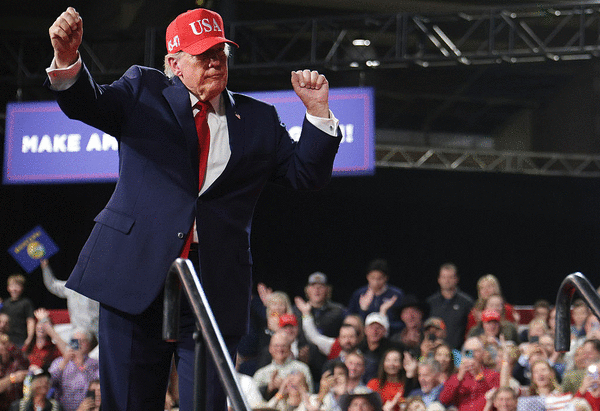
WASHINGTON — President Donald Trump consistently told voters this midterm campaign to pretend he was on the ballot.
Voters responded by making election night a disaster for the Republican Party the president has spent a decade remaking in his own image. Trump spent his first two years back in the White House focused almost exclusively on his “Make America Great Again” base.
One GOP strategist, granted anonymity to be candid, called the election results for Trump a “2006-style massacre,” referring to President George W. Bush’s second midterms when Democrats picked up a combined 37 House and Senate seats amid frustrations with the Iraq war, the economy and other issues at home.
“This is much bigger than a couple of candidates here and there. … The issues were Americans prefer cheap gas and not the Iran conflict, and [Trump’s] tariffs were … an issue given grocery prices,” the GOP strategist said in a text message as midnight approached Tuesday in Washington, D.C. “What’s going on in Texas … could be the shot heard around the world.”
That was a reference to Texas going blue on Trump’s watch, his handpicked GOP Senate nominee, state Attorney General Ken Paxton, losing his race to Democratic state Rep. James Talarico, and Trump-backed GOP Gov. Greg Abbott losing to Democratic state Rep. Gina Hinojosa. Trump blamed Abbott, whom he had long praised, in a late-night post, calling the three-term governor a “RINO,” or Republican in name only.
For 21 months, multiple public opinion polls charted the independent voters who pushed him to a second nonconsecutive term in 2024 steadily leaving his coalition. Many of the same polls showed an electorate fed up with the high prices of groceries, health care, travel and other everyday items.
Even as voters already were casting votes Tuesday, Trump continued to dismiss the country’s “affordability” crisis, which he for months dismissed as a Democratic-manufactured lie. The president who long sold himself as the one true messenger of the forgotten American man and woman dismissed voter concerns as a “hoax.”
Down went Senate candidates he rallied for in the homestretch of the campaign, including Sen. Darline Graham in South Carolina, Kansas Sen. Roger Marshall, GOP nominees Ashley Hinson in Iowa and Michael Whatley in North Carolina, and Paxton in Texas.
Several media outlets called Democrats winning control of the House before or just after 10 p.m. Eastern time. In South Carolina, Trump backed Graham over veteran GOP Rep. Ralph Norman, and in Texas, he put his grudge against longtime Sen. John Cornyn — who didn’t endorse him to be the GOP presidential nominee in 2024 — over Paxton’s baggage.
Former GOP Rep. Charlie Dent said “the president’s support among Republicans has been slightly diminished leading up to this point, and I suspect it will become more diminished after the election.”
“Over the next two years, many Republicans will be looking forward, not backward, and I think that the president will be less of a factor in the party. He’ll still be a factor, don’t get me wrong, but I think less of one,” Dent said in a telephone interview. “The [2028] presidential nominee, whoever that is, will be the one who will be trying to determine the future of the party.”
An ever-defiant Trump took to social media Tuesday night as the results rolled in and blamed GOP candidates, writing: “I wasn’t on the Ballot and if I was, we would have won IN A LANDSLIDE! Thank you for your attention to this matter.” Except, he had pleaded with voters for a month to “pretend” he was on the ballot.
Blame game
One White House official tried to deflect blame away from the boss, writing in an email that “candidate quality matters, and President Trump did a better job promoting many of the candidates on the ballot than the candidates did themselves.”
But Marc Short, who worked in the Trump 1.0 White House, on Tuesday night said the blame fell squarely on 1600 Pennsylvania Ave. “It’s hard to think of a WH that’s sabotaged House and Senate candidates more than this one,” he wrote on X.
Leading up to election night, however, Trump was dug in on defending his second term’s record.
“The inflation is solved. … I mean, everything’s going good,” Trump said Tuesday morning on “Fox & Friends” on Fox News Channel, calling his unpopular tariffs “tremendous.”
“I mean, we have a thing going that nobody has ever seen before, and that includes China and other countries, and they will let you know,” he said.
Trump’s campaign-trail economic message was further complicated by his decision to join Israel in striking Iran. The conflict, which started Feb. 28, defied his pledge of no new prolonged military conflicts, which had been a hallmark of his foreign policy for a decade.
Even as polls showed majorities of Americans placing high gas and diesel prices atop their lists of most-concerning issues, Trump for months shrugged them off, predicting oil prices would plummet, eventually.
“The onus and the blame is going to be right on the president of the United States, which of course he is going to resist,” Dent said. “At his rallies, there were these never-ending comments on things that were just really not connected to what most voters care about, which was inflation and the cost of everything and how challenging their lives are, from a financial standpoint. And the president just didn’t focus on those issues and talked about all these other things that, frankly, were irrelevant.”
‘Work with the Democrats’
Trump would not allow his party’s candidates to put distance between their campaigns and his unpopular second term.
As some House and Senate GOP candidates attempted to run on messages that downplayed Trump, he announced the first-ever Republican midterms convention in Dallas. The primetime spectacle spanned two nights, with Trump as the headlining act on Sept. 9 and Sept. 10 at the American Airlines Center.
During his lengthy appearance on the opening night, Trump got pushback from even some Republican lawmakers when he pledged he would send every U.S. citizen $5,000 — but only if his party retained control of the House and Senate.
On night two, Trump’s loyalists in the large arena — home to the NBA’s Dallas Mavericks — agreed to his demand that they raise their right hands and declare allegiance to him.
The convention made clear Trump would not ease his grip on the GOP.
Then came his October campaign rally blitz, with the president continuing to dismiss voters’ economic worries and issue cryptic threats about the accuracy of American elections and what he called Democrats’ collective intention to “cheat.”
By the end of his midterm rally sprint, Trump increasingly went for laugh lines, a striking contrast to his fire-and-brimstone events in 2016. Audiences of his supporters from Gastonia, N.C., to Corpus Christi, Texas, to Dalton, Ga., to Salina, Kan., to Wasilla, Alaska, chuckled along at times.
His closing-argument event Monday at the Reflecting Pool that sits between the Lincoln Memorial and the World War II memorial on the National Mall offered another example of Trump’s predilection for talking about matters relatively unimportant to voters. He talked about pool liners, his White House ballroom and other non-election issues.
By late Tuesday night, Trump appeared to have moved on, telling The New York Times he would accept the outcomes of the election results.
In other media interviews, the GOP president said he was ready to meet congressional Democrats at the negotiating table but that he had his veto pen ready.
“We’re going to work with the Democrats to make sure things go well for our country,” he said on a Politico livestream Tuesday. “They’ve already called and they want to work with me.”
—Niels Lesniewski contributed to this report.
©2026 CQ-Roll Call, Inc., All Rights Reserved. Visit cqrollcall.com. Distributed by Tribune Content Agency, LLC.














































Comments