Trump rushes to put imprint on DC -- if lawsuits don't stop him
Published in Political News
WASHINGTON — Donald Trump’s effect on the nation’s capital will last far longer than the results of any election — or his presidency — if he has his way.
Lawsuits over a growing number of projects are reaching critical moments as President Donald Trump seeks to start construction on a local golf course and a triumphal arch in Washington as soon as next month. Even if the lawsuits succeed in blocking some of Trump’s initiatives, he has been able to plow ahead before the courts could act, including in bulldozing the East Wing of the White House, cutting down trees at the golf course and shuttering the Kennedy Center.
Kirk Savage, a University of Pittsburgh professor emeritus known for his academic work on public monuments, race, and politics, said the scale of Trump’s personal imprint on the capital stands out historically.
“I don’t really see a comparable in the past century, as far as a president who is trying to put his own personal stamp on the memorial landscape of Washington, D.C.,” Savage said. “These are all very much identified as Trump projects.”
Preservationists, local officials and community groups have sued over projects big and small, turning Washington’s monuments, parks — and even bike lanes — into court fights.
Here’s where the legal battles over Trump’s Washington workup stand.
—East Potomac golf course
Trump wants to remake the 106-year-old East Potomac Golf Links into a Tom Fazio-designed championship course capable, he says, of hosting the U.S. Open, PGA Championship and Ryder Cup. On Oct. 18, he said that the public course will close Nov. 15 and reopen roughly 15 months later.
The D.C. Preservation League and two golfers say the administration is rushing ahead without required environmental and preservation reviews. The fight escalated this month after workers cut down hundreds of trees with little notice, prompting Judge Ana Reyes to halt further felling through Oct. 26 and require advance warning before other irreversible changes.
At an Oct. 19 hearing, Reyes pressed lawyers over the apparent disconnect between Trump’s announcement that construction will start in November and their position that the redesign remains in the planning stage.
“Do I believe the president of the United States, or do I believe you?” Reyes asked a Justice Department lawyer.
Reyes has yet to rule on whether to extend the restrictions. The Justice Department unsuccessfully sought to remove Reyes from the case, and, on Oct. 19, Trump called her a “crazed lunatic.”
—White House ballroom
Trump’s biggest Washington construction project has already reached the Supreme Court. The National Trust for Historic Preservation sued after the administration demolished the East Wing and began work on a new 90,000-square-foot ballroom complex.
A federal judge halted most above-ground construction in March, finding Trump likely needed congressional approval. But the Supreme Court in August stayed that order, allowing work to continue while the case proceeds. The 5-4 majority said the government was likely to show the preservation group lacked standing; it did not decide whether the ballroom itself is lawful.
Although the highest court order is temporary, it all but guarantees Trump can complete the vast majority of the structure before the legal fight concludes.
—Trump’s triumphal arch
Trump’s proposed 250-foot triumphal arch at Memorial Circle, between the Lincoln Memorial and Arlington National Cemetery, has drawn two separate lawsuits.
In Washington, three Vietnam War veterans and an architectural historian argue the monument would intrude on the historic vista connecting the two landmarks and cannot be built without congressional authorization. Judge Tanya Chutkan has ordered the administration to give the court advance notice before undertaking arch-related work at Memorial Circle.
Across the Potomac, Arlington County sued this month, accusing the National Park Service of rushing its environmental review and understating effects on historic sites, traffic and public infrastructure. The county says construction could damage an aging water main serving the Pentagon and Reagan National Airport and has also raised aviation-safety concerns.
The administration said in a court filing earlier this week that construction could start Nov. 5.
—Kennedy Center
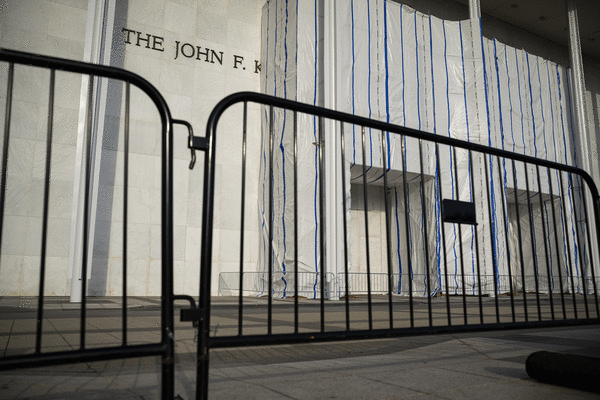
Early into Trump’s second term, he purged the Kennedy Center’s board to stock it with political allies and was elected chairman. His overhaul of the institution has produced two legal battles: one over how the institution is run and another over what can be done to the building.
Democratic Rep. Joyce Beatty of Ohio sued over Trump’s efforts to put his name on the center and the board’s plan to close it for two years. In May, U.S. District Judge Christopher Cooper ordered Trump’s name removed and blocked the closure, for now. The administration appealed, but the lettering came down.
The dispute didn’t end there. When the board later sought to again add Trump’s name to the facade and rename the grounds for him, Cooper blocked those moves as well. The fight is now on appeal.
The main building has since closed. After Trump publicly raised the prospect that it could be torn down, Cooper told the center to give 30 days’ notice before any demolition or other major physical changes are made.
Separately, eight architecture and preservation groups sued to require federal reviews of the renovation itself. Cooper declined to halt that work in May after officials testified there were no plans to demolish the building, though the litigation remains active as the project develops.
—Eisenhower Executive Office Building
Even a paint job has landed in federal court.
Preservationists sued over the Trump administration’s plan to turn the ornate gray-and-black Eisenhower Executive Office Building white, arguing the administration must complete historic-preservation and environmental reviews before altering the 19th-century landmark.
Now the administration’s own draft environmental assessment, released Oct. 16, says painting the building would diminish the historic character of the White House complex. The government estimates the project would cost at least $7.5 million; the assessment says cleaning and restoring the stone instead would be a better alternative.
—Lincoln Memorial Reflecting Pool
Aside from allegations of vandalism in high-profile criminal cases, which were eventually dismissed, Trump’s bright-blue makeover of the Lincoln Memorial Reflecting Pool has also sparked a civil lawsuit. The Cultural Landscape Foundation sued in May, alleging the Park Service had begun resurfacing the historic pool without required preservation and environmental reviews.
The government said “American Flag Blue” would improve the landmark’s appearance, while the Cultural Landscape Foundation argued the change would make the landmark resemble a swimming pool.
By early June, the resurfacing was finished. The group withdrew its emergency effort to stop the work, but the underlying lawsuit continues, with the administration seeking dismissal.
In one of the criminal cases, the U.S. charged a former Olympic canoeist with vandalizing the pool by ripping off a piece of the lining. The charges were eventually dropped when U.S. Attorney Jeanine Pirro said new documents provided by the Interior Department showed the damage was caused by shoddy work on the part of the contractor hired for the project.
—West Potomac Park
Trump’s proposed National Garden of American Heroes would put roughly 250 statues in West Potomac Park, along with gardens, plazas, dining facilities and an amphitheater.
The National Parks Conservation Association and six other groups sued Interior Secretary Doug Burgum in June, arguing the project would displace historic recreational space and cannot proceed without congressional authorization and required environmental and preservation reviews.
The groups have asked Judge Emmet Sullivan to block the project while the case proceeds. Both sides submitted written arguments this month, but there has not yet been a substantive ruling.
—United States Institute of Peace
The legal fight over the U.S. Institute of Peace began with Trump’s effort to oust its leadership and take control of its Washington headquarters. The administration later put Trump’s name on the building — and explored making it permanent by engraving it into the facade.
That last step hit a judicial roadblock in September. A divided U.S. Court of Appeals for the D.C. Circuit panel barred the administration from carving Trump’s name into the facade while the broader appeal over control of the congressionally created institution continues. The ruling didn’t require removal of the lettering already attached to the building.
—National Mall bike lanes
The Washington Area Bicyclist Association sued the Interior Department and other federal agencies over plans to remove protected bike lanes along 15th Street NW near the National Mall. In April, U.S. District Judge Amy Berman Jackson ruled that the government’s decision was arbitrary and capricious, vacated it and sent the issue back to the agencies, keeping the lanes in place.
©2026 Bloomberg L.P. Visit bloomberg.com. Distributed by Tribune Content Agency, LLC.
















































Comments