Trump's immigration detention policy to face justices
Published in Political News
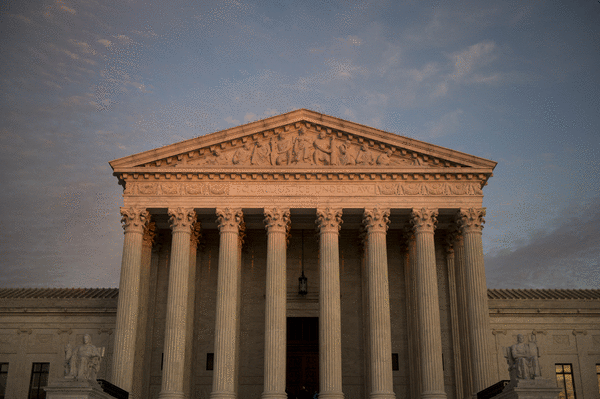
WASHINGTON — The Supreme Court agreed Thursday to hear a dispute about the legality of the Trump administration’s mandatory detention policy for many immigrants facing deportation.
The brief order sets up another high-profile fight during the coming term, when the justices will also hear issues ranging from gun rights to civil rights. The administration has argued that a 1996 immigration law requires that federal officials detain any immigrant “seeking admission” — a category that the administration says covers almost every immigrant without legal status — indefinitely without bond.
The interpretation shifted from prior administrations, including the first Trump administration, and resulted in tens of thousands of immigrants facing indefinite detention for civil immigration violations. Hundreds of immigrants have challenged the policy in federal court since last year, and a majority of lower court judges have found the policy violates federal law and the Constitution.
The dispute stems from language in the Illegal Immigration Reform and Immigrant Responsibility Act of 1996, which said that an immigrant who federal officials determine is “seeking admission is not clearly and beyond a doubt entitled to be admitted” then “shall be detained” pending removal proceedings.
Until last year, every presidential administration has applied that provision to people who recently crossed the border or otherwise entered the country. However, since last July the Trump administration has sought to apply that to almost every immigrant detained within the country without legal status.
In court the administration has argued that immigrants who did not present themselves at the border must be detained “regardless of how long the alien has been in the United States or how far inland from the border they managed to migrate before being detained.”
Immigrants and civil rights groups who challenged the policy argued that misinterpreted a law meant to apply to a much narrower category of immigrants.
The case the Supreme Court took Thursday originated from a Brazilian immigrant, Ricardo Aparecido Barbosa da Cunha, who entered the country without documentation in 2005, according to court records. He applied for asylum in 2016 and received a work permit.
Then in 2025, the Trump administration issued an administrative warrant for his arrest and detained him without bond. Da Cunha then challenged his detention in federal court and a judge agreed that he was entitled to a bond hearing, and later found that he was eligible for release pending the removal proceedings.
The Trump administration then appealed to the U.S. Court of Appeals for the 2nd Circuit, which ruled that the law does not require mandatory detention for immigrants like da Cunha.
Judge Joseph Bianco of the 2nd Circuit, who wrote for the unanimous three-judge panel, wrote that the government’s interpretation of the law “would send a seismic shock through our immigration detention system and society, straining our already overcrowded detention infrastructure, incarcerating millions, separating families, and disrupting communities.”
“If Congress meant to achieve such a radical break from the past, it would not have done so in such an indirect and ambiguous way,” Bianco wrote.
After the panel decision, the full 2nd Circuit declined to hear the case, setting up a Supreme Court fight. Eight other federal appeals courts issued decisions similar to the 2nd Circuit. However, two courts sided with the Trump administration: the U.S. Court of Appeals for the 5th Circuit and the U.S. Court of Appeals for the 8th Circuit.
The mandatory detention provision is separate from one of the Trump administration’s first legislative victories, the Laken Riley Act, which mandated detention for immigrants accused of certain crimes ranging from shoplifting to assaulting a law enforcement officer.
The case is Philip L. Rhoney, Acting Director of the Buffalo Field Office of U.S. Immigration and Customs Enforcement v. Ricardo Aparecido Barbosa da Cunha.
©2026 CQ-Roll Call, Inc., All Rights Reserved. Visit cqrollcall.com. Distributed by Tribune Content Agency, LLC.


















































Comments