Editorial: There's gold in that thar swamp!
Published in Political News
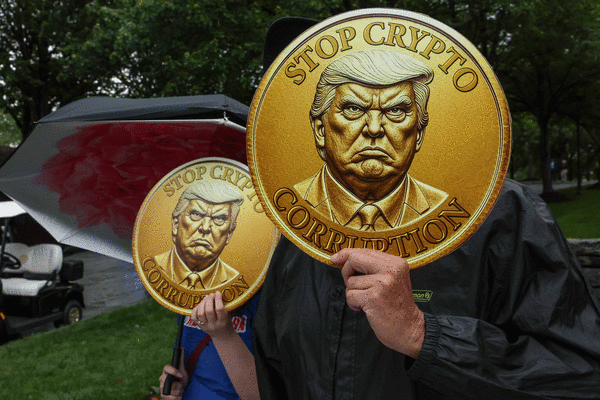
In President Donald Trump’s world, public service pays better than being a real estate mogul.
Trump has been lining his pockets since he returned to the White House. His sons, Eric and Donald Jr., have been cashing in, too. So has his wife, son-in-law Jared Kushner, and other cronies in the Trump administration.
In just his first year back in office, Trump made more than $2.2 billion — an unheard-of sum for any previous president, and more than he ever made in any of his years as a private businessman.
More troubling is how Trump has blurred his private profiteering with public policy — so much so that it is hard to know where one starts and the other ends.
Most of Trump’s recent windfall has come from a murky crypto venture and a number of foreign real estate deals. But his cash grab seemingly has no end. Trump incorporated dozens of new companies just before returning to the White House.
He launched numerous Trump-branded products, including Bibles, $249 “Victory 47” cologne, $399 gold high-top sneakers, $450 golf shoes, work boots, a line of watches that go from $499 to $100,000, and guitars for $10,000.
While much of Trump’s shameless self-dealing has occurred in broad daylight, he has received little pushback from Republican lawmakers who control Congress, or the conservative media echo chamber that once championed his calls to “drain the swamp.”
The White House continues to maintain the president is doing precisely that. The administration has repeatedly denied accusations of corruption and self-dealing, stating through a spokesperson that “President Trump only acts in the best interests of the American public.”
Questions about whether Trump’s focus during his second term is more on personal enrichment than public service began even before Day One.
Four days before returning to office, the Trump family’s newly created cryptocurrency company, World Liberty Financial, sold a 49% stake in the company valued at $500 million to Sheikh Tahnoon bin Zayed Al Nahyan, the United Arab Emirates’ national security adviser, known as the Spy Sheikh.
In May 2025, another company chaired by Tahnoon invested $2 billion using a stablecoin issued by World Liberty. Two weeks later, the Trump administration announced a deal to sell hundreds of thousands of dollars worth of advanced computer chips for use in AI to the UAE.
Trump made almost $60 million on foreign licensing deals in 2025, a 900% jump from the years before he returned to the White House.
Unlike in his first term when Trump promised not to make any private foreign business deals, some recent family ventures include a $530 million luxury skyscraper on the Red Sea, an 80-story Trump Tower in Dubai, and golf resorts in Oman and Qatar.
Most of Trump’s foreign money-making has occurred in the Middle East, but he added millions to his wealth through far-flung ventures in India, Ireland, Romania, and Vietnam. At the same time the Trump family is cutting lucrative private foreign business deals, he, as president, is negotiating public trade deals while ricocheting between imposing and lifting tariffs.
Amid making more than a billion through crypto, Trump hosted a White House gala for top crypto purchasers. He also used the power of the presidency to pardon three crypto convicts, including a billionaire who was critical to helping his family’s crypto business and another man who was serving a double life sentence for using Bitcoin to facilitate sales of heroin, cocaine, and LSD.
Along the way, Trump has cashed in on his deep business ties to Saudi Arabia that go back decades. Since his return to the White House, his family has announced at least nine deals worth more than $50 billion.
At the same time, Trump has used the federal government to benefit Saudi Arabia. His administration just approved a deal to sell billions of dollars worth of F-35 fighter jets to Saudi Arabia — rejecting concerns raised by the intelligence community and lawmakers that the advanced technology may end up in the hands of the Chinese.
Trump also approved a deal to allow Saudi Arabia to enrich uranium for nuclear energy at the same time he is at war with Iran to prevent it from obtaining nuclear weapons.
Trump continues to mix politics and personal business, often at the same time. Trump recently used the lavish $400 million jet the Qatari government gave to him to attend a golf tournament at his resort in Ireland, where he met with government leaders and sparked an international incident regarding the future of Northern Ireland.
Trump rejected dire warnings from artificial intelligence executives to slow down and regulate the technology before it spirals out of control. Trump called the concerns that AI could end humanity a hoax — but failed to disclose how he and his sons are personally invested in the technology.
The billion-dollar question is whether Trump’s Oval Office decisions are made in the best interest of the American people or his bottom line.
Trump’s tangled financial history with Russia for so long has caused many to wonder if it influences his embarrassing deference to Vladimir Putin, unwillingness to fully help Ukraine defend itself, and constant attacks on NATO.
Years before he became president, he proposed building a hotel there and brought the Miss Universe pageant to Moscow. After Trump’s real estate empire ran into financial trouble, he received help from Russia.
A Republican-led Senate intelligence report found Russia interacted with Trump campaign officials during the 2016 election, and recently declassified documents show Russia tried to help him win the 2020 election.
Amid that backdrop come two recent reports that show how Trump continues to mix policy and business in Russia. First, the White House has been dangling business deals to get Putin to end the war in Ukraine. Second, a Russian oligarch and Putin ally helped bankroll the recent wedding of Trump’s son, Don Jr. (Trump said his son will give the money back.)
Trump came of age in the 1980s when the Wall Street mantra was “greed is good.” As president, he’s showing that graft is even better — at least for him.
Even when the schemes don’t work out, they never die.
Trump floated a brazen deal to reward cronies who committed crimes and violence on his behalf with financial payouts from a $1.8 billion fund to be created with taxpayers’ money. It was part of an unprecedented “settlement” Trump reached between himself and the IRS — which he oversees — on the heels of a lawsuit he filed against the agency for $10 billion after his tax information was leaked to the news media.
Amid bipartisan pushback and legal challenges, then-acting Attorney General Todd Blanche declared the plan “dead” in June, and the U.S. Department of Justice formally rescinded it in August.
The second part of the deal — which received essentially no GOP pushback — includes a scheme to issue a blanket pardon to Trump, his businesses, and his family members for pending tax audits. The deal could enable Trump to avoid a potential $100 million penalty.
Despite resistance and legal challenges, the president continues to support the slush fund and the IRS immunity. Both remain alive, even as a federal judge this month demanded to know who came up with these ideas in the first place.
After the Constitution was established, Benjamin Franklin wrote that the document has “an appearance that promises permanency; but in this world nothing can be said to be certain, except death and taxes.”
For Trump, the certainty of taxes apparently now does not apply.
After all, in Trump’s world, corruption is king.
It is all part of Trump’s second White House tenure, which could be coined the Art of the Steal.
_____
©2026 The Philadelphia Inquirer. Visit inquirer.com. Distributed by Tribune Content Agency, LLC.















































Comments