Do Democrats have a chance in November in GOP-dominated Florida?
Published in Political News
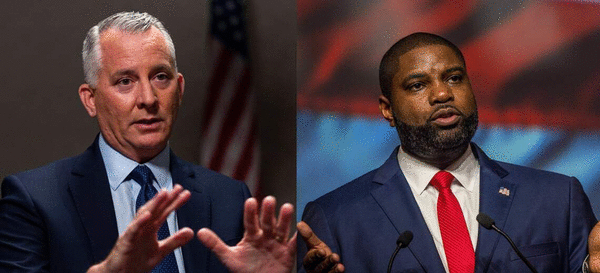
In a state that has become a Republican bastion — where the GOP has been in the governor’s mansion for nearly 30 years, holds a supermajority in the legislature and loves that President Donald Trump calls Florida home — Democrats are not used to optimism.
But in 2026, amid a toxic national environment for the GOP, Republican campaigns are suddenly sounding the alarms and backing away from Trump, as recent polls and analyses show Florida’s statewide contests tightening ahead of the November election.
That’s made Democrats unusually hopeful, buoying both the candidates and their supporters.
“If the race were tonight, we’d win this race. I firmly believe that,” said a confident Democratic gubernatorial candidate David Jolly last week. “This race is following the trajectory that we’d hoped it would.”
Most experts still think Florida turning blue next month is unlikely, but they see a path where Jolly wins — and acknowledge plenty of signs of GOP distress, especially as the Republican in the White House is increasingly unpopular.
This month, Republican gubernatorial candidate Byron Donalds, who long branded himself “Trump-endorsed,” scrubbed some references to the president from his website.
In Miami, Republican U.S. Rep. Maria Elvira Salazar took it a step further and released an ad directly warning the president that his immigration deportations had “gone too far.”
And Sen. Ashley Moody, one of Florida’s two GOP U.S. senators, cited a pair of polls showing her running tied with Democrat Angie Nixon in a panicky email to donors Sept. 18, asking them to pony up and help her in the final six weeks of the race.
“This is a full blown-emergency and we need all hands on deck,” it read.
Since then, the non-partisan Sabato Crystal Ball, run by the Center for Politics at the University of Virginia, shifted Florida’s gubernatorial race from “likely Republican” to “leans Republican,” indicating the GOP is only a slight favorite in a state where it outnumbers Democrats in registrations by more than 1.5 million voters.
The elections analysis firm Decision Desk HQ went a step further, classifying the race as a “toss-up.”
J. Miles Coleman, an associate editor of the Sabato Crystal Ball, said his group’s changes stem from a national political environment that favors Democrats this year, as well as Jolly’s strength as a candidate.
The former Republican congressman, who broke with the party as Trump and his MAGA movement took over, has positioned himself as a moderate who can appeal to a range of Florida voters.
Coleman and his UVA colleagues are more skeptical of Nixon, the progressive state representative who won an upset, defeating a well-funded, party-backed opponent in the Democratic primary.
And on balance, he said, he’d still rather be Donalds and the Republicans in Florida.
“We’ve been, for the past couple of cycles, skeptical of Democrats in Florida and I think the results have borne that out,” he said.
The 2018 election, for example, was a Democratic blue wave across the country — but not in Florida, where Democratic U.S. Sen. Bill Nelson still lost narrowly to then GOP Gov. Rick Scott, while Democrat Andrew Gillum, ahead in the polls over Republican Ron DeSantis for months, lost by about 40,000 votes in the governor’s race.
Nationally, Democrats have high hopes for this year’s midterms as Trump’s approval rating fell to 32%, a record low, according to a Reuters/Ipsos poll released this week, and voters continue to seethe at the ongoing Iran War and high prices on gas and groceries.
That’s made some think solidly red Florida could be in play, too.
A recent poll conducted for Florida Politics by St. Pete Polls showed Donalds and Jolly about even in the gubernatorial race, with Donalds at 43.5% and Jolly at 43.4%. The same poll found Nixon and Moody effectively tied, with Moody at 45.2% and Nixon at 44.8%.
Michael McDonald, a political science professor at the University of Florida, said he thinks the toss-up polls for the governor’s race are probably accurate and that, given the nationwide trend favoring Democrats, there’s a possibility that Jolly is catapulted to victory. He too is less confident that Nixon, a firebrand who took a bullhorn to the Florida House floor to protest the GOP’s redistricting plans, can eke out a win.
“There’s a very good chance we could see a split outcome where the Senate election goes one way and the governor’s election goes the other,” he said.
Evan Power, chairman of the Republican Party of Florida, said Friday, however, that he remains confident, despite recent polls. State Republicans outperformed polls in the 2024 elections, he said, and the party’s own polling shows its candidates are comfortably ahead in their races.
But Power acknowledged his party is in a difficult position, in part because of dissatisfaction over the economy.
“We have to tell people we understand their pain,” he said. If the economy is not where voters want, he added, the GOP’s argumgent is still, “but we’re much better off than we were under the four years of President Biden.”
This year, Donalds, a Naples congressman who easily won a heated GOP primary in August, has spent considerable time in Central Florida. Last week he took questions in Orlando from Republican voters, who peppered him with their concerns about artificial intelligence and data centers, education and costs, but said they were eager to see him as the state’s next governor.
Asked about his removal of Trump references from his website — a change first reported by the Miami Herald — at an event in Sanford, he said he made the switch to shift the focus to his own campaign.
“We wanted to make sure that the campaign website gave the voters an opportunity to hear from me, see what I stand for, find out about myself and my lieutenant governor, Bryan Avila, because that’s what the people are voting for,” Donalds said.
The change in campaign strategy is striking when comparing flyers left at the same Orlando home.
One from this summer’s primary campaign mentions Trump’s endorsement of Donalds five times, features a photo of Trump and Donalds together and includes a full reproduction of the Truth Social post in which the president declared Donalds would be a “great governor.”
A flyer left last week makes no mention of Trump and instead cites the backing of ESPN commentator Stephen A. Smith.
“Byron Donalds wants to distance himself from an unpopular president because that is dragging down his election,” said Gregory Koger, a political science professor at the University of Miami. “I think it’ll be difficult for him … he got the nomination because he was Trump’s guy.”
Koger said disaffected Republicans unhappy with the Trump administration “are looking to send a message, even if that means voting for Democratic candidates who they otherwise will not be inclined to support.”
He also thought the Senate race is a less likely place for a Democratic win.
Still, he added, “I was among the many people who were completely surprised by Nixon winning the primary, so I have made a commitment to not count her out going forward, because she has the ability to organize and inspire.”
Orlando Bishop Kelvin Cobaris, a Republican who introduced Donalds at his recent Orlando event, said he’s generally skeptical of polls, noting that some showed the Republican primary would be a close race — yet Donalds won by nearly 23 points.
But he’s working to galvanize clergy in Florida to talk about the elections in their churches and is concerned many of his colleagues, and other voters, aren’t very interested in these midterm elections.
“There’s a lack of engagement across all sides,” he said.
At a well-attended Nixon campaign fundraiser at the popular Will’s Pub in Orlando on Wednesday, supporters were enthusiastic but also said they needed a strong showing at the polls.
“I think we all have to step up and make sure that we follow through and make sure that the right woman gets elected,” said Hannah Miller, a Nixon supporter.
Suzan DelBene, chair of the Democratic Congressional Campaign Committee, the party’s campaign arm in the House of Representatives, said last week she sees plenty of reason for optimism in Florida and across the country.
DelBene was in Florida helping several of her party’s candidates, including Rep. Darren Soto of Kissimmee and Bale Dalton, who is running for the District 7 seat, centered in Seminole County and currently held by Republican Cory Mills. Dalton faces Ryan Elijah, who defeated Mills in the GOP primary, in the general election.
Though Dalton and Soto are running in Republican-leaning districts, she said both candidates have “crossover appeal” that can attract voters in Central Florida. She pointed to Dalton’s strong record in public service as a Navy veteran and former NASA Chief of Staff and Soto’s reputation as a strong advocate for his constituents since his first election to Congress in 2016.
Soto’s district, a former Democratic stronghold, was hit hard by Republican state lawmakers’ redistricting efforts. Florida was one of several GOP states that redid their congressional lines at Trump’s behest, aiming to elect more Republicans to Congress.
Soto’s district now stretches from Lake Nona down to Lake Okeechobee and east to Vero Beach, gives Republicans a registration advantage and has a smaller voting-age population that is Hispanic at about 36%, down from 50% before the boundary lines changed this year.
But DelBene said she thinks Soto can hang on, saying he has won by larger-than-expected margins in the past and voters, including Hispanics, have drifted away from Trump.
A New York Times analysis of high-quality national polls over the last month found Democrats lead Republicans 64% to 29% among Hispanic likely voters on a generic congressional ballot, showing huge gains from two years ago.
“A lot of people who might’ve voted for Donald Trump in the past are angry,” DelBene said.
_____
©2026 Orlando Sentinel. Visit orlandosentinel.com. Distributed by Tribune Content Agency, LLC.













































Comments