No cheery time for election pollsters in run-up to US midterms
Published in Political News
Pollsters approach this year’s midterm elections dogged by high-profile misfires in recent elections while facing challenges from brash rivals intent on reshaping the landscape of political forecasts.
There are no guarantees that polling’s troubles – and persistent popular skepticism about the dependability of election polls – will be alleviated anytime soon.
In fact, it hasn’t been very cheery for pollsters for the better part of 10 years, since Donald Trump confounded poll-based expectations to defeat Hillary Clinton for the U.S. presidency in 2016.
In 2020, pollsters turned in their worst collective performance in 40 years by overestimating margins of Joe Biden’s victory over Trump. It’s an outcome I discuss in “Lost in a Gallup,” my book about polling failure.
Polling in the 2022 midterms was more spotty than spectacular. In 2024, pollsters overall underestimated Trump’s popular support — for the third successive election. That outcome prompted The Atlantic to describe the 2024 polls as “quietly still bad.”
The succession of polling embarrassments was extended in August 2026, in the widely followed Democratic primaries for Senate in Michigan and for governor in Wisconsin. In both races, polls signaled double-digit leads that proved illusory when votes were counted. Those results inspired headlines such as “Should we ever trust polls again?”
August also brought disclosures about fabricated poll results in competitive races in Wisconsin, Nevada and Los Angeles. The bogus polling was the work of a 21-year-old recent college graduate who distributed the invented results through a website called Median Strategies. He said he sought to demonstrate how false survey data can attract wide attention.
Results of one of the sham polls, which claimed Los Angeles Mayor Karen Bass was leading by double digits in her reelection bid, were posted on social media by the mayor’s campaign. They also were the subject of newspaper and television reports before being exposed as fraudulent.
Primary elections are difficult enough for pollsters without the disruption effects of made-up survey results. Primaries typically attract low turnouts, which complicate pollsters’ efforts to estimate who is most likely to vote.
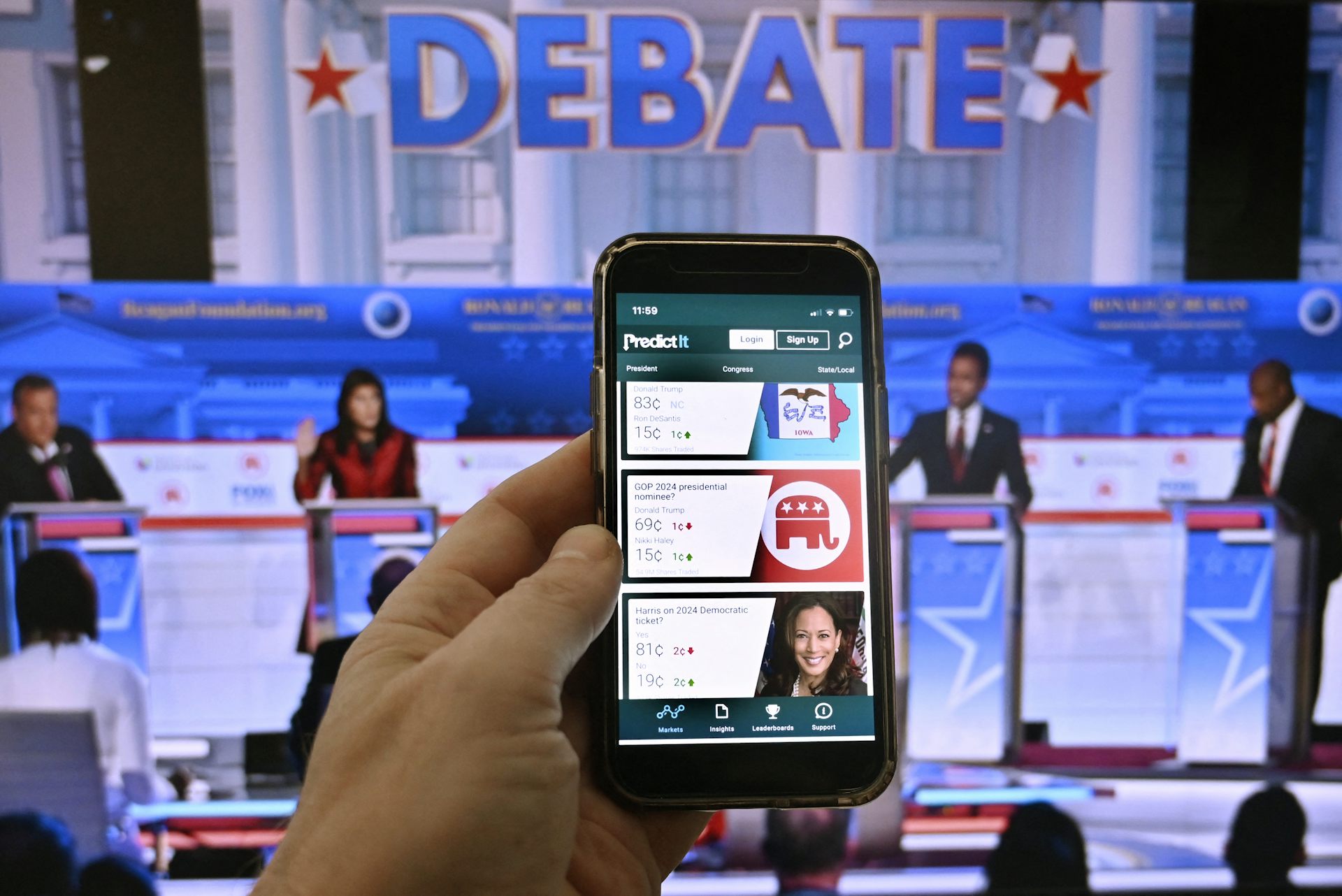
Meanwhile, pollsters face pressure from prediction markets such as Kalshi and crypto-based Polymarket, both of which allow participants to wager on election outcomes.
Betting on U.S. elections has a long if little-recognized pedigree. In 1924, The Wall Street Journal reported from New York that “[s]ome half dozen firms here make a business of receiving and placing bets,” noting that a rule of thumb had emerged that “when odds are more than two to one in a campaign the favored candidate is practically certain to win.”
Wagering on outcomes as a way to forecast election results was supplanted beginning in the 1930s with the emergence of quasi-scientific polling techniques developed by pioneers in survey research such as George Gallup and Elmo Roper. Polls at that time offered what scholars Paul W. Rhode and Koleman S. Strumpf called “a ready substitute for the betting odds, one not subject to the moral objections against gambling.”
In recent years, as polling troubles have deepened, prediction markets have returned from obscurity to become inescapable elements in election forecasting.
Their trading volume, political influence and public profiles have expanded — as have their pretensions.
Polymarket’s 28-year-old founder, Shayne Coplan, has characterized prediction markets as “the most accurate thing we have as mankind right now.” Coplan also has scoffed at traditional, interview-based surveys, declaring in 2024, “Nobody takes polling seriously anymore.”
Prediction markets can provide real-time probabilities in fluid ways that election polls cannot. But whether such markets pose existential threats to traditional polling is an unsettled question.
Data journalist Nate Silver has said he doubts whether “prediction markets can serve as a good substitute for polls.” Among the reasons for skepticism is that prediction platform bettors often rely on, and react to, results of preelection polls and poll-based forecasts.
But prediction markets hardly seemed reliant on preelection polls in the 2024 presidential election. Polymarket and Kalshi both predicted Trump’s victory, while polls in aggregate tended to give Vice President Kamala Harris a slight edge.
“Trust the markets, not the polls,” Coplan declared on the social network X soon after the election. Kalshi, meanwhile, proclaimed that its projections favoring Trump “showed how prediction markets can decisively outperform polls and traditional media.”
Wisconsin’s recent Democratic gubernatorial primary election was, however, something of a comedown for prediction markets. Betting odds on Kalshi and Polymarket gave Francesca Hong a 95% and a 96% chance of winning, respectively. Hong lost, narrowly.
Beyond the challenges from prediction markets, pollsters confront the stubborn problem of low response rates. Many people avoid answering pollsters’ overtures, a reality that makes representative samples drawn from surveys alone nearly impossible. This, in turn, obliges pollsters to apply statistical adjustments to their raw data, a process known as “weighting.”
The adjustments are intended to improve accuracy by aligning raw polling data with demographic or political characteristics such as education, race, gender, party registration and how respondents say they voted in the past. But weighting choices vary by pollster and offer no assurance of accuracy.
Josh Clinton, a political scientist at Vanderbilt University, has noted that even “reasonable choices” a pollster may make in weighting can produce marked shifts in a poll’s results.
Deepening the aggravations in survey research these days is a practice called “silicon sampling,” in which AI agents simulate humanlike poll responses.
Silicon sampling, which has gained prominence in recent months, is much faster and far cheaper to complete than conventional polling. And it has gained a toehold in survey research.
For instance, Gallup has said it is “exploring the potential of simulated responses” to determine “whether AI systems and emerging methods can help deepen our understanding of how humans think and behave.”
Silicon sampling troubles some polling traditionalists who are uneasy about ethical and other implications of simulating human responses.
The 2024 presidential election brought a modest example of silicon sampling in action. AI agents of the startup company Aaru forecast that Harris would carry four of the country’s seven critical swing states. Such an outcome would have given her sufficient electoral votes to be elected president.
Those results, however, were no better than traditional polling in the swing states conducted by CNN and The New York Times. Both organizations reported Harris leading in four states – enough to win had outcomes aligned with their polls.
Harris lost all seven swing states.
This article is republished from The Conversation, a nonprofit, independent news organization bringing you facts and trustworthy analysis to help you make sense of our complex world. It was written by: W. Joseph Campbell, American University School of Communication
Read more:
What poll watchers can − and can’t − do on Election Day
How red went from the color of revolution to the color of Republicans in US politics
For 80 years, the president’s party has almost always lost House seats in midterm elections, a pattern that makes the 2026 congressional outlook clear
W. Joseph Campbell does not work for, consult, own shares in or receive funding from any company or organization that would benefit from this article, and has disclosed no relevant affiliations beyond their academic appointment.
















































Comments