Editorial: Congress needs to put a stop to Pete Hegseth's purges
Published in Political News
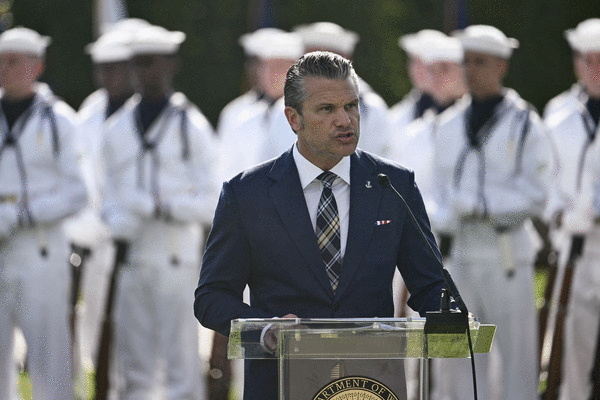
Defense Secretary Pete Hegseth and his critics agree on one thing: The Pentagon is in urgent need of transformation. The change he’s pursuing, however, is endangering that vital mission.
Hegseth has led an unprecedented purge of the military’s top ranks, firing or driving out at least 20 generals, admirals and civilian defense leaders, including the service chiefs of the Army, Navy and Air Force. In a break with tradition, he has also intervened to block the promotions of dozens of others, a disproportionate number of whom have been Black or female. Army Secretary Daniel Driscoll resigned earlier this month, reportedly out of frustration with Hegseth’s treatment of talented and deserving officers. In the middle of a war with Iran, the Army now has no Senate-confirmed leadership.
Hegseth has offered no explanation for his decisions. But he has declared a war on “woke garbage” in the Defense Department and hired personnel officials who share his preoccupation. Rising officers appear to have been targeted for even tangential connections to previous diversity initiatives, or simply for being touted as pioneers based on their gender or race. Others seem to have been ousted for links to past commanders who’ve drawn Hegseth’s ire, or controversial decisions by the Biden administration, such as the withdrawal from Afghanistan. Pressure from lawmakers for more details on the personnel moves has yielded little response.
Retired senior officers say the purges are doing generational damage to the world’s most powerful military. Morale has suffered; some promising young officers are questioning their career prospects if they don’t fit the right demographic or ideological profile. Others are noting how displays of political loyalty are being rewarded and drawing their own conclusions. Hegseth’s embrace of open partisanship has damaged the military’s hard-won reputation for remaining above the political fray.
Moreover, the secretary’s championing of culture-war issues is at best a distraction from the real challenges confronting the Pentagon. Chief among them is how to rapidly procure and integrate lower-cost, unmanned systems into a force that’s long depended on expensive, high-end weapons to dominate adversaries. At worst, the firings threaten to retard that effort. Several of the affected officers, as well as Driscoll, were regarded as highly capable and visionary champions of adopting new technologies and tactics. Without such focused leadership driving changes from the top, the parochialism and bureaucratic inertia that doomed previous attempts to remake the force is likely to undercut progress yet again.
The Pentagon can ill afford to dither just as its foes are coordinating more closely and learning how to undermine traditional U.S. advantages. At a minimum, Hegseth needs to provide better evidence that crucial personnel decisions have been based on performance, not political considerations. Joint Chiefs Chairman Dan Caine — the president’s principal military adviser — should warn the White House of the damage that continued and unjustified churn at the top will do to the military’s long-term capabilities. Lawmakers, meanwhile, should use their leverage over budgets and confirmations to insist on answers on the firings and blocked promotions, as well as assurances that they’ll cease absent real cause.
The pressure should be bipartisan. Ensuring that the military has strong, professional, merit-based leadership is a matter of national security. Americans are ill-served by anything less.
____
The Editorial Board publishes the views of the editors across a range of national and global affairs.
©2026 Bloomberg L.P. Visit bloomberg.com/opinion. Distributed by Tribune Content Agency, LLC.
















































Comments