Trump downplays AI concerns as CEOs call for slowing pace
Published in Political News
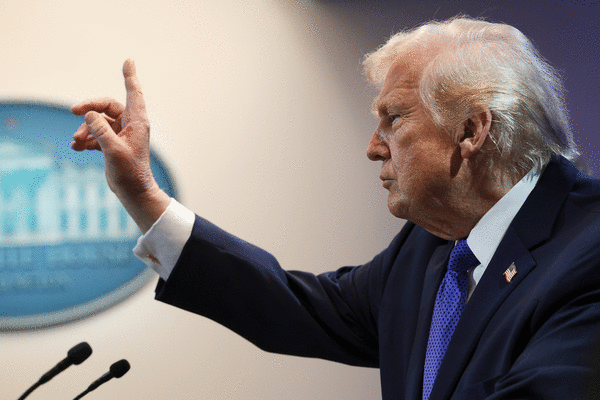
President Donald Trump downplayed the growing alarm over risks from artificial intelligence after some of the industry’s leaders called for slowing the pace of development of the technology.
“We’re leading China in AI. We’re the most sophisticated country in the world, and frankly, I want to keep it that way because whoever wins AI wins,” Trump said Sunday to reporters on the sidelines of the Irish Open. “And we can put guardrails. We can do this and that. But I think you have a lot of negative forces that are bringing it up that shouldn’t be bringing it up.”
Anthropic PBC Chief Executive Officer Dario Amodei issued a lengthy blog post Saturday calling on the industry to slow down and saying that the effort requires industry and global coordination. OpenAI chief Sam Altman and Elon Musk, who runs xAI Corp., swiftly endorsed Amodei’s message.
In particular, Amodei said his company would implement new safety steps including the use of third-party evaluators, an idea that Altman also said he’ll follow.
But there are questions about how committed the AI leaders will be about moderating the pace of development of their most advanced — and most lucrative — models, particularly given the intense competition from Chinese rivals.
National Economic Council Director Kevin Hassett said Sunday that Amodei’s proposal for additional AI safeguards could serve as a model for the private sector, including by giving independent observers access to the models.
Speaking on Fox News Sunday, Hassett called AI safety a “solvable problem.” He said AI is advancing rapidly enough to potentially overcome existing cybersecurity defenses, but companies are also developing new safeguards.
“If you look at the movement that the private sector is making, the fact that Elon and OpenAI folks have already supported the actually pretty sensible moves that Dario is advising, I think that that’s a good movement forward, a good step forward,” Hassett said, adding that Trump administration officials Sean Cairncross and Michael Kratsios are also studying the issue.
Some Democrats have seized on the risks around AI as a big issue heading into the November midterms and the 2028 presidential election. Former President Barack Obama told an audience at a private fundraiser last week that Democrats should make AI oversight a central issue in their campaigns, according to the New York Times.
Senator Chris Coons, a Democrat from Delaware who has helped introduce a bill to protect AI whistleblowers, said a lack of expertise in Congress risks hampering AI regulation as the Trump administration maintains a hands-off approach.
“That’s one of our real challenges: that we’ve got folks in the Senate and the House who are not as engaged, as curious, as current on this rapidly evolving technology as we need,” Coons said on Bloomberg "This Weekend." “We need agreement from Republicans and Democrats in Congress to put aside our partisan pre-election bickering and put in place some real guardrails before AI goes off the rails.”
House Minority Leader Hakeem Jeffries said on ABC’s "This Week" that House Democrats will meet as a caucus on Tuesday morning to discuss possible action on AI.
Speaker Mike Johnson called for a partnership between the tech industry and government to find AI guardrails, saying his message to the companies is that they “have a corporate responsibility to make sure your products are safe.”
“We have got to summon everybody together,” the Louisiana Republican said on CNN’s "State of the Union." “I have talked to the president about this as well. They probably should be summoned together at the White House.”
Amodei said he thinks there is a role for government regulation when it comes to AI. “Regulation allows the public and its elected representatives to have a say, and limits what the private companies can do,” the Anthropic chief said in an interview that aired Sunday on CBS’s "Sunday Morning."
But David Sacks, Trump’s former AI czar who now co-chairs his technology advisory council, said that AI companies don’t need government permission to slow down or be more responsible.
“You face massive product-liability exposure if your products enable a truly damaging cyberattack,” he wrote in a post on X. “The market already punishes models that behave in unpredictable or unauthorized ways.”
At the same time, it’s unclear whether Chinese companies or the government in Beijing will be interested in working with U.S. firms on a slowdown or guardrails.
Speaking on CBS, Amodei said a longer-term agreement with China would make sense to put a “speed limit on the rate of AI progress,” but he acknowledged it may be unrealistic. Verification would need to be “ironclad,” he said, because of the military advantages of pulling ahead. “Honestly, I don’t know if it’s possible. But we should try.”
The surge in safety concerns surrounding AI coincides with a growing backlash against the technology in the U.S., fueled in part by objections to the strain on local resources imposed by new data centers needed to support the technology. Concerns that AI is driving up electricity bills and potentially taking away jobs have made it a central issue in the midterms.
Another factor weighing on the market is whether the vast sums being poured into AI and related infrastructure will pay off. The scrutiny has left high-valuation shares linked to the technology particularly vulnerable, with signs of increased spending or weaker returns triggering selloffs in stocks.
“They’re bringing up things that won’t happen, but whoever wins, with AI, wins,” Trump said.
_____
(With assistance from Georgie McKay, Tony Czuczka and María Paula Mijares Torres.)
_____
©2026 Bloomberg L.P. Visit bloomberg.com. Distributed by Tribune Content Agency, LLC.













































Comments