OAS: Candidates with criminal ties should be barred from Haiti elections
Published in Political News
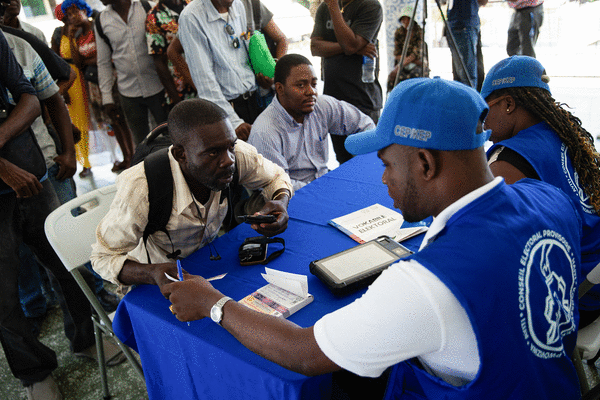
Anyone who has links to criminal organizations in Haiti should not be allowed to participate in the country’s forthcoming elections, the head of the Organization of American States said Friday, stressing that it is ultimately up to Haitian authorities to determine the eligibility of candidates to run for president, Parliament and local offices.
The United States and Canada have spent the past several years canceling visas and imposing sanctions on former politicians, gang members and businesspeople. But whether those efforts will exclude individuals from the electoral process remains an open question, as does the possibility that individuals with ties to criminal groups could be recycled into politics, having never been charged, investigated by Haitian authorities or hit with sanctions.
“The way that has to be checked is up to the Haitian authorities,” said Albert Ramdin, the OAS secretary general. “Normally, we accept bilateral sanctions in specific cases if the national authorities make that a criterion in their check-off on candidates. When the U.N. sanctions a person, then it is internationally accepted that person cannot be engaged in the political process.”
He added: “We would prefer that candidates who are taking part in these elections are solid and clean, and are complying with all of what is expected from a good candidate.”
Ramdin declined to say what steps the OAS would pursue should unacceptable candidates run and win.
“We will have to wait and see the result of the elections to be able to see how many of those, I call them tainted, politicians are elected,” he said. “Being a candidate is no guarantee as yet of being elected. But if it is a critical mass that has been elected and had relationship with criminal organizations, certainly the gangs, then it will be a point of discussion. I can assure you that.”
Ramdin, who recently visited Haiti with OAS elections experts, had said he intended to seek legal guidance from the Venice Commission on how sanctions can be handled in light of Haitian and international law. The European commission, an advisory entity of the Council of Europe composed of experts in the field of constitutional law, has already weighed in on the issue, and few believe further guidance will provide a clearer answer.
The problem for Haiti is that while transitional authorities have issued a list of documents candidates must submit to be eligible to run – including banking documents that sanctioned individuals theoretically should not be able to obtain – the system is not foolproof and could be challenged legally.
Carlos Hercule, a former Haitian justice minister who is part of a group monitoring the preparations for the elections, said judges who will be called on to rule on candidates’ eligibility possess little guidance.
He also noted that foreign governments, including the United States, historically have been reluctant to share information with Haitian authorities on individuals. The lack of information-sharing has been raised by the U.N. sanctions committee in its efforts to identify individuals who should be blacklisted over ties to armed groups.
“There are some politicians who have links with the gangs. That is a known fact,” Ramdin said. “This is a concern. … We have to make sure we have clean elections, elections that will be respected by the Haitian authorities, by the Haitian political groups.”
The possibility that people linked to criminal groups could participate in Haiti’s scheduled Dec. 13 general elections was among several concerns Ramdin addressed during a call with Caribbean journalists on Friday.
‘Dialogue within Haiti’
The slow registration of voters and other issues are raising doubts that Haiti’s planned vote will take place on Dec. 13, a date the secretary general said he’s avoided mentioning. Whatever day the country holds its first vote in a decade, he stressed, is neither for the OAS nor the international community to determine.
“There must be dialogue within Haiti with regard to when the elections will take place and how credible they will be, if they are held on a certain day and if all preparations are satisfactory,” Ramdin said. “We always have challenges. The key is that we need to be able to respond to those challenges on election day. The question is: Is Haiti prepared for that? That is not for me to determine.”
But the preparations are moving too slowly, he said.
With just 32 days left before the registration period for voters ends on Oct. 13, only 561,563 Haitians had registered to vote out of a potential electorate of 6.6 million people over the age of 18 with a national identification card, which is required to vote. Also, 134 voting centers have yet to be activated, according to the website of the Provisional Electoral Council.
“Registration of voters needs to take place with a higher intensity. Much more media campaigning needs to be done to get them to register,” he said. “Otherwise, we are going to have questions, both by the political class in Haiti as well as internationally, about the credibility of these elections.”
He emphasized the need to maintain momentum on the logistical preparations for the vote, including determining how many poll workers will be needed, ensuring they are properly trained and have safe working environments, and making sure polling stations have access to electricity and other basics.
“These are the regular things that are needed for the holding of elections,” he said.
Voter registration
Ramdin said he questioned the need for the extra layer of a registration process. Members of the elections council said rather than printing millions of ballots for people who have no intention on voting, they want a clearer picture on how many Haitians intend on voting so that they can better prepare for the polling stations and ballots needed.
“It’s something which is of course a decision” of the electoral council, Ramdin said. He added that his suggestion that Haitians retain their previous system, which involved going to the polls on Election Day and casting ballots using their national identification card, “was really voluntary.”
The elections, along with problems with violence, are the most pressing issues facing Haiti, Ramdin said. He warned that the deployment of the 5,500-member U.N.-authorized Gang Suppression Force is moving too slowly.
The force has just over 1,000 people in Haiti, and nations that have volunteered to participate are only now getting equipment together.
Meanwhile, Haiti is experiencing a surge in kidnappings, including the abduction and beheading of a journalist who operated a community radio station east of the capital. Another journalist, kidnapped this week, remains in captivity, while armed gangs continue attacking communities.
“I have appealed to all countries who have pledged support, forces and equipment to expedite that. It’s taking too long,” Ramdin said. “The force commander cannot function, cannot do his job if he doesn’t have the forces or the equipment.”
Force deployment needs help
Germany recently offered to help in transporting equipment for Bangladesh soldiers to Haiti by flying it to the Dominican Republic, leaving the United Nations to transport it into Port-au-Prince. Ramdin said while this will help, “there are other countries ready for deployment, but they don’t have the airlift. So we are working very hard to talk to countries to provide that. If they cannot provide troops, we ask them to provide airplanes to transport the deployed troops to Haiti.”
Later this month, the U.N. Security Council is expected to consider renewing the gang-fighting force’s mandate. The renewal and the force are both expected to figure prominently in discussions about Haiti during the U.N. General Assembly in New York, as the U.S. and Panama circulate a resolution for a six-month rollover of the force. The recommendation is far less than the two years that the Haitian government and the U.N. office in Haiti have pushed for.
Ramdin said he plans to raise the issue when he meets with the new assistant U.S. secretary of state for the Western Hemisphere, Juan Pablo Segura. He also plans to raise concerns about the slow deployment of the gang-fighting force and will also be reaching out to others in the international community for support.
“We want to show that we support Haiti,” he said. “Whether six months will be enough or not, it should not bring uncertainty about the value of the mission going forward.”
©2026 Miami Herald. Visit miamiherald.com. Distributed by Tribune Content Agency, LLC.















































Comments