'A forever project': Congressional modernizers look to next phase
Published in Political News
WASHINGTON — If Congress has 99 problems, modernizing itself will always be one of them.
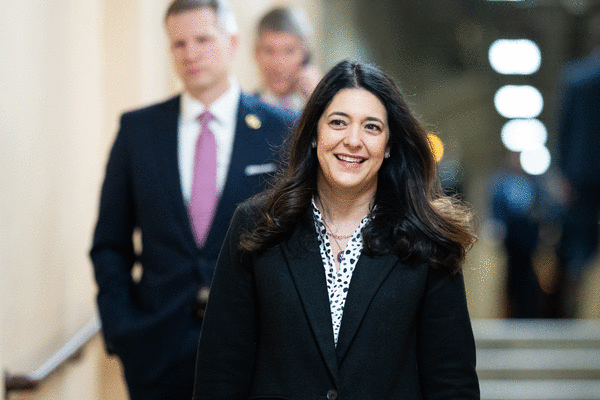
As members of the House Administration Modernization and Innovation Subcommittee look ahead to the remainder of the 119th Congress, they’re also trying to map out the next era.
“We need to be thinking about the future and what we can do,” said Chair Stephanie Bice, R-Okla.
Bice and her colleagues put out a call for ideas that closes at the end of August. “The House needs to stay current or risk falling behind,” the notice says, asking both congressional insiders and outside groups to chime in.
They don’t want to hear requests for new campus eateries or coffee shops. Instead, the “goal is to think big and think creatively.”
In the past, lawmakers would come together every couple of decades to study how they were (or weren’t) keeping up with the times. In 1993, for example, a joint committee was eager to show that “Congress is not some ‘creaky institution’ incapable of revamping its internal procedures,” as its final report insisted.
The most recent such effort ran from 2019 to 2023, when a select committee, known informally as ModCom, issued more than 200 recommendations to improve the House.
One of those? Don’t wait so long to do it again.
“It’s a forever project,” said J.D. Rackey, a former ModCom staffer who now works as associate director of structural democracy at the Bipartisan Policy Center. “The world keeps changing, and the country keeps changing, and Congress is supposed to be a reflection of those things — and so it necessarily has to keep modernizing.”
When Republicans took control of the House in 2023, they heeded some of that advice, creating a new home under House Administration to continue the work that ModCom started. For Bice, who chairs that subcommittee, it’s meant carrying the modernization torch in a time when the country — let alone the slow-moving traditions of the Capitol — can barely keep up.
“It’s not a big beautiful reconciliation package, right?” she said of pushing the House to adapt to new technology. “But it’s things that actually make this institution function better, and I think that’s incredibly important.”
‘All sort of scrambling’
Asking a more than 200-year-old institution to change its ways is no easy task, even for seemingly simple things, like adding ADA drop-off zones to help visitors access the Capitol.
That curbside project eventually got done, alongside a range of other ModCom recommendations. According to the subcommittee’s count, 152 of them are now closed, with 71 fully implemented. Some went deep into the weeds, like making it easier for lawmakers to digitally add co-sponsors to their bills. Others will be more visible to the public, like wayfinding tools aimed at demystifying the Capitol complex’s notoriously confusing halls.
Now it’s time for a fresh wish list, according to Bice. The call for new ideas is meant to “guide our work over the next few years.”
What the next few years will look like is anyone’s guess. Democrats are hoping they can flip control of the House, meaning they would set the House agenda instead of Republicans. And as Congress grapples with how the federal government should regulate the generative AI race, it also faces uncomfortable questions within its own walls, like whether humans should rely on the technology to interact with worried constituents — or even to write the nation’s laws.
As the midterm elections approach in November, the Modernization and Innovation Subcommittee has already held what Bice said was its last hearing of this Congress. The topic was public access to legislative data, while a different hearing last year waded into the debate over using AI in constituent services. Bice touts an “AI innovators pipeline” launched last month for House staffers, which comes as some are already finding ways to leverage the technology on their own.
Right now, “keeping up” with a tech revolution is the goal, not the reality, said Rep. Norma J. Torres, D-Calif., the subcommittee’s ranking member.
“I don’t think any part of government is keeping up to pace [with] what is happening right now, and I think that we are all sort of scrambling. But certainly, the federal government is not there yet,” Torres said.
Torres said she also wants to make it easier for the public to keep tabs on Congress using digital tools.
“Right now, I think you need a Ph.D. in how to navigate through the federal government’s websites in order to be able to find how a bill became law, the different steps that were taken, how their members of Congress voted,” she said. “I mean, to try to find amendments about a bill is nearly impossible, and that’s me working within the inside. Can you imagine what our constituents are having to deal with?”
Living up to its name
Even as the subpanel pivots its focus to the “innovation” part of its name, some argue “modernization” shouldn’t get left in the dust.
“The big, difficult questions — like staffing sizes and depolarizing the institution — that were a big focus of the select committee don’t really have as much of a home now,” said SoRelle Gaynor, an assistant professor of public policy at the University of Virginia and a former ModCom staffer.
Problems in Congress predate AI, and so do ways to fix them. Some of the best ideas focus on people, Gaynor said, pointing to proposals like giving every congressional committee a small number of permanent, nonpartisan staff who can serve as subject matter experts without being bound to the whims of who holds the majority.
“Your job isn’t inherently tied to whether your team wins or not. Your job is to make good policy and develop expertise,” she said.
Both Rackey and Gaynor say that can’t happen until Congress spends more money on itself, an idea that has long been a tough sell to lawmakers.
“The single greatest thing that’s holding back some modernization efforts and just congressional capacity in general is the funding situation that Congress gives itself, particularly the funding it gives to committees and to the support agencies,” Rackey said.
Funding for the legislative branch makes up less than 1% of the federal budget. In fiscal 2026, $4 million was appropriated for the Modernization Initiatives Account, which is meant to “promote administrative efficiencies and expand the use of innovative technologies in offices of the House.” That number is down from a couple of years ago, when the account got $10 million.
Bice said more money for modernization won’t fix Congress’ antiquated state of affairs.
“I don’t think it’s a money issue. It’s actually figuring out what’s important, what the platform is, what technology is usable within the House network, and then executing on that,” she said.
But experts warn that without investment in its future, Congress will only continue to fall behind.
“A lot of the modernization recommendations and some of their most successful examples have been around technology improvements that help improve the daily workflow of staff, so they can be more efficient, so they can get more things done,” Rackey said. “But that can only go so far.”
_____
©2026 CQ-Roll Call, Inc. Visit at rollcall.com. Distributed by Tribune Content Agency, LLC.


















































Comments