German state elections imperil Merz's government: What to watch
Published in Political News
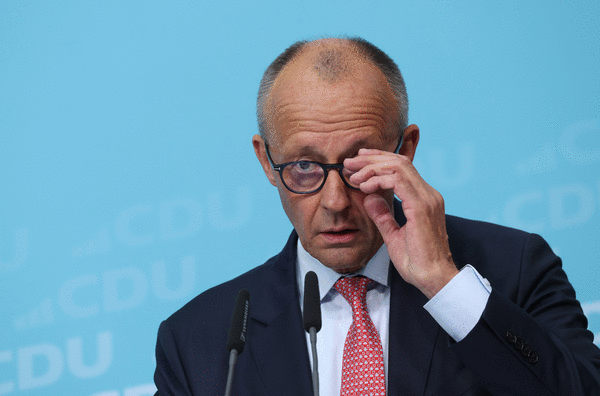
Friedrich Merz’s chancellorship has never been more at risk as two regional elections on Sunday threaten to destabilize his 16-month tenure as German leader.
In the Baltic coast state of Mecklenburg Western-Pomerania, Merz’s conservative Christian Democrats risk missing the 5% electoral threshold to enter state parliament — which would mark the first time the CDU has been evicted from a regional legislature since the federal republic was founded in 1949.
Many in the CDU feel that would trigger an intra-party rebellion as calls for Merz to step down have gathered pace. In the contest in the city-state of Berlin, the latest polls showed that the anti-capitalist Left party had an edge over the governing CDU.
Here’s what to watch as election day unfolds.
What happens on election day?
Voting begins in both regions at 8 a.m. on Sunday local time and the first forecasts based on exit polls are expected when voting ends at 6 p.m. Projections incorporating counted ballots will follow shortly thereafter and a preliminary result should be announced overnight or early Monday.
The most important thing to look out for is whether the CDU exceeds the 5% threshold in Mecklenburg-Western Pomerania to qualify for seats in the state parliament. If the CDU fails to enter parliament, the party may try to force Merz to relinquish his post.
Who is expected to win in the northeast?
The Social Democrats, the CDU’s coalition partner that’s long dominated the region, polled at 37% this past week, one percentage point ahead of the far-right Alternative for Germany, or AfD, according to a survey by FG Wahlen. The CDU dropped to 6%, it showed.
In Berlin, the Left led a more crowded field with 22% support, two percentage points ahead of the CDU, according to an FG Wahlen survey. The AfD placed third with 18%, ahead of the Greens, who were at 15%. The SPD, which long dominated the German capital, registered in fifth place with 12%.
Why is Merz in so much trouble?
Polls show that Merz’s popularity is at a record low for any post-World War II chancellor. The government has seen its backing among voters plummet as it struggles to bridge differences within the coalition and restore economic growth after years of malaise.
The chancellor has summoned the CDU leadership, including a powerful group of state premiers who could potentially challenge him, to Berlin for Sunday evening as votes are counted. He plans to demand that they either come forward with any designs to replace him — or to get in line, according to a person who spoke on condition of anonymity as deliberations take place behind closed doors.
Can the far right win?
Germany’s political establishment was shaken by the AfD’s victory two weeks ago in the eastern state of Saxony-Anhalt, putting it in position to potentially form the first far-right state government in the country since World War II. The CDU, which has governed the region since 2002, saw its support collapse.
“This day not only changed things in Saxony-Anhalt, but also Germany as a whole,” Merz told reporters in Berlin the day after the vote, calling it the worst result for the CDU in decades. “Of course, there will have to be consequences.”
Polling shows the two contests on Sunday won’t be a repeat, despite far-right gains. The SPD in Mecklenburg-Western Pomerania under popular state premier Manuela Schwesig has mounted a stiff challenge to the AfD. Even if the far right comes out ahead, it would be well short of a majority. All other parties have refused to work with it, all but ruling out an AfD government on the Baltic.
Berlin has long tacked to the left, which makes the AfD’s 18% support there remarkable enough. But the party would be far from any path to governing, even if it eked out a win.
_____
©2026 Bloomberg L.P. Visit bloomberg.com. Distributed by Tribune Content Agency, LLC.

















































Comments