Abby McCloskey: Evangelicals still vote Republican. But there are signs of a rift
Published in Op Eds
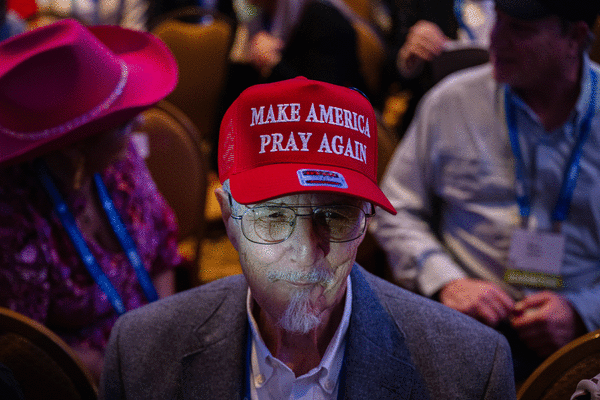
Is the Republican Party losing its allure for Christian voters?
That might at first seem like a ridiculous question. Never have evangelicals congregated so heavily into a single political party as they have under President Donald Trump. In the 2026 midterms, White evangelicals turned out to support Republicans at the same rate that they supported Trump for president in 2024 — an overwhelming 82%, according to CNN exit polling. Mainline Protestants, Catholics and Mormons have also historically leaned Republican.
At the same time, when Trump told Ross Douthat on 60 Minutes, “I do hate some of my enemies, and I always will,” it caused a jolt. Asked whether he could forgive political opponents before the judgment throne of God, the president’s response was simple: “The answer is no.”
No admission is more emblematic of his second term. It was honest and raw. It was divorced from any policy or MAGA talking points. And it defied the core of Christian orthodoxy itself: forgiveness of sin, love for those who persecute us.
It raises the question: How long can the GOP stay the political home base for Christianity? And is that even something Republicans — or Christians, for that matter — should want?
As someone who grew up in the evangelical church, I get why the GOP appeals. Christians have felt discriminated against for holding traditional sexual and gender views. The tax status of churches or religious schools has also felt at risk. And Republicans were instrumental in overturning Roe v. Wade, a longtime priority of evangelicals.
In many parts of the country — such as the Bible Belt — church is as deeply cultural as spiritual. Because a growing share of Americans identify as religious nones (28%, according to the Pew Research Center) and they are disproportionately concentrated on the political left, it’s not just politics at stake. Every time we have an election, it feels like a verdict on a way of life.
But increasingly, there has also been a lot for the faithful in the Republican Party to absorb. Such as the historic level of corruption in the Trump administration, something 90% of voters were concerned about, according to CNN’s exit polls. The Republican candidates mired in personal and public scandal. The effects of aggressive deportations on families.
There’s been a growing incongruence to it all — a casualness with which Republicans seem to assume that, despite all this, Christian voters won’t leave the party. Where would they go? The other side wants boys in girls’ sports and has said God is nonbinary!
And so you have Vice President JD Vance leading a rally crowd in prayer one minute and, the next, talking about giving Democrats an “ass-kicking.” You have Trump’s spiritual adviser comparing him to the risen Christ at a White House Easter lunch and the president posting a picture of himself as Jesus.
But even if evangelicals haven’t abandoned Trump as a result, it hasn’t been without cost — to the church. White evangelicals are a shrinking share of the electorate; they accounted for just 17% of voters in this year’s midterms, compared with 24% in 2022.
Studying why people have left the evangelical church, demographer Ryan Burge has found that politics has played an outsized role. As Burge explained in his book The Vanishing Church: “It’s no longer accurate to think of political party affiliation as flowing out of other, bigger and more ultimate beliefs. Instead, it seems, political partisanship is the master identity of our lives, and everything else exists downstream of that.”
This is a loss not only for the church, but also for our common political project. Religion cannot be a source of public accountability or a stable refuge through changing political winds when it has become subjugated to a political party.
But maybe change is in the air. The newly elected class of Democrats contains several pastors and a seminarian. On its own, this means little. But it might encourage more religious pluralism on the political left than there has been in recent years. Catholics swung towards Democrats by about 10 points in 2026 versus 2024.
Maybe the loss of electoral power for Republicans gives evangelicals a chance to rethink, too. Maybe their objectives don’t have to line up perfectly with a political party; in fact, maybe they shouldn’t give politics that much supercharged power. Political movements rise and fall; only orthodoxy is constant.
And there is a moral center that goes beyond anything that currently fits into our two-party politics.
Just days before Trump’s remarks, Democratic Senator-elect James Talarico was asked if he loved his Republican opponent, Ken Paxton, when they were on the campaign trail. He said, “Yes, Ken Paxton is a child of God. He is my brother in Christ.”
Skeptics on the right might think that the left has found a new wolf in sheep’s clothing. But maybe, just maybe, light is breaking into politics in the place that evangelicals least suspect.
_____
This column reflects the personal views of the author and does not necessarily reflect the opinion of the editorial board or Bloomberg LP and its owners.
Abby McCloskey is a columnist, podcast host, and consultant. She directed domestic policy on two presidential campaigns and was director of economic policy at the American Enterprise Institute.
_____
©2026 Bloomberg L.P. Visit bloomberg.com/opinion. Distributed by Tribune Content Agency, LLC.

















































Comments