Mark Gongloff: The Colorado River's problems run too deep for El Niño to solve
Published in Op Eds
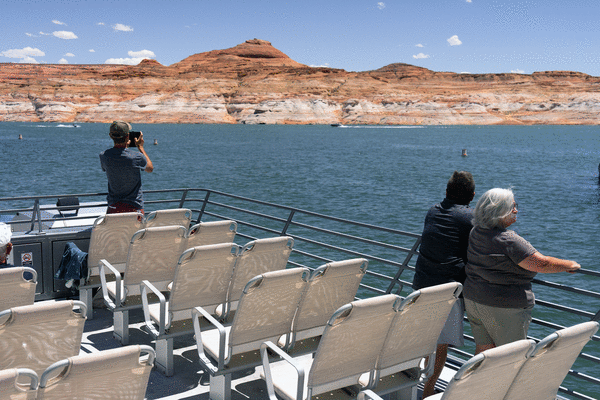
The Colorado River watershed is sort of the inverse of an iceberg’s tip: While a small volume of ice above the surface suggests a massive volume below, the Colorado’s absence of water above the ground hints at an even vaster void underneath.
Decades of overuse and climate-driven drought have drastically curbed the amount of surface water available to the 40 million people and more than 5 million acres of farmland the Colorado serves. The loss of groundwater in the river basin, including deep aquifers that took millennia to fill, has been even more drastic. This fall’s El Niño-driven floods in the region, deadly and devastating as they have been, will barely begin to compensate.
“Scientists have long predicted we would get less water in the Southwest, and that’s already happening,” Peter Gleick, a climate and water scientist and senior fellow and co-founder of the Pacific Institute, a nonprofit research group in Oakland, told me. “But the other problem with climate change is that the kind of precipitation we get is from more-intense storms, which runs off faster, and that does not help with groundwater.”
The Colorado River has lost 20% of its flow in this century, while its primary reservoirs, Lake Mead and Lake Powell, have each fallen to about 27% of full capacity. Even as these critical supplies have dwindled, demand for them has increased, triggering decades-long squabbles between the states, farmers, cities and tribes that use the river, waving around laws and agreements signed when it was far more robust.
Torrential rainstorms this fall, supercharged by the biggest El Niño in perhaps a millennium, have replenished some of these surface stores. Lake Powell is now 22 feet higher than its record low of 3,517 feet above sea level in mid-September. That’s the highest level since early January.
And … that’s about it for the good news. The downpours delivering this extra water have been too much for the people that live in the region to handle, killing four people and destroying homes and infrastructure. Arizona and other places received months’ worth of rainfall in just days.
Despite all of this water pounding down, Lake Powell is still 162 feet below full capacity. Meanwhile, downstream, Lake Mead is still just 2.5 feet above its record low set in late October and 180 feet lower than its potential maximum. The white “bathtub rings” on the walls of both reservoirs, representing increasingly obsolete high-water marks, are here to stay.
For now, both reservoirs are comfortably above “dead pool,” when water can no longer flow downstream, and “power pool,” when levels are low enough to stop hydroelectric power at the Glen Canyon and Hoover dams. But they lost a combined 33.5 million acre-feet of water between 2000 and 2023, by one estimate, enough to supply 33.5 million typical U.S. households for three years. (An acre-foot is how much water it takes to flood an acre with a foot of water, or 325,851 gallons.)
The situation below ground is even more dire. The Colorado basin has lost 31 million acre-feet of groundwater since 2012 alone, according to a study of NASA’s Gravity Recovery and Climate Experiment (GRACE) satellite data by Virginia Tech and Indiana University researchers published last month in the journal Water Resources Research. That’s more water than Lake Mead can hold. It’s also the vast majority of the 35 million acre-feet the entire watershed lost during that time, including surface water and snowpack.
The lower Colorado basin, which includes Southern California, the area around Las Vegas and all of Arizona, has lost 28 million acre-feet of groundwater since 2003, or just about one Lake Mead, according to a 2025 study of GRACE satellite data published in the journal Geophysical Research Letters.
California’s Central Valley, the agricultural heartland of the basin, lost a staggering 128 million acre-feet of groundwater between the time development began in the valley and 2019, the U.S. Geological Survey has estimated.
You get the picture: Far more of the Southwest’s water has gone missing below ground than above it. There are still vast resources down there, potentially enough to fill every Great Lake, according to a study published earlier this year in the journal Nature. But much of this is deep underground, where it’s difficult to access or the water quality suffers from millennia of absorbing minerals.
And while biblical floods can at least temporarily replenish lakes and rivers, they also flow too quickly over parched land to seep into the ground. Meanwhile, sucking water out of caverns causes the land above them to sink. That’s a problem not only for human houses and infrastructure but also for the ground’s capacity to hold water: The size of the container shrinks.
As the planet gets hotter, mostly because of humanity’s relentless burning of fossil fuels, swings between the extremes of drought and monsoon will intensify, but the drought will win the war in the Southwest, as it has for the past quarter century. It and other dry parts of the world keep getting drier while the wet parts keep getting wetter, according to a global 2025 study of GRACE satellite data.
That study also found that the drier parts of the world are drying faster than the wetter parts are getting wet. The rest of the water is running into the ocean, raising sea levels. And these grim supply trends will continue, leading to increasingly bleak choices for the Southwest unless it curbs demand immediately.
“When I worked with the World Bank, the analogy I used for economists is that the deep aquifer is like a trust fund,” Earth system scientist Hrishikesh Chandanpurkar, the lead author of the global GRACE study (and a co-author of the lower Colorado one), told me. The founder and director of science at Evergreen Resilience Institute, a nonprofit research group in Calgary, Chandanpurkar has also done research for the World Bank and Arizona State University. “Rain is income, evaporation is rent, and the runoff you need for ecosystems and the water cycle to continue are the taxes. The leftovers are your disposable income.”
When deeper groundwater disappears, he said, that’s a sure sign that we’re living beyond our means and eating into that trust fund. We still have the power to choose how much of that we’ll leave to our children.
_____
This column reflects the personal views of the author and does not necessarily reflect the opinion of the editorial board or Bloomberg LP and its owners.
Mark Gongloff is a Bloomberg Opinion editor and columnist covering climate change. He previously worked for Fortune.com, the Huffington Post and the Wall Street Journal.
_____
Bloomberg L.P. Visit bloomberg.com/opinion. Distributed by Tribune Content Agency, LLC.

















































Comments