Beth Kowitt: Huang may prove that the 'irreplaceable CEO' is a myth
Published in Op Eds
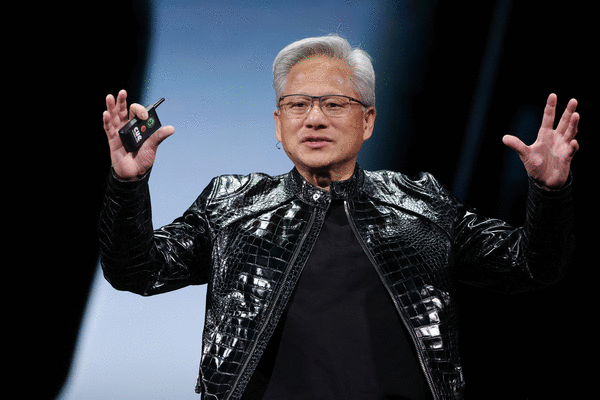
“He’s irreplaceable,” Larry Ellison said.
The year was 2009 and Oracle Corp.’s then-chief executive officer was talking about his friend Steve Jobs, who had recently returned to lead Apple Inc. after a liver transplant. Pundits would later go on to say the same about Jeff Bezos, that Amazon.com Inc.’s founder and CEO had “no viable successor.” (Both companies, of course, would go on to do just fine without their founders.)
It’s worth remembering those prophecies as that word — irreplaceable — gets bandied around with abandon about Nvidia Corp. CEO Jensen Huang, who stepped down Thursday after nearly a week of turmoil at the company he cofounded and the industry he anchored. One of many examples: “I believe Jensen is irreplaceable for America’s AI leadership,” Sequoia partner Shaun Maguire posted on X, a sentiment Elon Musk endorsed.
Revelations from the New York Times on Wednesday, that Huang had an extramarital relationship with the company’s vice president of health care, made it impossible for the board to let him keep his job. While less shocking than Huang’s earlier admission that he had an affair with a suspected Chinese spy, he had clearly violated the company’s code of conduct to “avoid situations where our actions create a conflict.” Before board members could make the case that Huang was the victim of a honeypot scheme. But there’s no convenient explanation for a relationship with a subordinate.
The board named CFO Collette Kress as the interim CEO, but now its members will have to plan for a future without Huang at the helm. This appears to be something they had rarely considered before, after allowing Huang to structure the company almost entirely around himself. The question now is whether he had also built it to survive without him. As Harvard Business School professor Rakesh Khurana put it to me: “The difference between a cult and a religion is that one outlasts the other.”
At Nvidia, the evidence suggests that Huang created a system much more akin to the former. The company has no chairman, no No. 2 and no public succession plan. Huang had 60 direct reports whose job it was to quickly carry out his decisions, Bloomberg News has reported. Few other executives had a broad purview or responsibilities and instead focused on narrow products or technologies. Other executives had some public exposure but were always overshadowed by Huang, who delivered hours-long keynotes at events. On earnings calls, as the Wall Street Journal noted, Huang fielded questions from analysts mostly by himself, leaving scripted comments to others — a regular practice at Nvidia but atypical at other companies. His board lacked the expected heavy hitters for a company of its size and import; other than Huang, it has no sitting CEOs.
None of that necessarily means Huang can’t be replaced. There was no finding another Jobs or Bezos either — they were both singular leaders. But what they did, which appears to be missing at Nvidia, was methodically build companies designed to carry on their doctrines without them. Both created internal structures that institutionalized their ways of operating and thinking that allowed their successors to thrive: Apple’s stock returned nearly 2,800% during Tim Cook’s 15-year tenure as CEO that ended in September; Andy Jassy has overseen a roughly 50% increase since he took over at Amazon in 2021.
At Apple, Jobs was a micromanager who was involved in every detail of the company. But he also taught employees to anticipate how he would solve problems. “The organization has been thoroughly trained to think like Steve,” Fortune reported in 2009. “People could envision, ‘This is what Steve would do.'” He also had a clear No. 2 in Cook, a manufacturing and supply chain guru, who had a trial run as CEO when Jobs was out on medical leave. Jobs made sure it wasn’t always the Steve Jobs show either. Cook and other executives were given public exposure by appearing alongside him on stage and on earnings calls. (It’s worth noting that Cook is being floated as a possible replacement for Huang, including by President Trump.)
At Amazon, Bezos turned his management philosophy into an actionable way of operating — a set of leadership principles that Jassy and other executives helped him write. Bezos picked Jassy as his first shadow, a role in which he followed around the CEO for about 18 months. That’s when the two came up with the idea for Amazon Web Services, and then Bezos gave Jassy a wide berth to run it. By the time Jassy was tapped as CEO, he had already run a hugely important and valuable business.
Part of the genius of both Bezos and Jobs was that they figured out how to turn their personal capabilities into corporate culture and competencies. The parallels are hard to find at Nvidia, which is a real failure of leadership by Huang. His successor will have to figure out how to run a company built around someone who is no longer there. That should be one part of Huang’s legacy that no one tries to replicate.
____
This column reflects the personal views of the author and does not necessarily reflect the opinion of the editorial board or Bloomberg LP and its owners.
Beth Kowitt is a Bloomberg Opinion columnist covering corporate America. She was previously a senior writer and editor at Fortune Magazine.
©2026 Bloomberg L.P. Visit bloomberg.com/opinion. Distributed by Tribune Content Agency, LLC.














































Comments