Mary Ellen Klas: Can we please end these gerrymandering wars now?
Published in Op Eds
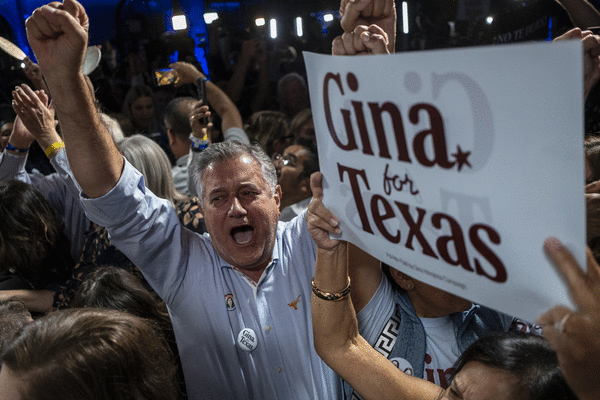
Tuesday’s political earthquake upended the balance of power not only in Washington, but also in state capitols. Democrats now control both the governor’s offices and the state legislatures of Pennsylvania, Wisconsin, Arizona, Michigan, Nevada and Minnesota. They flipped the governor’s office in Texas, Georgia, Ohio and Iowa. And they broke Republican supermajorities in eight states.
After a two-year gerrymandering arms race that saw Republicans try to build a “red wall” out of redrawn districts, it will be enormously tempting for both lame-duck Republican legislatures and newly powerful state-level Democrats to redraw more maps their own party’s advantage before 2028. They all should resist the urge — and start talking about ways to end this war.
There’s a reason politicians like gerrymandering. It’s easier to pick your voters than to try to get the voters to pick you. But a hallmark of a democratic system is that power flows from the people. That can only happen when voters are free to choose representatives who represent their interests — and free to hold them to account. Gerrymandering distorts all that.
Although the GOP’s newly redrawn seats ultimately failed to save them from losing their majority on Tuesday, the party was still protected by gerrymanders they had been perfecting for decades. In Georgia, for example, Democrats flipped the governor’s office, swept every statewide contest on the ballot, and were poised to win a majority in the state House of Representatives for the first time in 22 years. But the U.S. congressional map has been so manipulated to benefit Republicans that despite the Democratic rout in the state, Georgia will send nine Republicans and five Democrats to Washington next year.
In Florida, the Democratic candidates for governor and U.S. Senate captured nearly half of the statewide vote and Democrats fended off efforts to elect Republicans in four districts that Governor Ron DeSantis designed to benefit Republicans. But the Florida delegation won’t look any bluer next year. Thanks to decades of partisan map-making, Republicans held on to their 20-8 House majority.
That’s a power that’s tempting for any party to exploit, especially when they think their rival is benefiting from it. This cycle, for instance, we also saw states like California respond to the GOP’s gerrymanders with new maps of their own.
And we probably haven’t seen the end of the redistricting wars.
For the next two months, lame-duck legislatures in the Republican-controlled states of Texas, Mississippi, Alabama, South Carolina and Louisiana could decide they need to recalibrate their congressional maps one more time before 2028.
States run by Democrats will be watching and ready to respond in kind, said John Bisognano, president of the National Democratic Redistricting Committee, which advocates for federal redistricting reform.
Democrats now have more firepower to go on the offensive, but they should do everything they can to resist igniting another redistricting war. The last one stretched on for 18 months, cost taxpayers millions of dollars in legal fees and election revisions and — perhaps most important to die-hard partisans — resulted in an epic failure.
Republicans dismantled districts that had given voice to Black voters for decades; it turns out voters weren’t happy about that. First, they showed up in unprecedented numbers in primary races for the Democrats in those seats, and then they showed up again in the general election. Republicans had inadvertently found a way to bring infrequent voters of color to the polls, Bisognano explained: “A group of people that had been disenfranchised realized their own ability to carve their own future and they engaged in it.”
When the counting is over, Republicans will have lost nearly all their newly gerrymandered seats and diverted resources away from defending their incumbents. They wrongly assumed the coalition President Donald Trump built in 2024 would hold. They thought they could turn blue seats red in 15 districts across the South, but instead of flips, they got flops.
That’s a cautionary tale both parties should remember.
“My hope is that states take a look in the mirror after this and decide that cheating and redrawing their maps and gerrymandering is not the path forward,” Bisognano told me.
A better approach is for the incoming Democratic Congress to pass the Freedom to Vote Act, which would significantly limit partisan gerrymandering. It passed the House of Representatives in 2022, when the chamber was last controlled by Democrats, but was blocked by a Republican-led filibuster in the Senate. Democrats should pass it again. If Republicans filibuster it or Trump vetoes it, Democrats will have forced Republicans to go on the record.
At least one Republican governor has realized that as enticing as it is to use try to engineer an outcome for 2028, he’s not going to do it. Georgia Governor Brian Kemp on Wednesday ruled out calling legislators into a lame-duck redistricting session. “The voters of our state have spoken,” he said.
That’s a laudable sentiment, although it leaves something out. Georgia’s maps are already gerrymandered for Republican advantage. Until the maps fairly represent the entire state, only some voters have a voice.
____
This column reflects the personal views of the author and does not necessarily reflect the opinion of the editorial board or Bloomberg LP and its owners.
Mary Ellen Klas is a politics and policy columnist for Bloomberg Opinion. A former capital bureau chief for the Miami Herald, she has covered politics and government for more than three decades.
©2026 Bloomberg L.P. Visit bloomberg.com/opinion. Distributed by Tribune Content Agency, LLC.

















































Comments