Kaitlyn Buss: Why Abdul El-Sayed is now a top Senate contender
Published in Op Eds
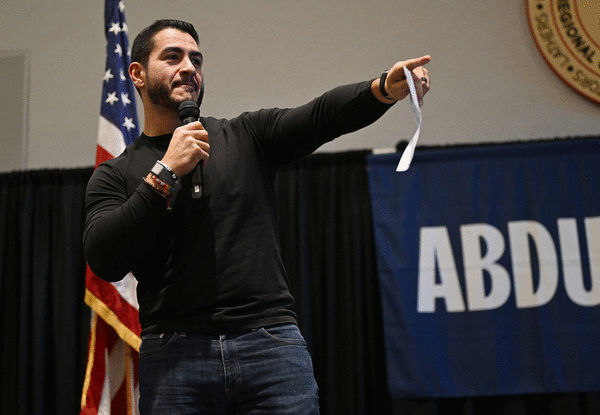
There’s little question Michigan’s U.S. Senate race is a bellwether for the entire nation in this midterm election.
The contest between Republican Mike Rogers and Democrat Abdul El-Sayed is now the most expensive election in Michigan history, with $400 million, perhaps $500 million by Tuesday, in spending.
But how did Michigan’s open U.S. Senate seat become such a marquee race? And how did El-Sayed, whose progressive policies were considered far outside the mainstream just eight years ago, become a leading contender for the U.S. Senate?
The answer is that Michigan has been moving left for a decade. El-Sayed didn’t necessarily change his politics to win Michigan. Michigan’s political environment changed enough to make his politics more popular.
To understand how, we have to start in 2016.
In the bitter presidential rivalry that year, Vermont Sen. Bernie Sanders beat Democratic establishment darling Hillary Clinton in Michigan’s primary by more than 17,000 votes.
That victory laid the groundwork for a candidate like El-Sayed.
Sanders’ popularity didn’t translate into the Democratic presidential nomination, in part because the party’s superdelegate system overwhelmingly "favored" Clinton, who also won more pledged delegates nationally.
That top-down establishment advantage wasn’t easily forgiven, or so it would seem.
Two years later, in 2018, El-Sayed, a political newcomer, launched his quixotic gubernatorial campaign against Gretchen Whitmer, another Democratic favorite.
El-Sayed’s 2018 campaign was similar to the platform he’s running on for the U.S. Senate: Michigan needed a more ambitious, progressive change in its economic and political priorities, not simply a change in party control.
He proposed ideas that seemed out of the mainstream at the time but have since grown in popularity, particularly among Democrats.
Take, for example, health care. El-Sayed in 2018 proposed a Michigan-level, single-payer, Medicare-for-all-style health care system called Michicare, covering all state residents. That approach has since become a defining ambition of the Democratic Party’s progressive wing.
He wanted corporate PAC money out of politics, a concern about money’s influence on elections that has only intensified. He advocated for a $15-per-hour minimum wage. Today, Michigan’s minimum wage is approaching $14 an hour.
He was critical of Israel in 2018, when the issue attracted far less attention in American electoral politics. In 2026, his perspective has essentially crystallized a raging debate over U.S. financial support for Israel, helping define this Senate race.
Nearly 50% of voters oppose funding for Israel, according to The News/WDIV’s September polling.
He was supported by Sanders and Democratic New York Rep. Alexandria Ocasio-Cortez, early allies in what now looks like a long-term political transformation.
El-Sayed hasn't changed much since 2018, but Michigan's political environment has.
Trump won Michigan in 2016 and again in 2024. But his victories didn’t necessarily mean Michigan voters had rejected the economic interventionism Sanders and El-Sayed advocated.
What Sanders and Ocasio-Cortez couldn’t control was how Trump’s second term would go, or where frustration among voters who supported his populist message might land.
Now, with Trump’s declining popularity, Democrats have an opportunity to capitalize on that dissatisfaction. And increasingly, the candidates positioned to do so are not the establishment Democrats of a decade ago.
They’re candidates like El-Sayed.
Unlike in 2016, when the progressive wing of the Democratic Party was forced to accept Clinton as its nominee, El-Sayed has commanded the opposite outcome in Michigan.
That would have been difficult to imagine in 2018. And it helps explain why the contrast with Rogers, who was also on the ballot in 2024, has become so consequential.
El-Sayed’s political ascent didn’t happen overnight. It shows where Michigan's electorate has been heading. Nov. 3 will show whether the political revolution Sanders promised a decade ago can deliver a progressive U.S. senator from a purple state.
_____
©2026 www.detroitnews.com. Visit at detroitnews.com. Distributed by Tribune Content Agency, LLC.















































Comments