Commentary: The US is likely to lose its edge in scientific research because of political priorities
Published in Op Eds
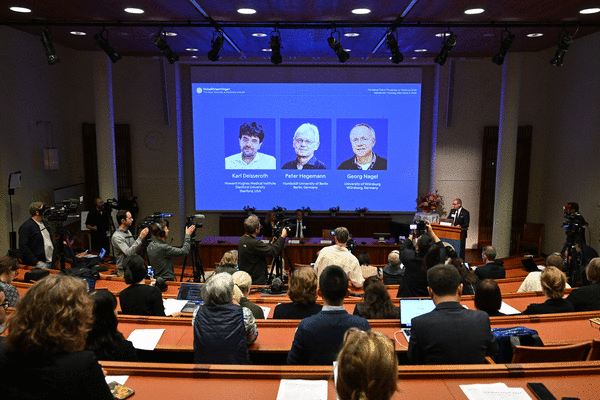
As is the tradition, the first full week of October marked the announcements of Nobel Prizes, with a new one each day: Physiology and medicine Oct. 5, followed by physics, chemistry, literature and peace on successive days. The first three often are considered the science prizes, and since their start in 1901, scientists in the United States have won 44% of those. But that dominance has not always existed, and it may not continue to.
The early prizes were awarded mostly to Europeans, as German science especially was preeminent. This year, only one of the six laureates was born in the United States. The other scientists who were honored were French, Japanese, two Germans and a Belgian scientist who immigrated to the U.S. Nobel Prizes usually honor discoveries that were made years or decades ago, so this year’s awards may not reflect a trend yet. But, for several reasons, the U.S. might begin to lose some of its edge, particularly because of reduced funding and new political priorities.
In the past fiscal year that just ended Sept. 30, the National Science Foundation, the federal agency that funds basic research in the U.S., has awarded about 30% fewer research grants as it did in previous years. For the new fiscal year, the NSF’s budget is proposed to be cut in half, along with large budget cuts in most areas of basic science, including medical science at the National Institutes of Health. Although that may sound insignificant, today’s technology would not exist without the underlying basic research. By cutting fundamental science, the U.S. runs the risk of falling behind not only in Nobel Prizes but also of missing out on the most impactful innovations of tomorrow.
One example that demonstrates this is the MRI, something most humans will need at some point in their life. This technology would not exist without the development of quantum mechanics over a century ago and many discoveries about fundamental ideas, such atoms and electrons. Those discoveries led to the discovery of nuclear magnetic resonance, or NMR, in the 1940s and eventually to its application for imaging in the 1970s. Yet, the many physicists and chemists involved in this fundamental research did so purely to find out what makes nature tick. They could not possibly have imagined their work one day would lead to an application in healthcare.
This is true for most of modern technology. We may marvel at the applications but take the underlying science for granted. Solid-state physics in its early days was just an esoteric exercise to satisfy curiosity. But that research wound up producing transistors and all of modern electronics from cellphones to artificial intelligence. If doctors would have asked scientists over a century ago to invent some way to look through patients and see their bones, no one would have had an answer. But the research by a German physicist, Wilhelm Röntgen, unexpectedly produced such a tool.
The same is true in spades in medical science. The discovery of the structure of DNA and thousands of resulting breakthroughs have fundamentally changed the medical world as well as our understanding of nature. The pharmaceutical industry would not exist without the basic biochemistry research done in academic laboratories.
In short, without that purely curiosity-driven research, funded by taxpayer dollars, none of the modern world would exist. To be sure, the vast majority of fundamental research leads to nothing practical, but we cannot do only just the projects that are eventually successful because we can never know what those will be. And there is another argument for supporting basic research in addition to its practical outcomes: Science is a cultural value. It shapes how we look at ourselves and at the world. It defines who we are as humans.
For all these reasons, the world needs scientists playing in the sandbox. And it matters where in the world that sandbox is located.
The history of the Nobel Prizes shows that the geographical emphasis of science can shift over time. Germany lost its status in science in the 1930s when many leading physicists fled from fascism. (About 40% of American Nobel Prizes have been won by immigrants.) As another perspective, most prizes have gone to affluent countries that can afford to fund basic research. At the same time, their societies are also strengthened by their intellectual prowess. All this is at stake when fundamental science budgets are being drastically cut.
Given this, future Nobel Prize October announcements may provide the bellwether for America’s stature or decline in the scientific world.
____
Mattanjah de Vries is a distinguished professor of chemistry at University of California, Santa Barbara, and a Public Voices fellow of the OpEd Project
___
©2026 Chicago Tribune. Visit at chicagotribune.com. Distributed by Tribune Content Agency, LLC.

















































Comments