Juan Pablo Spinetto: Tulum's ugly downfall is a warning for Mexico
Published in Op Eds
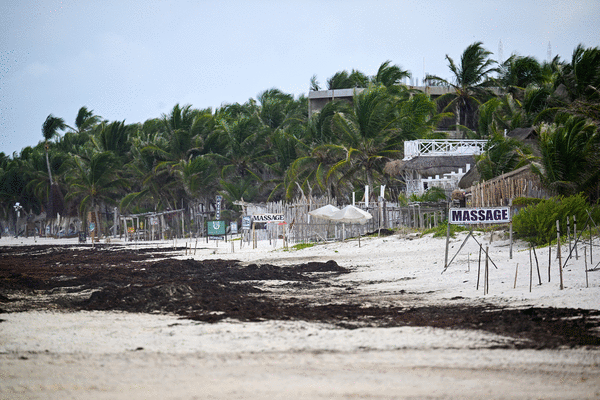
There was a moment, around 2015 or 2016, when Tulum was the coolest town on Earth.
Every fashion magazine seemed to billboard the beach retreat on Mexico’s turquoise-water Caribbean coast as a mecca for global trendsetters. “Tulum style” came to describe a distinctive aesthetic — flowing fabrics, linen & crochet, neutral colors, bare feet, traditional craftsmanship — that blended rustic-chic, environmentalist and free-spirit ideals into the boho-luxe look of the moment.
This effervescence bubbled to a peak in July 2018, when Vogue put modeling queen Gisele Bündchen on its cover, photographed in Tulum’s tropical forest in a printed floral Ralph Lauren dress and presented as a “climate warrior.” The accompanying line was deliciously obnoxious: “Gisele: Earth Mother, Eco-Activist, Fashion Superstar.” Thus came Tulum’s “it” breakthrough.
Fast forward a decade, and that utopian version of the antique Mayan town, which promised ornamental indulgence, paradise views and a dose of spiritual cleansing, is long gone. These days, Tulum is grappling with overexpansion, insecurity, inadequate infrastructure, real-estate speculation and a stinking sargassum invasion. Tourists are fleeing to less pretentious destinations: Visitor numbers plunged to about 115,000 in July, almost a third below the level of two years earlier, while hotel occupancy has averaged just 64% so far this year, nine percentage points below 2025.
While every major tourist hotspot in Mexico, from Cancún to Puerto Vallarta, is going through difficult times due to higher airfares, the strong peso and the sargassum crisis, Tulum’s problems seem more fundamental. This is, after all, a boutique destination that couldn’t cope with its own explosion in popularity. It still lacks basic services, including proper water and sewage systems, and struggles with degraded streets, irregular settlements and drug-trafficking activity.
It’s a sad but foreseeable outcome for a place that should have resisted the model of growth at any cost. As someone who first visited Tulum in 2001, when it was little more than an off-the-grid, bucolic destination of laid-back beach camps and about 7,000 residents, I’ve watched its overexploitation become a bracing showpiece of what badly planned development can bring. Tulum now has more than 75,000 residents — an astonishing 61% increase since 2020 — while its urban footprint has expanded several times since my backpacking trip, making it one of the country’s fastest-growing urban areas. A 2023 government study estimated that by 2050, Tulum’s population together with that of the neighboring municipality of Felipe Carrillo Puerto could exceed 716,000 people.
I am no degrowth zealot, and I get that more visitors are ultimately a sign of approval. Still, nothing good can come from such anarchic expansion. Some might argue that Tulum’s travails are almost inevitable given surging demand and Mexico’s historic difficulties with urban planning. After all, less glamorous towns across the country suffer from similar shortages of basic services. At least Tulum creates jobs and economic activity.
Yet even if we grant that point, there is something deeply wrong with a town that accommodates ever more real-estate and commercial projects with scant regard for legal regulations and environmental damage. With Cancún, the region’s mass-tourism hub, just 80 miles north, Tulum could have followed a more constrained and sustainable expansion model.
Problems had been building for years, from land disputes and feverish property speculation to abusive prices designed to exploit naïve tourists and the slow takeover of public beaches by local developers. Nightclubs and electronic music festivals followed. By 2019, a string of pharmacies had popped up along the main coastal road catering to Americans looking for over-the-counter legal medications without prescriptions. It felt like the beginning of the end; the boho-chic wonderland with eco-conscious manifestos was already turning into something much less ethereal.
President Andrés Manuel López Obrador’s controversial decision to build a dedicated international airport in the middle of the jungle — even as his administration was also developing the Maya Train line connecting Tulum with Cancún’s massive airport — boosted the strategy of chasing ever more tourists. Yet the airport, with an initial capacity of 5.5 million annual passengers, hasn’t quite taken off — literally. Opened for commercial operations in late 2023, it’s struggling to attract passengers, with traffic falling almost 34% this year so far compared to 2025, and two local airlines, Aeroméxico and Volaris, recently announcing the temporary suspension of their operations. The retreat’s troubles have become so apparent that the government has launched a “Tulum Reborn” strategy to lure visitors back.
Tellingly, what was once a fashionista nirvana surrounded by beautiful cenotes and archeological sites has become the laughingstock of social media, with endless reels and videos proclaiming the death of Tulum, a deeply hypocritical place in which everything is marketed as eco-friendly, ethical and sustainable, when so little of it actually is.
That may be unfair, but the backlash reflects something real: Tulum’s betrayal of its promise of a simpler life in an unassuming and quiet paradise. Its big challenge now will be to rethink its strategy and regain what made it special in the first place.
_____
This column reflects the personal views of the author and does not necessarily reflect the opinion of the editorial board or Bloomberg LP and its owners.
JP Spinetto is a Bloomberg Opinion columnist covering Latin American business, economic affairs and politics. He was previously Bloomberg News’ managing editor for economics and government in the region.
_____
©2026 Bloomberg L.P. Visit bloomberg.com/opinion. Distributed by Tribune Content Agency, LLC.


















































Comments