Commentary: Why chaos on election day is highly unlikely
Published in Op Eds
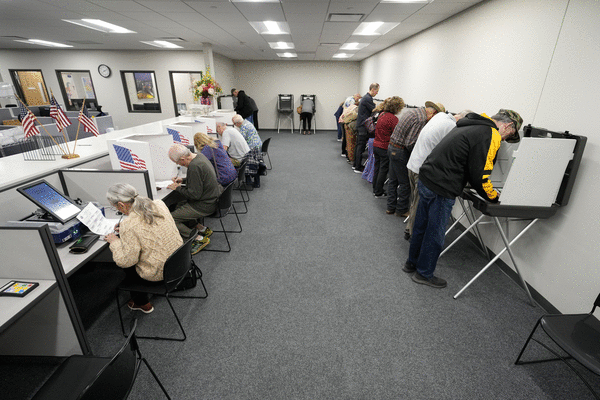
Americans are understandably freaked out about the possibility of disruption in the elections next month. I get the concern. But every doomsday scenario falls down in practice. If we can just tune out the noise, the process at the polls is most likely to be refreshingly mundane.
I have run a nationwide election protection program. It’s real work to get people to dedicate a full day to helping others. It’s much harder to recruit bodies to hunt for fraud: because fraud at scale doesn’t really happen, that sort of snipe hunt doesn’t get many takers. And intimidation? Keyboard warriors love to act out online, but to actually show up is a totally different thing. They would be thrown out of the polls. They would be risking jail, because intimidating voters is a crime local officials are very prepared to enforce.
What if the federal government sends armed agents, including immigration officers, to polling sites to suppress turnout and maintain power? Not only is it emphatically not legal, it’s not practical. There are almost 100,000 polling places. The logistics of an intimidation operation don’t work countrywide.
Here’s what I believe will happen: The federal government will send a group of a dozen goons to a suburban polling place somewhere, and they’ll have a camera crew with them. Bystanders will happily oblige them in filming as well. That clip will go viral and scare some voters into not showing up at the polls because they think that there are individuals intimidating voters all over the place.
If people are worried about intimidation, go see for yourself that in your neighborhood things are very normal. Even if social media depicts pure chaos. You want to see whether it’s raining? Don’t use a weather app: Look outside.
Local and state election officials are preparing for mayhem or interference by the federal government. That doesn’t mean chaos is likely. It’s local authorities’ responsibility to prepare for everything so that the voters don’t have to worry about it. And they are as prepared as I have ever seen them. They’re preparing for a lot of truly outlandish scenarios, and some that are more realistic, so that they can be ready to make sure that the election is smooth and secure and feels very normal.
Ballot seizure is also very much on people’s minds, and I think it’s particularly salient because federal agents did it in Fulton County, Ga., and because local sheriffs did it in Riverside. But there are two big reasons that’s not going to happen this fall.
First, the seizures in both Fulton County and Riverside were of old ballots. Fulton County’s ballots seized this year were from 2020. California’s were more recent. It was a 2026 seizure for the 2025 elections, but those elections were still over, and results had already been tallied.
That’s very different from an attempt to seize ballots while results are still pending, which is flatly unconstitutional.
The seizures in Fulton County and Riverside surely took the judges in those districts by surprise — and overzealous law enforcement in those cases did us a favor. Now there are very few judges anywhere who are going to be surprised by such requests.
As the years go by, fewer and fewer things can catch us all off guard. I’ve been working on elections for a couple decades now. My list of things to watch out for in 2000 was long. My list of things to watch out for in every subsequent election grew longer. The last couple of years, my list of things to watch out for has spilled off the page and onto the floor. For election officials, it’s a lot. They are stressed out, they’re underpaid, they’re overworked.
But all that said, they’ve got this. They’re actually as prepared as I have ever seen, including dealing with things that they haven’t ever seen before and should never have to be seeing.
I understand why people might feel afraid. I understand why people think there are risks. And that’s because it’s not normal to have the president fostering this much concern about the democratic process, nor to have the president this unattached to the democratic process.
But the process doesn’t depend on the president. It depends on us.
____
Justin Levitt is a professor of law at Loyola Law School Los Angeles. This article was produced in collaboration with the Conversation.
©2026 Los Angeles Times. Visit at latimes.com. Distributed by Tribune Content Agency, LLC.













































Comments