Marc Champion: Why Putin says Russia could 'cease to exist' if it loses
Published in Op Eds
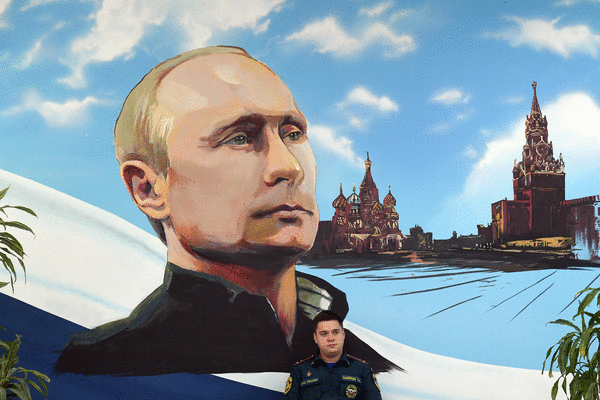
Ever since things in Ukraine first went sideways for Vladimir Putin back in the spring of 2022, the Russian president and his officials have said that, not only were they fighting Nazis and responding to NATO aggression, but that the stakes of the conflict were so high that Russia may cease to exist should they fail.
This claim has always been puzzling, because it seems so absurd. And yet such a belief would help explain the extent to which the Kremlin is now ramping up attacks on Ukraine, expanding its campaign of hybrid warfare in Europe and — by announcing massive budget transfers from non-defense to military spending — risking discontent at home.
Putin touched on the idea yet again earlier this month in his annual address to the Valdai Club conference of foreign policy and Russia analysts. Harping on a 2022 comment from then-NATO Ambassador Julianne Smith that the U.S. sought Russia’s “strategic defeat,” Putin said this put his nation’s “very right to exist” in question.
What Smith intended must be seen in the context of the ultimatums Putin sent to the U.S. and North Atlantic Treaty Organization before the war, in the form of two draft treaty proposals. These described his subsequent war aims and went far beyond requiring Ukraine’s neutrality. They also demanded the removal of all alliance troops, weapons and bases from Central and Eastern Europe, and all U.S. nuclear weapons from any foreign base, significantly reducing the credibility of the nuclear umbrella Washington could offer its allies.
So, strategic defeat meant putting an end to Putin’s project to reimpose control over Moscow’s so-called historical zone of interest by stopping his forces in Ukraine’s eastern Donbas region. Allow him to take Ukraine and the only question would be: Where next? It’s still a valid concern, but use of the term “strategic defeat” has proved a gift that never stops giving to Putin’s victimhood narrative. “This is the way it was all articulated,” he recalled in his Oct. 1 address. “No one forgot this. At least, we did not forget this”
But how would losing in Ukraine pose a threat to Russia’s existence? Even in the unlikely event that Kyiv should win the war by pushing Russia’s troops all the way back to their internationally recognized borders — a true and humiliating defeat for Putin — Russia would not disappear. It would just continue to exist in the form it had until 2013. And if the front lines were frozen where they are today, Russia would have gained about 20% of Ukrainian territory.
Whatever they may say, Russia's leaders know their opponents bear no resemblance to the invading armies of Nazi Germany (1941), Napoleonic France (1812) or the Polish Lithuanian forces that occupied the capital in 1610. Nobody is marching on Moscow.
Indeed, the U.S. has effectively moved to the sidelines. Having halted American aid to Ukraine last year, President Donald Trump is now doing more to help Moscow than Kyiv, calling for Volodymyr Zelenskyy to unilaterally halt attacks on Russian oil refineries. When the Ukrainian president refused, Trump lifted a ban on the purchase of diesel exports and called for Zelenskyy to resign.
Political expediency explains some of Moscow’s inflated rhetoric. Putin wants Russians to perceive a critical threat, because he is asking them to make new levels of sacrifice. He is boosting the country’s already large defense budget for next year by 27%, paid for in part by cutting further into education, healthcare and welfare spending, while printing money at the central bank. This will hit living standards.
He’ll also need to recruit more soldiers, whose average life expectancy at the line of contact the Ukrainian and U.S. intelligence services now estimate at about 30 minutes. So, it helps for the cause to appear existential — as it could well be for Putin personally, and for the system he has built around him, should he be perceived to fail.
Hyping the threat also supports his efforts to persuade Europeans that by continuing to back Ukraine, their governments are inviting all-out war — perhaps even nuclear war — with Russia.
There is more at work here, though, than cynical manipulation. There’s also real paranoia among the crop of current and former KGB officers who currently run Russia, starting with Putin himself. Not only did their training and careers program them to assume threats all around, but they already saw one seemingly immortal great power (the former Soviet Union) collapse around them to the joy of the West. Why not the Russian Federation, too?
Putin and his fellow strongmen half believe it when they say they’re reenacting World War II, because they see the gains the Soviet Union made in Europe at the end of that conflict — and lost after 1991 — as what’s at stake. They also genuinely think Ukraine isn’t a real country, but rather a Frankenstein state whose creation required ripping out Russia’s historic heartland. This history is wrong, but it is sincerely believed.
And, just as for ex-KGB officials the distinction between war and peace is blurred, so too is the question of what Russia is and where it ends.
This is essential to understand. It affects what is and is not negotiable with the Kremlin, what the true purpose of any peace offer Putin makes might be and what is meant by the apparently ludicrous claim that Russia is being attacked in Ukraine. Western leaders should accept none of it, but they need to grasp the mentality to avoid unnecessary escalation or being gas lit into chasing settlements that cannot be had.
The Russia Putin talks about is quite simply bigger than the one on our maps. It’s also defined by keeping its place at the table of great powers, by an idea that it’s a civilizational state that spills across borders and by a historical inheritance whose expanse that now, as always, had to be gained and held by force.
“Multiplying one’s heritage,” Putin told his Valdai audience, is the best way for nations to avoid becoming "a vintage collectible.” This, to the president and his entourage, would appear to be the worst of all fates — and it’s certainly how they see Britain. Foreign Minister Sergei Lavrov oozed contempt when he recently described the UK as “diminished to the utmost degree” and no longer worthy of its permanent seat in the United Nations Security Council.
It is this potential future that Putin and others foresee with dread when they talk about their country ceasing to exist. The attempt to restore not necessarily the USSR or Russian Empire, but the idea of Russia as a great power supersedes all other Kremlin concerns, including for the economy, welfare or popular approval.
Putin will abandon his vision only if he becomes convinced it cannot be achieved, and that to continue in the attempt is more dangerous to him personally than to settle. This question will be decided by force, even if it ends in a negotiated ceasefire, because Russia’s now sovereign neighbors have their own ideas of history and heritage. They, too, want to exist.
____
This column reflects the personal views of the author and does not necessarily reflect the opinion of the editorial board or Bloomberg LP and its owners.
Marc Champion is a Bloomberg Opinion columnist covering Europe, Russia and the Middle East. He was previously Istanbul bureau chief for the Wall Street Journal.
©2026 Bloomberg L.P. Visit bloomberg.com/opinion. Distributed by Tribune Content Agency, LLC.













































Comments