Mary Ellen Klas: Florida's GOP governor candidate exposes his party's emptiness
Published in Op Eds
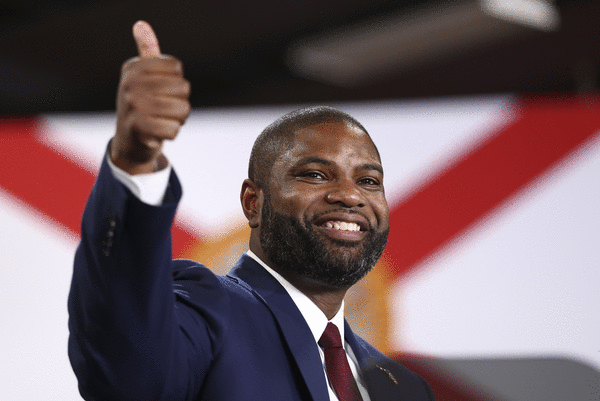
When students at Florida A&M University in Tallahassee grilled Republican gubernatorial nominee Byron Donalds last month about his record, he promised to bring his finance background to the state’s top job. “The next governor has to have experience in how a company’s balance sheet operates,” said Donalds, who was a financial adviser before being elected to the Florida House in 2016 and the U.S. House in 2020.
A week later, the online news site the Florida Bulldog reported that Donalds had to amend his annual federal financial disclosure forms for every year he has been in Washington. In a June 4 letter to the clerk of the U.S. House, he acknowledged that his previously filed reports “did not include disclosure of certain liabilities.” He amended his form again on Aug. 13, offering the same explanation.
Leave aside the irony of a former banker boasting about his facility with a balance sheet while filing incorrect financial forms. Donalds’ performance at FAMU, Florida’s only public historically Black university and a school he attended for three years, exposed a much large much larger problem: Florida’s Republican Party — very much including its gubernatorial nominee — is a weak collection of stale rhetoric, failed ideas and vague plans.
When a FAMU student noted that Florida ranks 42nd in the nation on affordability, and asked what he planned to do to improve things, Donalds responded with some talk about the high price of property insurance, housing and healthcare. But he offered no real fixes.
Property insurance premiums are on the decline, Donalds suggested — which is true enough but ignores the fact that the meager decline is because coverage is shrinking and the legislature’s reforms have led to dropped coverage. The solution, he said, is to reduce regulation to make it easier to harden homes and lower the cost of replacement if a home is destroyed. Less regulation might help, but only if accompanied by industry reforms that prevent parent companies from siphoning off profits so their affiliates can justify higher premiums — details Donalds ignored.
When it comes to the state’s housing crisis, Donalds has a similar refrain: deregulation. Specifically, he wants to make it easier for builders and homeowners to get permits. But that’s only a piece of the problem, and it won’t relieve the market distortions brought on by billionaires and retirees who have priced out Florida’s workers.
As for healthcare, Florida has the fourth-highest percentage of residents without health insurance in the nation, yet Donalds rejects Medicaid expansion. His plan is to somehow increase coverage by requiring hospitals to publicize their prices — as if sick patients will be shopping around.
Florida state government needs a refresh. The state’s population is older and less White than most of America — putting it a decade ahead of where the rest of the country is heading. That makes it an ideal testing ground for policies that could have nationwide impact.
The Democratic nominee, David Jolly, is offering several novel ideas to address the state’s affordability problem. He wants state-backed housing assistance and greater access to healthcare, a state-backed property insurance fund, new taxes on insurance industry profits and caps on the profits of investor-owned utility companies.
Donalds hasn’t bothered to engage in a productive debate on these proposals. Instead, he swats them down with a worn GOP line: “It’s government-run socialism.”
That’s the mindset that kept Governor Ron DeSantis and the Republican-controlled legislature from doing anything to prepare the state’s aging labor pool for a tech-torn future or addressing the growing number of uninsured Floridians crowding hospital emergency rooms. They preferred to wage culture wars over gender identity, education policy and academic speech, distracting voters from their government grift — like DeSantis awarding contracts to donors to build the ill-considered and ill-fated “Alligator Alcatraz” immigrant detention center in the Everglades.
Donalds, who is touting DeSantis’ endorsement over the one he got from President Donald Trump, has indicated he’s going to continue the governor’s small-minded, transactional politics. It’s why his $111 million campaign has received seven-figure donations from a casino mogul, a school-choice billionaire, a private prison operator, an electric monopoly, and a hedge fund manager.
For Black voters, Donalds presents a special challenge. If he is elected, he would be the first Black Republican governor in the history of the U.S. But Donalds is so close to Trump, whose decades of racial animus includes advancing a birther lie about the nation’s first Black president, that Trump has his own ringtone on Donalds’ phone.
When a FAMU student asked Donalds how he could understand the struggles of Black Americans when his “political alignment and personal circle are rooted in spaces that historically exclude them,” Donalds replied with a bromide. He wants all people, he said, “to succeed based on merit.”
But merit is meaningless when the game is rigged. After the U.S. Supreme Court gutted the Voting Rights Act last April, states saw an opening to erase predominantly Black and Latino districts for partisan gain. Florida Republicans jumped on the midterm redistricting bandwagon, slicing up three Black districts in an attempt to create four new GOP seats. Donalds endorsed the plan.
Republicans remain the favorite in a state Trump won by 13 points in 2024. But most voters in Florida are unhappy with the president’s performance and have signaled they are restless with Republicans. Donalds has repeatedly defended Trump’s Iran war, tariffs and handling of immigration. If enough voters give Donalds the same kind of scrutiny he received at FAMU, he won’t be Florida’s next governor.
____
This column reflects the personal views of the author and does not necessarily reflect the opinion of the editorial board or Bloomberg LP and its owners.
Mary Ellen Klas is a politics and policy columnist for Bloomberg Opinion. A former capital bureau chief for the Miami Herald, she has covered politics and government for more than three decades.
©2026 Bloomberg L.P. Visit bloomberg.com/opinion. Distributed by Tribune Content Agency, LLC.














































Comments