Michael Hiltzik: Trump's deal for Venezuela's oil is secretive, exaggerated and suspicious
Published in Op Eds
Here's what President Donald Trump has said about his deal for Venezuelan oil: that it's a deal with the current Venezuelan government, that it will more than double U.S. oil reserves and that it will "substantially lower Gas Prices for all Americans, long into the future."
Here's a simple rule of thumb for assessing all these claims: None of them is true.
The deal is with a private company of suspect character, which may enable White House to keep its details under wraps. The quality of the oil is so low, and the cost of extracting and refining it so high, that counting it as part of America's petroleum reserves is what Mark Twain's Huck Finn generally called a "stretcher."
As for bringing down U.S. gas prices, either today or "long into the future," on the gonna happen scale that's a "not." And that's even assuming that a future Venezuelan regime won't put a match to the whole thing.
Before getting into the details of these fatuous claims, a few words of background on Trump's Venezuelan adventure are warranted.
Trump launched aggressive moves against the dictatorial regime of Nicolás Maduro last year. These encompassed "attacks on Venezuelan boats in the Caribbean purportedly carrying drugs destined for the U.S., tankers carrying oil to China and other countries ostensibly in violation of international sanctions and the threat of military action," I wrote in December.
On Dec. 16, he declared on social media that he had it "surrounded by the largest Armada ever assembled in the History of South America" and that it would stay in place until its leaders "return to the United States of America all of the Oil, Land, and other Assets that they previously stole from us."
Then came the kidnapping of Maduro and his wife on Jan. 3, and their transfer to the U.S. to face narco-terrorism and other charges in U.S. federal court. The action placed political and legal observers in a quandary: Maduro was a vicious specimen, and no one was sorry to see him go. The Defense Department, by most accounts, managed the operation professionally.
On the other hand, the projection of American might into the affairs of another country, while hardly unprecedented, gave many experts pause. Among their concerns was the paucity of American planning for the post-Maduro era; the regime landed in the hands of Maduro's vice president, Delcy Rodríguez, which doesn't herald much in the way of regime change, not to mention an end to government corruption in Venezuela.
Within a day of Maduro's capture, Trump was already trying to threaten Rodríguez into complying with his policies in her country: "If she doesn't do what's right, she is going to pay a very big price, probably bigger than Maduro," he told Michael Scherer of the Atlantic. (Leaving aside what he meant by "what's right.") He has also turned a cold shoulder to the leader of the anti-Maduro opposition, Nobel Peace Prize laureate Maria Corina Machado.
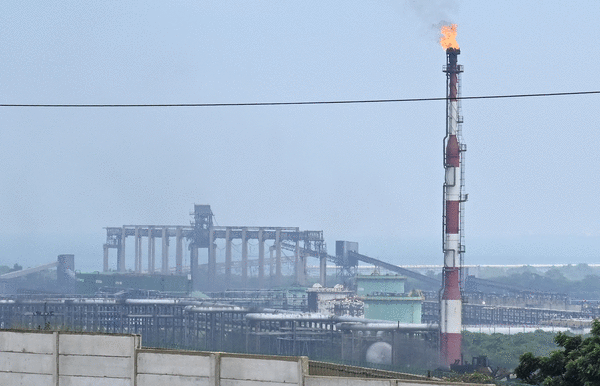
As for the quality of Venezuelan oil, it doesn't measure up to what most American refineries are geared for and typically trades at a discount to other formulations. "Most of it comes out of the ground with the consistency of cold peanut butter," observes economist David I. Levine of UC Berkeley. Moving it through a pipeline and into a tanker requires treatment that would add $15 a barrel to its cost, he estimates, not counting the specialized equipment needed to refine it.
Even Trump, during a 2023 campaign speech, disdained the product as not worth importing. "We have more liquid gold under our feet than any other nation, but we're buying tar from Venezuela and we're refining it in Houston," he said. "The dirtiest, the worst oil probably anywhere in the world.... So you can imagine what's going up into the air."
A Trump spokesman told me by email that "several refineries, specifically in Texas, ... were built for and are capable of refining Venezuelan crude." That's true, but as Samantha Gross of the Brookings Institution has commented, those refineries are already running at close to capacity. High oil prices might make expanding those capabilities economical, but the $90 current price of crude is an artifact of Trump's Iran war, and once that's resolved the price is likely to fall.
Trump's claim that the supply of Venezuelan oil will bring gas prices down is a macedoine of aspiration and ignorance. "The oil industry in Venezuela is a shambles," Gross noted, with production falling from a peak of about 3.2 million barrels a day in 2000 to as low as about 800,000 barrels now.
White House spokesman Taylor R. Rogers told me by email that "as soon as early next year, material production will be coming to the United States" and enough oil would be flowing to the market to help bring down gas prices by the end of 2027. Experts consider that a wildly ambitious timeline.
"Restoring production to its peak would require years and billions of dollars in investment," Gross wrote. It's one thing to look ahead optimistically to Venezuelan oil taking enough of a place in world markets to influence gasoline prices, but one must confront reality.
In any event, many factors play into the price of gasoline other than the price of crude, especially on the way down. That's why prices at the pump proverbially soar like a rocket when crude prices rise, and drift down like a feather when crude gets cheaper. And much of the market response occurs at the retail level — your corner gas station — than at the crude market.
That brings us to the oil deal that Trump announced on Aug. 28, grandiloquently calling it "the biggest oil deal in world history."
The White House has made the most basic term of the deal — namely, who's on the other side of the table from the U.S. — into a moving target. In his Aug. 28 announcement on social media, Trump called it "an agreement with the country of Venezuela."
The administration may have seen that as a problem, for as former State Department treaty expert Michael Mettler noted on the Just Security website, U.S. law requires the executive branch "to disclose to Congress and the public the texts of most significant international agreements the United States enters into with other countries."
Accordingly, the deal is now specifically fashioned as a deal with a third party, North American Blue Energy Partners. The current Venezuelan government, according to Trump, granted NABEP a 100-year concession for "17 oil fields with proven reserves of approximately 65 billion barrels."
NABEP then granted the U.S. government a 35% equity stake in its parent company, guaranteed access to 20% of its output at its production cost and the right of first refusal to the remaining 80%. Consequently, according to the White House, "This is a deal with a private company — not the Venezuelan interim government." (Emphasis in the original.)
That means, according to Mettler, that "despite the arrangements explicitly contemplating significant roles and benefits for U.S. government agencies (even including an equity stake in the private company contracting with Venezuela)," key elements of the deal may be exempt from public disclosure requirements in federal law.
The administration describes NABEP as "a proven operator" in Venezuela. That said, in August the Washington Post reported that senior U.S. officials "intervened" to block criminal charges by Switzerland against Alejandro Betancourt, NABEP's chief executive, who also was reportedly the target of U.S. money-laundering investigations as recently as early this year.
Betancourt has denied any wrongdoing. His lawyer told Reuters that no charges have been brought against him in any jurisdiction. The White House didn't respond to my request for comment on the Washington Post report.
The White House responded indignantly when I asked whether any member of Trump's family, his business partners, or the administration had any role as investors or management at NABEP, implying that I was trying to "fabricate conflicts of interest." That response evoked for me Gertrude's remark in "Hamlet" that "The lady doth protest too much, methinks," but so be it.
By its nature, the future of Trump's oil deal with Venezuela — or NABEP, as he prefers — is bound to be murky. White House spokesman Rogers told me "the Venezuelan ministries that have power to grant concessions were the ones that lawfully granted these concessions" to NABEP.
But obviously nothing would prevent a future Venezuelan government from canceling those concessions, just as a prior government canceled those awarded to foreign oil companies in the past — an action that garnered Trump's profound resentment.
Too much about this deal is hidden, and too much is claimed for its virtues than it could plausibly deserve. Don't expect the oil to be flowing anytime soon, and don't expect it to bring down the price of gas at your neighborhood pump.
©2026 Los Angeles Times. Visit at latimes.com. Distributed by Tribune Content Agency, LLC.

















































Comments