Editorial: The US can't fake its way out of fiscal trouble
Published in Op Eds
The U.S. government, steward of the world’s largest economy, faces a darkening fiscal outlook as sovereign borrowing costs surge. Unfortunately, it seems intent on trying any fix except the one that might help.
In a trend affecting the entire developed world, the yield on the 10-year Treasury note has risen to 4.7%, from 4.4% less than two months ago. The driving forces behind the spike aren’t all bad.
For one, rightly or not, investors are increasingly expecting stronger economic growth will put an end to a long period of abnormally low interest rates. Their optimism stems in part from a multi-trillion-dollar artificial-intelligence investment boom that is competing with the U.S. government for capital, putting further pressure on rates. In the classic terminology of cycles, this still seems to be more about greed than fear.
Whatever the reasons, though, the rising borrowing costs are highlighting America’s fiscal fragility. The country’s debts are so large — at about 100% of gross domestic product — that changes in interest rates have an outsized budgetary impact. Interest on debt held by the public is now running at more than $1 trillion, rivaling spending on defense. If sustained, a 30-basis-point increase in borrowing costs would add about another $100 billion — at a time when the trust funds dedicated to two of the government’s most important responsibilities, Social Security and Medicare, are on track to run out in 2032 and 2033, respectively.
When you can’t afford to borrow more, the obvious solution is to borrow less. In America’s case, this would entail striking the difficult political bargain required to reduce the developed world’s largest budget deficit, which stands at more than 6% of GDP. Yet bipartisan efforts to do so have so far gained no traction. To the contrary, the White House and Congress keep finding ways to cut taxes and spend more, including on “election security” and a disastrous war in Iran.
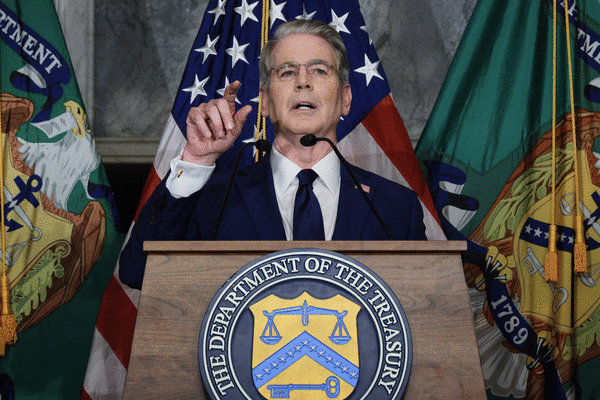
Meanwhile, Treasury Secretary Scott Bessent is resorting to seemingly desperate measures. The latest is his pledge to increase “by at least double” buybacks of 30-year Treasuries, the maturity at which the surge in yields has been most pronounced.
Although the surprise move did dampen yields temporarily, it comes at a cost. For one, the stratagem undermines the reputation of a Treasury that had promised regular and predictable debt issuance. Also, the government may have to raise the money by issuing relatively more shorter-term debt, making it more dependent on refinancing and more vulnerable to shifts in rates — an approach for which Bessent criticized his predecessor.
No market machinations, however sophisticated, can hide the stark reality: The U.S. government is woefully unprepared for a world in which borrowing costs return to a level that was, not long ago, considered normal. The only solution is to get its fiscal house in order.
_____
The Editorial Board publishes the views of the editors across a range of national and global affairs.
_____
©2026 Bloomberg L.P. Visit bloomberg.com/opinion. Distributed by Tribune Content Agency, LLC.

















































Comments