Mark Gongloff: Puerto Rico's water crisis is a man-made disaster
Published in Op Eds
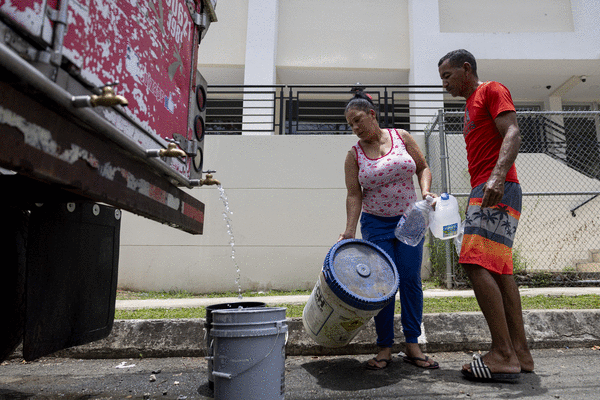
The average human being can’t survive more than 72 hours without water. In Puerto Rico, hundreds of thousands of U.S. citizens are being forced to go 48 hours without running water in their homes during a hot, dry summer while also enduring a shaky electrical grid.
If such things were happening to a mainland population of similar size — Richmond, Virginia, say, or Cape Coral, Florida — it would be a political apocalypse. Because it’s happening in Puerto Rico, it barely merits mention in the news. But we should all pay attention, because Puerto Rico is a lesson in just how fragile civilization can become when you mix climate change and inept governance. Nuisance can turn to tragedy in a moment, and Puerto Rico won’t be the last or even worst example.
Residents of 180,000 households in Puerto Rico’s capital of San Juan and six other cities have been asked to forgo running water for 48 hours on a rotating basis to address a dire shortage. Hotels, restaurants and other businesses are losing $20 million a day while the rationing continues, according to the United Retailers Association.
San Juan just had its driest July on record, and 68% of the island is suffering from at least moderate drought, according to the U.S. Drought Monitor. San Juan and some surrounding cities are in severe drought. But nature isn’t the only cause of this sort of extreme rationing, which also happened in 2015 and 2020 to an even larger degree, affecting 400,000 customers each time. Human incompetence plays a key role.
About 59% of Puerto Rico’s water goes missing on the way from its water authority to final users, according to a 2019 American Society of Civil Engineers (ASCE) assessment, mostly because of leaky equipment. The global average for such loss is 30% to 35%, the Tech Times points out. The ASCE gave the island a D-minus grade for its drinking-water infrastructure, meaning it’s “mostly below standard … with strong risk of failure.”
Sedimentation has slashed the capacity of San Juan’s biggest water source, the Carraizo Reservoir, by 45%, according to a 2024 study. For months before the latest rationing, water users in San Juan had suffered from spotty service because of failing pumps and a burst pipeline. Puerto Rico’s Senate is investigating a crisis that has been building for decades and shows little sign of easing soon.
The wait could be very long if Puerto Rico’s power grid is any guide. The island has still never fully recovered from the devastation of Hurricane Maria in 2017, which caused an 11-month blackout that is still the longest in U.S. history. Most non-Puerto Rican Americans were probably unaware of this until Bad Bunny did a whole Super Bowl halftime show about it.
The ASCE gave the island’s electricity a failing grade, and for good reason. The average Puerto Rican suffers through 27 hours a year without power, compared with two hours for the average mainlander, according to the Energy Information Administration. And that’s without counting the effects of natural disasters; in 2022, Hurricane Fiona forced Puerto Ricans to spend 199 hours without electricity, on average. Power failures are one vector by which a mere hurricane can become a compound disaster that multiplies the damage.
This failure is in one sense a shameful embarrassment for the administrations of Presidents Donald Trump and Joe Biden for letting millions of U.S. citizens live in such dire conditions. When it comes to electricity, Puerto Ricans these days have more in common with Cubans than they do Virginians or Floridians, and that’s as Trump is trying to keep Cuba down. Throwing paper towels looks like a kindness in retrospect.
But it takes a village. The U.S. government has at least thrown $14 billion at the problem of Puerto Rico’s grid in the past decade, but only 25% of that has been put to use, according to a recent Government Accountability Office report. You can blame everything from the shaky financial condition of the island’s electric power authority to lengthy permitting processes and layers of bureaucracy.
As the climate keeps getting hotter, mostly as a result of burning fossil fuels, droughts will grow more frequent and intense, and hurricanes will grow more destructive. It is still possible to limit the death, economic loss and general human suffering these things inflict by upgrading water infrastructure; by hardening homes, businesses and power grids against damage; and by making communities more resilient.
Puerto Rico may be an extreme example of how not to adapt, but it’s far from alone, especially as the Trump administration frustrates such efforts across the US, including canceling hundreds of millions of dollars’ worth of solar projects on the island. Before you know it, today’s Puerto Rico will be tomorrow’s Richmond or Cape Coral.
____
This column reflects the personal views of the author and does not necessarily reflect the opinion of the editorial board or Bloomberg LP and its owners.
Mark Gongloff is a Bloomberg Opinion editor and columnist covering climate change. He previously worked for Fortune.com, the Huffington Post and the Wall Street Journal.
_____
©2026 Bloomberg L.P. Visit bloomberg.com/opinion. Distributed by Tribune Content Agency, LLC.
















































Comments