James Stavridis: Putin can't break down NATO's door. He's trying the window
Published in Op Eds
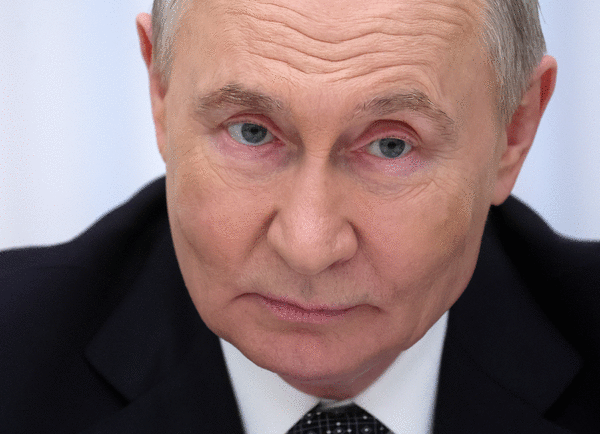
Recent reporting says Russian leader Vladimir Putin is considering testing the resolve and combat responses of the North Atlantic Treaty Organization (NATO) over the next couple of years. Despite being outgunned in defense spending and seemingly having its hands full in Ukraine, the Russian Federation already appears to be probing the alliance.
Last week, an explosives-carrying drone ended up on a runway at the airport in Leipzig, Germany (Russia denies any connection to the weapon). Around the same time, a Russian cruise missile landed more than 50 miles inside the Polish border, detonating in a field. Could these have been errant munitions that strayed from intended targets in Ukraine? Perhaps. But coupled with reported U.S. intelligence about Moscow’s designs on NATO, the incidents paint an ominous picture.
Why would Putin pick this moment to increase his provocations? And how likely is such a strategy to further his overall aims in both Ukraine and western Europe more broadly?
When I served as supreme allied commander of NATO from 2009 to 2013, we had a reasonably cooperative relationship with Moscow. There was a small liaison group from the Russian Federation embedded in NATO’s military headquarters outside Brussels. We worked together on counter-piracy, counter-narcotics and counterterrorism, especially in Afghanistan. But Putin’s first invasion of Ukraine in 2014 revealed the Kremlin’s real intent: conquer Ukraine for its vast wealth and 44 million citizens, then use those resources to pressure Europe into subservience.
Today’s scheme is different. Putin knows he is losing in Ukraine, facing a combination of Kyiv’s raw courage and determination; clever use of drone warfare; and vast quantities of U.S. and European weapons. From Moscow’s perspective, the key to getting back on the front foot is simple: cut off aid to the Ukrainians.
While the U.S. has already backed off the robust support it once provided, fortunately the Europeans have stepped up. So Putin reckons that if he can peel off some number of the Euros — by intimidating them with a combination of nuclear threats and hybrid warfare attacks — he can split the alliance and succeed in his ambitions.
Think of Putin as a burglar who has been battering Europe’s front door by attacking Ukraine. The door hasn’t broken, so he’s going to try the windows and back entrance instead. This will likely include continuing to launch weapons that “accidentally” end up in or near transportation hubs — notably airports and train stations.
He will likely amp up his already active cyberattacks, perhaps targeting institutions that have the potential to frighten or intimidate civilian populations (fuel delivery systems, food processing and delivery, medical facilities). Additionally, while European and U.S. financial institutions and military systems are reasonably well protected, our industrial infrastructure (electric, water, data centers and natural gas) is more vulnerable.
Also expect more nuclear threats. Putin has been rattling that saber for the past four years, mostly through the public pronouncements of former President Dmitry Medvedev and current Foreign Minister Sergei Lavrov. He may shift nuclear weapons around western Russia or in Belarus as a display of his capabilities.
Most aggressively of all, Putin could send special forces, probably not operating in uniform, into the small Baltic nations of Estonia, Latvia or Lithuania. Such “little green men” might conduct unconventional operations like the physical sabotage of transportation and power networks, perhaps using dramatic means like car bombs. They could unleash small, AI-powered drones connected through commercial networks.
NATO would be wise to take these threats seriously now, before the situation demands a major military response. The North Atlantic Council should hold public hearings in Brussels concerning the threat and direct the supreme allied commander to present detailed plans for countering Russian activities. This should include a significant, alliance-wide exercise that fuses American intelligence with European ground forces. A powerful defensive cyber campaign should be part of it.
Additionally, the alliance should draw up plans for proportional retaliation. It’s particularly important that NATO demonstrates its cybersecurity capability, so that Putin realizes his own vulnerabilities and sees there is no “free punch” he can land on the U.S. or Europe. NATO certainly has more combat capability than its opponent and can reply forcefully in the field as well. The Russian enclave of Kaliningrad is a tempting location for direct retaliation given the confluence of vulnerable military power located there. It is also geographically proportional to any attacks on the Baltic states.
Above all, Putin must be made to see that the alliance will respond with force if he continues down this dangerous path. Exercising NATO’s major operational plans for defending the Baltic states would send a direct signal.
The bottom line: If the Russians probe with a bayonet and encounter mush, they will likely keep going. If they find steel, they will withdraw. NATO has plenty of military steel to resist an adventurous and risk-taking Kremlin. But it must find the resolve to use its muscle before Putin decides it’s mush.
_____
This column reflects the personal views of the author and does not necessarily reflect the opinion of the editorial board or Bloomberg LP and its owners.
James Stavridis is a Bloomberg Opinion columnist, a retired U.S. Navy admiral, former supreme allied commander of NATO, and vice chairman at Carlyle.
_____
©2026 Bloomberg L.P. Visit bloomberg.com/opinion. Distributed by Tribune Content Agency, LLC.

















































Comments