Michael Hiltzik: Trump's new orders on child vaccines are even more dangerous than they seemed at first
Published in Op Eds
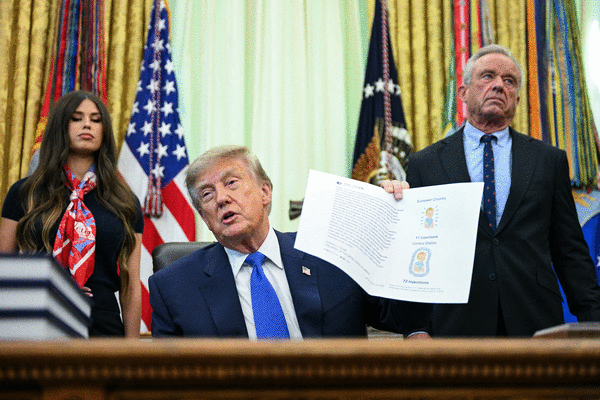
No one can claim to have been surprised by the executive order President Donald Trump issued Monday calling for a radical transformation of childhood vaccination practices in the U.S.
After all, Trump has been beating the anti-vaccination drum for years. His secretary of health and human services, Robert F. Kennedy Jr., is an established anti-vaccine activist.
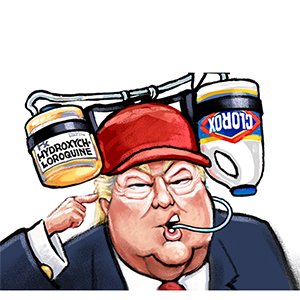
Trump himself has been an almost limitless fount of misinformation and disinformation about medicine, promoting useless nostrums against COVID-19 such as hydroxychloroquine, pondering whether ingesting bleach would kill the virus and questioning whether expectant mothers should take Tylenol.
Monday's executive order marks a new phase in his battle against public health.
The order is tantamount to a one-stop shop offering all the common anti-vaccine tropes claiming that America's children have been overwhelmed by excessive immunizations — a multivalent injection of fact-free claptrap, if you wish.
The tsunami of fabricated claims in the order and voiced by Trump and others at the Oval Office announcement Monday is almost overwhelming.
If there's a saving grace in this episode, it's that most states and the vast majority of parents are likely to ignore Trump's order. But the order will leave its mark by magnifying the confusion many parents already face in making decisions about their children's immunizations. That's a public health threat all on its own.
Here's a look at Monday's order, which claims to "deliver gold standard childhood vaccine recommendations."
First, the order pares the list of recommended immunizations to 11 diseases from 17. Six immunizations — for hepatitis A and B, rotavirus, meningococcal disease, flu and COVID-19 — are knocked down from "recommended" to "shared clinical decision-making." That's code for expanding the opportunity for parents to refuse the shots for their children.
Trump calls for supplanting the combined measles, mumps and rubella vaccine by individual vaccines for each disease, administered at separate physician visits.
He calls on the Department of Justice to pursue cases against states and localities whose immunization rules contradict "parental authority, religious freedom, disability accommodations, and equal protection under the law, including their obligations to provide religious and medical exemptions from childhood and adolescent immunization requirements."
He revived the canard about vaccines contributing to a rise in autism, despite the connection having been thoroughly refuted by years of clinical research.
Trump also called on the Centers for Disease Control and Prevention, under whose imprimatur federal vaccine recommendations are issued, to revise its recommendations to match those of other "peer, developed countries."
That last item points to Trump's disregard for the niceties of government procedure. In effect, he has presented his newly installed director of the CDC, Erica Schwartz, with a heaping, steaming platter of policy manure. Schwartz only won Senate confirmation on Wednesday, after a hearing in which she pledged to "never betray the science" on which CDC policies are based. This is her first test.
Schwartz hasn't commented on the Trump order as of this writing. I asked the CDC for her view on the executive order, but received no reply.
Trump unveiled his executive order at an Oval Office ceremony at which no licensed physician was in attendance. Trump himself issued mouthfuls of balderdash during the event. "I've seen proof," he said, "where they have a vaccination that looks like the size of a bottle of soda, poured into a little child's body, and bad things happen."
Let's be crystal clear: There's no such thing. To quote infectious disease expert Jake Scott of Stanford Medicine, "every vaccine given at a baby's two-month visit adds up to about half a teaspoon. A 20-ounce soda bottle is more than 200 times that."
At Monday's announcement, Trump called the MMR vaccine "quite lethal." Asked by a reporter what evidence he had for that, he replied, "What I've heard is that there are some people that say it is that way."
Trump's order cites no scientific research to justify splitting multivalent vaccines such as the MMR into individual parts, even though it's obvious that doing so and requiring multiple doctor visits will raise the cost and time-wastage for many households and despite research showing that the bundled vaccines don't present a health threat to children and work as expected.
I asked the White House for the scientific grounds for splitting up the vaccine. "President Trump is one of countless parents who have voiced questions and concerns about the combined MMR vaccine," said White House spokesperson Kush Desai. "The Administration's push to develop separate vaccinations for all three diseases ... ultimately will increase vaccination rates for all three diseases."
In fact, experts generally hold that splitting the shots will decrease vaccination rates for all three diseases by erecting an unnecessary obstacle to the shots. That was Japan's experience when it split off mumps from the MMR vaccine and ended up with a higher incidence of mumps than before.
As it happens, almost nothing Trump called for is practical or possible today. Monovalent childhood vaccines aren't available in the U.S., or in most other developed countries.
Physicians oppose a return to monovalent vaccines because that would "unnecessarily delay administration of the three vaccine components, leaving children susceptible for a longer period of time to serious, life-threatening diseases," according to the American Academy of Pediatrics. "Use of monovalent vaccines also would increase the number of injections a child would need and increase the number of visits required to complete the vaccination series."
In other words, the bundled vaccines are better for children's health.
Developing separate measles, mumps and rubella vaccines and bringing them to market could take a decade of R&D including clinical trials. Drugmakers aren't likely to embark on the process now, knowing that a new administration will take office Jan. 20, 2029, and — assuming it hews to accepted science — likely as not will reverse these recommendations.
Also, vaccine policy is firmly in the hands of the states. None are mandated to follow federal standards. To date, almost all states have maintained their previous mandates or otherwise decoupled their policies from the federal recommendations. According to the healthcare information site KFF, by Jan. 20 this year, 28 states and the District of Columbia — including all states with Democratic governors — had announced that they wouldn't follow the federal government.
In Florida, a red state, the anti-vax surgeon general Joseph Ladapo — whom I earlier labeled "the most dangerous quack in America" — has recommended ending all childhood vaccine mandates. But Florida lawmakers haven't gone along, and the mandates are still in place.
Trump's latest order is an attempted end run around a federal judge's ruling in March that blocked Kennedy's attempt to cut the vaccine schedule to 11 immunizations. Trump followed that ruling with the executive order citing peer countries May 29.
Vaccine specialists find Trump's citing "peer nations" to be "nonsensical," to quote Paul Offit, one of the nation's leading vaccinologists, of Children's Hospital of Philadelphia. When it comes to child immunizations, Offit has observed, there are no "peers" to emulate: "Different developed world countries make different decisions based on demographics, health system capacity, vaccine access, and vaccine cost," Offit notes.
For example, Denmark, which Kennedy has held up as a model, doesn't pay for the rotavirus vaccine, "which prevents a virus that causes vomiting, diarrhea, and severe dehydration," Offit says. But it has been recommended in the U.S. since 2006, eliminating as many as 70,000 hospitalizations every year.
"Denmark should mimic the U.S., not the other way around," Offit says.
The bottom line is that childhood immunizations save lives. The advent of the measles vaccine reduced the incidence of that disease in the U.S. from an average of 530,000 cases per year to fewer than 50. Cases of whooping cough, polio, smallpox, rubella and diphtheria fell by 99-100% after vaccinations for each became standard.
Trump and Kennedy want to return us to those bad old days by refashioning them fictitiously as the good old days. They would expose millions of children to severe disease and death, which could be averted by the science at hand. It's a terrifying turn in American medical policy. In heaven's name, why would they want to do it?
_____
_____
©2026 Los Angeles Times. Visit at latimes.com. Distributed by Tribune Content Agency, LLC.













































Comments