Supreme Court case could change Maryland's assault weapons ban
Published in Political News
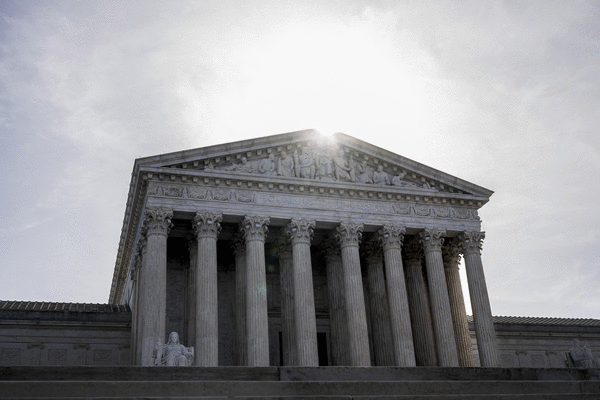
The U.S. Supreme Court will hear arguments next week in two cases that could unravel Maryland’s assault weapons ban, a centerpiece of the state’s gun control laws for more than a decade.
On Dec. 2, the justices will consider whether Cook County, Illinois, and Connecticut can ban certain semiautomatic rifles, including AR-15s, without violating the Second Amendment.
“If Illinois’ law is struck down, I would not bet very much on Maryland’s law surviving,” said Mark Graber, a professor at the University of Maryland Francis King Carey School of Law.
The arguments come little more than two weeks after the Supreme Court declined to hear a challenge to Maryland’s restrictions on carrying firearms in public, leaving most of those restrictions intact.
When the Supreme Court declined to hear a challenge to Maryland’s ban in June 2025, Justices Clarence Thomas, Samuel Alito and Neil Gorsuch indicated they would have taken the case. Justice Brett Kavanaugh separately questioned a lower court’s decision upholding Maryland’s law and predicted the Supreme Court would address the issue within the next two terms.
Kavanaugh specifically identified the Cook County and Connecticut cases now before the court.
In July, a federal appeals court ruled that New Jersey’s restrictions on semiautomatic rifles such as the AR-15 violated the Second Amendment, putting it at odds with the federal appeals court that upheld Maryland’s ban. New Jersey’s restrictions remain in effect while the state seeks Supreme Court review.
Maryland Attorney General Anthony Brown is among 19 attorneys general urging the Supreme Court to uphold the Cook County and Connecticut bans. In a brief filed in October, they argued that such restrictions are consistent with the nation’s history of regulating firearms.
The U.S. Department of Justice has sided with the challengers and will participate in next week’s arguments. The challengers argue that the Second Amendment protects firearms commonly owned by Americans for lawful purposes.
Brown’s office declined to comment on the case and how it could affect Maryland.
What’s at stake in Maryland
Maryland enacted its assault weapons ban as part of the Firearm Safety Act of 2013, months after the shooting at Sandy Hook Elementary School in Connecticut killed 20 children and six adults. The law prohibits the possession, sale, transfer and purchase of certain firearms, with exceptions for some people who acquired them before the ban took effect.
The Supreme Court has declined to review challenges to Maryland’s ban three times — in 2017, 2024 and 2025. None of those decisions amounted to a ruling on the constitutionality of Maryland’s law.
In August 2024, the 4th U.S. Circuit Court of Appeals upheld Maryland’s ban, finding that the state could restrict certain particularly dangerous weapons without violating the Second Amendment.
Kathleen Hoke, another professor at the Carey School of Law, said Maryland would have to bring its law into compliance with any ruling finding Cook County’s ban unconstitutional.
But how the Maryland law would need to be adjusted remains unclear, Graber said.
“There are a dozen reasons why [the Supreme Court] could say that, in fact, this is problematic,” he said about the Illinois law. “And until you know what the reasons are, you can’t make any predictions about how Maryland will in fact react. Or how Maryland should react.”
A ruling against Cook County or Connecticut would not, by itself, strike Maryland’s law from the books.
An uncertain path in the Supreme Court
On Monday, the Supreme Court granted lead petitioner Cutberto Viramontes’ request to withdraw from the case. Cook County has argued that the remaining petitioners lack the legal standing necessary for the case to proceed.
Even if the court dismisses the Cook County case, it could still rule on Connecticut’s ban.
Guha Krishnamurthi, another professor at the law school, said uncertainty stems in part from how the justices compare modern restrictions with historical laws.
Central to the legal fight is a landmark 2022 Supreme Court ruling that requires governments defending firearm restrictions to demonstrate that their laws are consistent with the nation’s historical tradition of regulating firearms.
“You can have a law that looks exactly the same as a prior law and a majority of the court will say, ‘Yeah, that’s not sufficiently analogous,'” Krishnamurthi said. “So we’re really stuck in limbo. And hopefully the oral argument will give us some clarity.”
Eleven states and the District of Columbia have enacted assault weapons bans, according to Everytown for Gun Safety, a gun control advocacy group.
Janet Carter, managing director of Second Amendment litigation at Everytown, said the nation’s 10 highest-casualty mass shootings from 2016 to 2025 involved both assault weapons and large-capacity magazines.
“Our nation’s history shows that governments have always had the power to prohibit especially dangerous weapons,” she said in a statement.
Mark Pennak, president of the gun rights advocacy group Maryland Shall Issue, said AR-15s are commonly used for self-defense. He said his organization believes criminals should be punished for their actions rather than restricting the rights of law-abiding gun owners.
“And that is the philosophy that Maryland has rejected, and the philosophy which I think the court will address,” he said.
Pennak said he expects the Supreme Court to overturn the lower courts’ decisions and find the bans unconstitutional.
The future of Maryland’s gun laws
Next week’s arguments could also offer clues about the future of Maryland’s other gun restrictions. Krishnamurthi said this includes “sensitive place” laws, which restrict gun possession in areas like schools and state parks.
Last week, the Supreme Court declined to hear a challenge to Maryland’s sensitive place law. Although Thomas agreed with the Nov. 16 decision not to hear Maryland’s case, he questioned the constitutionality of many of the state’s restrictions on carrying firearms in public.
“I harbor serious doubts that our Nation’s historical tradition of firearm regulation supports many of these sweeping restrictions,” Thomas wrote in a separate statement accompanying the court’s decision.
Krishnamurthi said the court’s decision on the ban of semi-automatic rifles is “obviously” going to be important.
“But there’s also a lot of methodological questions on how you can proceed with gun regulation, or if you can at all,” he said.
©2026 Baltimore Sun. Visit baltimoresun.com. Distributed by Tribune Content Agency, LLC.










































Comments