Haiti's former first lady who said she left over safety is back seeking presidency
Published in Political News
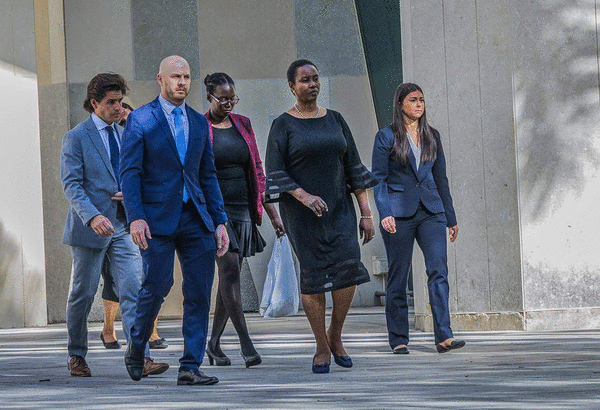
The widow of slain Haitian President Jovenel Moise returned to Haiti from Miami on Wednesday to formally register as a presidential candidate in the country’s long-overdue general elections, a bid that could face significant hurdles.
Wearing a baseball cap and a green T-shirt, Martine Moise stepped off the American Airlines flight from Miami at the international airport in Cap-Haitien around midday. She was greeted by a small crowd on the tarmac as she bypassed the diplomatic lounge.
Moïse, who has never held elected office and told a jury during a U.S. federal trial stemming from her husband’s July 7, 2021, assassination that she never discussed politics with him, is one of three women in a field of 33 presidential hopefuls. She was the last to register online before the deadline at midnight on Nov. 15.
The first round of the elections, originally scheduled for Dec. 13, has been pushed back to July 18, 2027, with a second round for Oct. 4.
The other two women seeking the presidency are Dominique Dupuy, a one time permanent representative to UNESCO, who briefly served as foreign minister in 2024, and Savary Marie-Anne Savannah Hadid, a businesswoman and philanthropist.
The field of 30 men include two former presidents; a former foreign minister who briefly served as Moise’s interim prime minister; a prominent public prosecutor accused of carrying out summary executions; several members of Haiti’s private sector; the recently dismissed director of the government’s anti-corruption unit, and a two-time presidential candidate whose allegations of electoral fraud helped precipitate a political crisis.
Haiti last held a presidential election on Nov. 20, 2016, and has postponed the current vote multiple times amid a worsening gang-violence crisis and slow voter registration. As of Wednesday, the country had finally crossed the million mark in voter registrations, with 1,035,639 people registered out of an estimated 6.5 million eligible voters. But 117 voting sites still had not been activated because of ongoing gang violence.
“The Haitian people have endured appalling violence, the erosion of state authority & years without national elections,” United Nations Secretary-General António Guterres said on Monday in a post on X. “Haiti needs a Haitian-owned political process that restores democratic institutions through elections, rebuilds the authority of the state, and offers young people hope beyond the grip of gangs.”
Monday deadline
Under rules established by the Provisional Electoral Council, presidential hopefuls, along with the 535 people seeking seats in the Senate and 1,855 vying for seats in the Lower Chamber of Deputies, have until Monday, Nov. 30, to submit the supporting documents required for their candidacies to be considered. The council is expected to publish a preliminary list of approved candidates on Dec. 15, followed by a final list on Jan. 11.
Whether Moise will make the final cut remains unclear. Haiti’s electoral law requires, among other things, that presidential candidates have resided in the country during the past five years. They also must provide a document from the judicial police certifying they are not the subject of a criminal investigation.
A key prosecution witness in the U.S. Justice Department sprawling federal conspiracy case in her husband’s assassination, Moise has been living in South Florida since the attack that left her husband dead and her severely wounded. In March, during the first trial, which ended with the convictions of four South Florida men, she testified she had fled Haiti after 42 years because “I did not feel safe.”
She again invoked safety concerns under cross-examination when she was questioned about her indictment in Haiti in connection with her husband’s killing. Moise had refused to answer a Haitian investigative judge’s summons to provide testimony in the case. The judge later raised questions about discrepancies in her public accounts of the attack, including her assertion that she had hidden underneath their bed. During her testimony in Miami federal court, she backed away from that account.
“The bed was very low, even though Joe told me to try to go,” she testified.
Last week, federal prosecutors secured their fifth trial conviction in the case after a Miami jury found Christian Emmanuel Sanon, a South Florida pastor, guilty on eight counts. The charges included conspiring to kidnap or kill a person outside the United States, organizing a military expedition against a friendly nation in violation of the U.S. Neutrality Act and proving material support. Prosecutors accused Sanon of helping to recruit and equip the squad of 22 Colombian former soldiers implicated in the assassination.
Among the government’s witnesses was Frederick Bergmann Jr., a Tampa businessman and longtime friend of Sanon who is serving nine years after admitting to illegally shipping 20 bulletproof vests to Haiti from Miami for the Colombians.
_____
©2026 Miami Herald. Visit miamiherald.com. Distributed by Tribune Content Agency, LLC.



























Comments