Xi, Putin assail trade barriers ahead of summit with Trump
Published in Political News
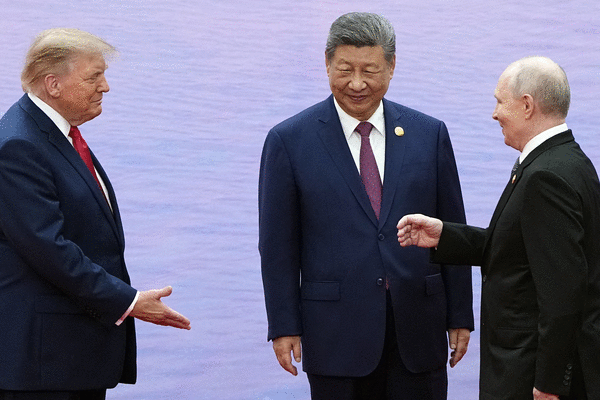
Xi Jinping warned against economic barriers and urged closer cooperation among Asia-Pacific nations ahead of talks with Donald Trump, as new U.S. restrictions on China’s access to advanced AI chips strain a fragile trade truce.
It was a message reinforced by Russian President Vladimir Putin, who used a speech at the Asia-Pacific Economic Cooperation meetings to accuse formerly dominant powers of trying to hold back rising competitors, arguing that sanctions, tariffs and export restrictions couldn’t halt their development.
Xi, Putin and Trump are set to meet Thursday for unprecedented talks in Shenzhen, China. Despite the aggressive messaging at the APEC gathering, Xi later went in person to welcome Trump at the airport, while Putin shook hands with the U.S. president during a family photo with a host of leaders.
Xi’s airport greeting reciprocated a gesture Trump made to welcome him upon his landing in the U.S. for a visit in September, even as tensions remain high: Just hours before, Beijing threatened retaliation over new U.S. rules aimed at curbing Chinese companies’ access to AI chips through overseas data centers and third countries.
The Trump-Putin handshake marked the duo’s first in-person interaction since their bilateral summit in Alaska last year. The Shenzhen gathering offers Putin a prominent international stage as he seeks to counter efforts to isolate Russia over its war in Ukraine.
In an address to business leaders on Wednesday, Putin singled out the European Union for criticism, arguing that its decision to turn away from Russian energy had undermined its industrial competitiveness.
‘Old friend’
In his speech at the CEO summit, Xi said, “Global growth lacks momentum, and unilateralism and protectionism are rampant.” He called for closer technology partnerships and efforts to keep global supply chains stable and open.
At their bilateral meeting, Putin pledged to work “back to back” with Xi for the benefit of their countries. The Chinese leader said their relationship had “remained steadfast through storms” and brought greater stability and certainty to a turbulent world. Xi called Putin his “old friend” and remarked that this was the 50th time they have met, in person or via video calls, since 2013.
The two leaders also called for a more multipolar world. Xi urged China and Russia to lead that effort, while Putin backed expanding cooperation in trade, energy and education, according to a Chinese readout of their meeting.
In his summit address, Xi urged economies to deepen cooperation on AI and the digital economy, casting technological advances as a shared source of growth. He described China as “a super-sized innovation testing ground, where frontier technologies are tested, improved, and upgraded in real-world scenarios.”
“That message is likely to resonate with many countries in the Global South and reinforces Beijing’s effort to contrast its technology strategy with that of Washington,” George Chen, a partner and chair of digital practice at the Asia Group, said of Xi’s portrayal of China as a more open technology partner.
The Chinese leader also pledged to cut tariffs, expand market access and reform rules and regulations to make China a more stable and predictable place to invest and do business. The overtures to global companies come as Beijing seeks to shore up growth at home while countering U.S. efforts to curb its technological ambitions.
The world’s second-biggest economy is flashing numerous warning signs. Official figures released on Monday showed a slowdown across the board, underscoring the sluggish domestic demand that’s prompted complaints from China’s major trading partners.
‘Will not waver’
“China has stood up to unilateralism and protectionism and remained committed to true multilateralism,” Xi said, adding that “no matter how the international landscape changes, China will not waver in its pursuit of win-win cooperation with all other countries.”
The speeches set the stage for a week of diplomacy and dealmaking as the APEC event gets underway. Xi has wrapped up several bilateral meetings, including talks with Canadian Prime Minister Mark Carney during which both countries agreed to further tariff relief on agricultural and steel exports.
Xi also met South Korean President Lee Jae Myung, who sought China’s support to build peace on the Korean Peninsula as the two leaders held their third meeting in just over a year. Lee said peace and stability were essential to their strategic partnership, while Xi pledged to strengthen communication and coordination.
In addition to Xi, the leaders of 11 other APEC economies — including Australia, Chile, Indonesia, Malaysia, Mexico and Vietnam — are also attending the CEO Summit that runs Nov. 17-18, state media Xinhua News Agency reported.
_____
(With assistance from Colum Murphy, Fran Wang and Ilya Arkhipov.)
©2026 Bloomberg L.P. Visit bloomberg.com. Distributed by Tribune Content Agency, LLC.













































Comments