Lawmakers advance aviation safety legislation, amid FAA funding debacle
Published in Political News
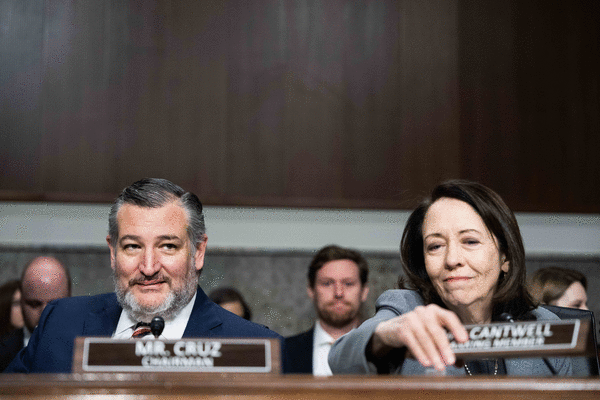
WASHINGTON — Days after a nationwide ground stop brought scrutiny to the Federal Aviation Administration's antiquated air traffic control system, long-stalled aviation safety legislation inched closer to becoming law.
Sens. Maria Cantwell, D-Wash., and Ted Cruz, R-Texas, on Tuesday said key lawmakers struck an agreement to mandate surveillance technology meant to help aircraft spot one another in the air, nearly resolving a dispute that has delayed safety reform for months. Negotiations between the Senate and the House over two bills have been unfolding since a deadly midair collision between an Army helicopter and American Airlines plane in January 2025 that killed 67 people.
The announcement came as a group of families who lost loved ones in the crash gathered on the Capitol Hill lawn Tuesday to demand progress on the effort.
“With this agreement in principle, I believe we’re going to get this bill done,” Cruz said during the news conference. “My objective is to get it done this year, this Congress.”
Cantwell underscored that some debate remains underway. “While we have a deal in principle in civil provisions, we do not have a deal on the military provisions,” Cantwell said. “We have to have strong military accountability in the national airspace. The military must be a willing partner with the Department of the Transportation and the FAA to make sure what happened that January never, ever happens again.”
Federal lawmakers from Washington state have led the pursuit for national reforms, championing substantially different bills in the Senate and the House to implement safety recommendations laid out by the National Transportation Safety Board in response to the collision — efforts that must be reconciled before any legislation is signed into law.
Rep. Rick Larsen, D-Everett, led the effort to pass the Airspace Location and Enhanced Risk Transparency, or ALERT, Act, alongside Rep. Adam Smith, of Bellevue, and Republican Reps. Sam Graves, of Missouri, and Mike Rogers, of Alabama. The ALERT Act passed the House in April.
Meanwhile, Cantwell and Cruz had introduced the competing Rotorcraft Operations Transparency and Oversight Reform, or ROTOR, Act.
The two bills initially differed on requirements for technology known as Automatic Dependent Surveillance Broadcast, or ADS-B.
ADS-B Out, which broadcasts information about an aircraft’s location, altitude and other data to nearby aircraft and air traffic controllers, is already required for most aircraft in busy airspace. ADS-B In, the system that allows aircraft to receive data from other nearby aircraft, is not mandated.
Cantwell and Cruz said Tuesday that key lawmakers reached a tentative agreement to mandate ADS-B In on all flights, striking a partial agreement between the Senate and House bills.
Larsen said he expected lawmakers to finalize a deal this year to sign the aviation safety bill into law. There weren’t major sticking points left, he said in an interview with The Seattle Times Tuesday, and the few differences remaining needed just a little more time.
The deal’s details weren’t immediately clear, and the lawmakers did not yet have bill text. But the breakthrough significantly increases the odds that the aviation safety legislation may be finalized within the final months of this Congress.
After the ground stop
The gathering of victims’ families and lawmakers was planned before the nearly five hour nationwide ground stop last week, and the funding disputes that have since arisen loomed over the conversations.
Transportation Secretary Sean Duffy on Tuesday continued to push for more funding to modernize the FAA’s air traffic control system, meeting with Senate Majority Leader John Thune and other Republicans and formally requesting congressional appropriators for $50 billion “to deliver a truly world-class air traffic control network.”
Since the ground stop on Friday, Duffy has repeatedly said that Congress needs to allocate more funding for modernization projects, upping his recent budget request from $30 billion to $50 billion. But those funding requests have drawn scrutiny from Democratic lawmakers, who question whether the FAA and Transportation Department have spent the $12.5 billion already allocated to modernization efforts last year in President Donald Trump’s One Big Beautiful Bill.
Before his meeting with Thune on Tuesday, Duffy told reporters that the administration’s sweeping request attempts to rectify “a historic underinvestment in aviation.”
“When the numbers come in, and I put everything to the Senate and the House, they have to make a decision, what do they want to do? Everything, or do they want to give me some piecemeal?” Duffy said.
Larsen, ranking member of the House Transportation and Infrastructure Committee, and Rep. André Carson, D-Ind., ranking member of the subcommittee on aviation, said in a letter Saturday they will seek more information from the FAA on its funding request and how previous funds earmarked for upgrades to the air traffic control system have been spent.
On Tuesday, Larsen said he was concerned that the grand total for FAA's funding request had changed. Earlier this year, the ask was for $19 billion, Larsen said. Then $30 billion. Then $50 billion.
"The higher they go, the less likely this Congress is going to support that number because that number is changing so quickly," Larsen told The Seattle Times. "Trying to provide oversight and ensure they're held accountable for the money they are spending right now ought to be our primary oversight activity ... as opposed to giving them more."
Some Republicans, however, have backed Duffy’s pursuit for more funding.
Rep. Michael Baumgartner, R-Spokane, said in an interview with The Seattle Times Tuesday that he hopes to allocate more funds to FAA modernization efforts this session.
“We should find the $50 billion and get it fixed,” Baumgartner said. “We have a lot of pressing spending concerns, we have to be responsible with taxpayer dollars. (But) you can’t have an American economy function if you don’t have predictable air travel. This is a tier 1 spending requirement and obligation.”
He said the $50 billion was a “top line number” and expects more specific itemization before Congress would approve such a check.
Cantwell, Cruz and the Senate’s Committee on Commerce, Science and Transportation, sent a letter Monday to Duffy and FAA Administrator Bryan Bedford demanding a “complete account of what happened and how additional funding would address the vulnerabilities presented on Nov. 13.”
The committee also requested a pause on rolling out the updated routers that led to last week’s ground stop. The FAA called for the ground stop after maintenance work by defense contract L3Harris to replace aging copper wire to fiber optic cables at a remote FAA location in Arkansas overloaded two routers, disrupting communication between air traffic control and aircraft.
“Modernization cannot come at the expense of operational safety,” the letter read.
The FAA said Tuesday it already had paused installation of the routers. After identifying the issue on Friday, the FAA disabled the two routers that were overloading the system with data, one in Arkansas and one in Texas. It then disabled other similar routers; about 60 had already been installed. And paused work on upgrading the rest of the network, according to the FAA.
Duffy said Tuesday that investigators were able to “re-create what happened” on Friday but have not yet determined a root cause for the data overload. It's still unclear if the router was installed incorrectly or if there was an issue with the equipment.
_____
© 2026 The Seattle Times. Visit www.seattletimes.com. Distributed by Tribune Content Agency, LLC.















































Comments