Election officials brace for federal interference but expect to persevere
Published in Political News
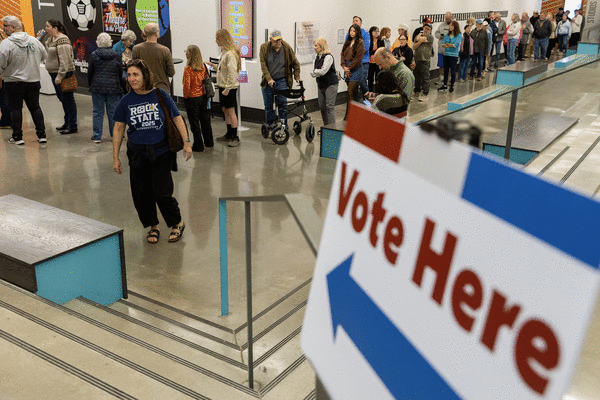
As concerns rise about the potential for federal influence over the results of next week's midterm elections, many voting experts and advocates remain confident that the nation's highly localized systems of administering and counting votes will persevere.
Facing sinking approval ratings over high prices, the White House has amped up attacks on state-administered elections: In recent weeks, the federal government sued Alaska and California to intervene in their elections and demanded election officials in Washington state pull aside ballots of 400 alleged noncitizens — laying the groundwork for a high-stakes showdown at the U.S. Supreme Court.
For months, state officials have been planning for federally induced electoral chaos in the form of federal law enforcement or immigration agents at polls, election investigations or attempts to overturn unfavorable results.
But the nation's vast network of state and local election offices is resilient by design, said Mai Ratakonda, program director of election protection at States United Democracy Center, a nonpartisan nonprofit dedicated to fair elections. Election officials are prepared for close races, recounts and potential interference, she said. And she noted courts have largely blocked President Donald Trump's efforts to intervene.
"There's no one person or agency or office that controls our elections as a whole," she said. "Instead, it's thousands of nonpartisan election officials across the country that are administering these elections ... Even if there are attempts by certain individuals to try to interfere with the election process, there are a lot of safeguards in place, and this isn't the first time that state and local officials will have to deal with those kinds of issues, unfortunately."
At stake is not only whether Republicans will maintain their grip on Congress, but also control of state governments across the country, which could provide a new check on Trump's power.
Trump, who still has refused to acknowledge his 2020 election defeat, has sought to cast doubt and seize control of elections for years. His administration has aimed to nationalize elections, purge voter rolls, restrict mail-in voting and raise alarms without evidence about an epidemic of noncitizen voting.
Since the chaos and insurrection that followed the 2020 presidential election, experts and advocates have worked to boost confidence in state and local election administrators, who operate a patchwork of highly decentralized — and scrutinized — voting systems. In recent weeks, Republicans and Democrats have pledged to operate fair and free elections regardless of how national politicians react.
"We all took an oath to uphold the Constitution of the United States and the Constitution and laws of the state we live in, and we take that oath very seriously," Mary Hall, the auditor of Thurston County, Washington, told reporters during a briefing with other election administrators Wednesday. "And I would not break that oath for anyone."
Hall, a Democrat, noted her Olympia-area district is home to a portion of one closely contested congressional district that could determine control of Congress. The Republican Party has invested deeply in that race as it looks to hold onto power in D.C.
"I don't feel any pressure from them," Hall said, "and if they want to try and insert pressure, I really don't think I would respond to it in any way because we have a job to do."
'We can handle the pressure'
New Hampshire Secretary of State David Scanlan, a Republican, said the federal government's actions have proven to be more of a distraction than an outright obstacle. He's not expecting any major problems and said he's ready to resist any outside pressure as the state is home to tightly contested races for both the U.S. Senate and U.S. House.
"I am confident that the results that are going to come out of New Hampshire are going to be accurate," he said. "And those are the results I'm going to stand by."
Scanlan noted the Granite State is accustomed to heightened electoral attention because of its first-in-the-nation presidential primaries.
"So, we can handle scrutiny, we can handle the pressure," he said, "And I think New Hampshire is going to do what it does best, and just have a good, solid election that the voters here can have confidence in."
Concerns are so serious that a group of U.S. national security officials has been discreetly advising state governments and congressional lawmakers how to prepare for potential interference from Trump, The Washington Post reported. That group includes about 10 current and former officials with experience in the Defense Department.
But voters shouldn't be dissuaded by the federal government's rhetoric, said former Pennsylvania Secretary of State Kathy Boockvar. A Democrat who now consults on election security and administration issues, she said every state has laws designed to ensure safe and secure elections.
Boockvar expects that the federal government will attempt to sway unfavorable election results. But she doesn't think those efforts will work.
"Election officials at every level are all about the rule of law," she said. "They know the law in their jurisdictions. They know the processes in their jurisdictions, and they have to follow them."
She said election administrators come to work every day with a singular purpose: to ensure every eligible voter can cast their ballot. Even if certain officials wanted to change results, she said systems are designed with strict protections that don't have "a lot of wiggle room." And the courts would likely block any baseless efforts — as they did repeatedly during Trump's 2020 election denial campaign.
"I think the institutions will hold," she said.
In 2020, Georgia Republican Secretary of State Brad Raffensperger resisted pressure from Trump to alter the outcome of the presidential election there.
This week, Raffensperger pledged that Georgia's election process would prove open and transparent. The U.S. Department of Justice plans to send election monitors to six Georgia counties, all of which are considered Democratic strongholds. But Raffensperger said poll watchers from both parties and the nonpartisan Carter Center will be monitoring elections alongside federal officials.
"It's a transparent process, and we're not concerned at all," he told reporters on Monday.
Deep preparation
Like many local government workers, employees at Arizona's Pinal County participated in tabletop exercises this year to see how they would react to all manner of Election Day chaos. Called "Ballotship," the gamified exercise considered everything from power outages to disruptive protestors.
This year's preparations included the potential for federal involvement, said Dana Lewis, the Republican county recorder.
"We know that there comes a certain amount of chaos, confusion, but that's probably why we're all heavily caffeinated, and we're good at it," she said, "because we've gone through several of them, and we work through it."
Since 2020, Lewis said, election skepticism has increased in her central Arizona community. And the office has seen big turnover among election administrators and poll workers. But she's worked to open up the voting process, showing how elections operate and underscoring the fundamental commitment to getting the results right — no matter the outcome or outside pressure.
"It's an interesting time that we're in, but no matter what, there is something to be said about putting your hands on a Bible and taking an oath to uphold the Constitution that I very much take seriously," she said. "And my job in this role is to follow the law, and I will continue to do that and I will do it transparently. My staff also understands that, and in no which way, shape or form will that kind of tomfoolery happen here."
The deep preparation for all manner of election complications in jurisdictions such as Pinal County have helped build more resilient systems that are able to respond quickly to a slew of Election Day hiccups, said Alex Gulotta, Arizona state director for All Voting is Local, a nonpartisan organization working to protect voting access at the local level.
But like other states, Arizona is home to politicians and election officials who still refuse to accept the results of the 2020 presidential election.
Among the most prominent is Justin Heap, the Republican recorder of Maricopa County, the state's most populous county and home to Phoenix. All Voting is Local put Heap on its list of the nation's "Top 10 Most Dangerous Election Deniers" because of his insistence that "inconsistencies and illegalities" occurred in previous Arizona elections.
Heap's office did not respond to a Stateline request for comment.
But Gulotta said even a powerful and controversial figure such as Heap does not have the ability to alter election outcomes because of Arizona's bifurcated system. Arizona law divides election duties between county boards and recorders.
"Not everyone understands all the mechanics of how this system works and the level of checks and balances that are built into it," he said.
He does worry that close congressional races could lead the federal government to pressure certain counties not to certify election results.
"To me that's the biggest risk," he said, "and the biggest antidote to that is overwhelming turnout that reduces the likelihood that we have races that are that close."
_____
_____
©2026 States Newsroom. Visit at stateline.org. Distributed by Tribune Content Agency, LLC.












































Comments