Supreme Court asked to allow mail ballot curbs for midterms
Published in Political News
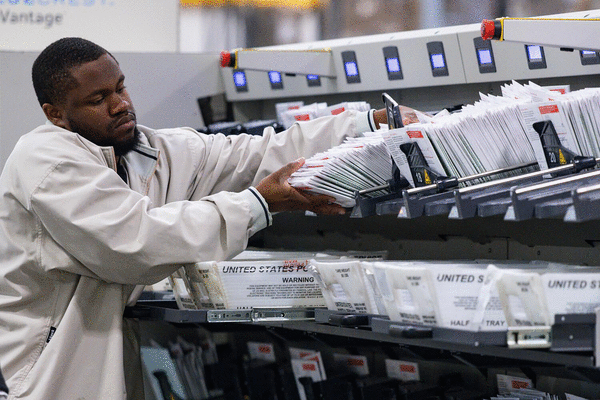
WASHINGTON — The Trump administration asked the U.S. Supreme Court to let the Postal Service enforce new rules for mail-in ballots ahead of the November midterm elections, a move that some states have warned would wreak havoc as they prepare to send ballots to voters in the coming days.
The Justice Department filed an emergency request on Thursday to lift a Boston federal judge’s order blocking the Postal Service from mandating changes to how it handles election mail for the midterms, when Republicans will defend their slim majority in Congress. The move pulls the justices back into the high-stakes election fight as early voting gets underway.
Election officials in North Carolina are preparing to start sending the first absentee ballots to voters on Friday. More states are expected to mail ballots in the next two weeks. Democratic officials who sued have said that it’s too late for many jurisdictions to comply with a new process as they work to follow state-mandated schedules for mail-in voting before the Nov. 3 election.
Shortly after the government filed its request, the Supreme Court announced a deadline of Sept. 8 for the Democratic state officials and voter advocacy groups that sued to file a response. The Justice Department also asked the justices for an immediate “administrative stay” lifting the block as they decide whether to let the Postal Service enforce the new rules while the legal fight goes forward.
U.S. Solicitor General D. John Sauer, the administration’s top Supreme Court lawyer, urged the justices to quickly intervene because “once those ballot envelopes enter the mailstream, there is no retrieving them.”
‘Sowing confusion’
Although the Boston judge’s temporary block “allows the Postal Service and the states to continue taking steps to ensure that their envelopes satisfy the rule’s requirements, the order risks sowing confusion and chaos because it makes those preparatory steps voluntary, rather than mandatory,” Sauer wrote.
Spokespeople for the Democratic states and voter rights groups did not immediately respond to requests for comment.
The administration’s opponents have accused Trump and U.S. officials of racing to implement the Postal Service’s new rules to aid Republicans in the congressional midterms and sow doubts among voters about the reliability of the results. The administration says it’s trying to prevent fraud, though studies have shown an extremely low incidence of illegal voting in U.S. elections.
The Supreme Court sided with the administration during an earlier phase of the legal fight in August, lifting a prior injunction that barred the Postal Service and other federal agencies from implementing President Donald Trump’s March executive order calling for more federal control and oversight of mail-in voting.
The high court’s conservative majority held at the time that a case brought by Democratic state officials was premature because agencies hadn’t taken concrete steps yet. The justices made clear at the time that they weren’t ruling on the merits of whether future agency actions to carry out Trump’s directives would be lawful.
The court fights resumed after the Postal Service announced in late August that it had finalized a new rule that would require states to comply with revised ballot envelope designs and to submit voter information to a centralized “portal” if they wanted the agency to deliver their election mail.
On Aug. 27, U.S. District Judge Indira Talwani in Boston entered a 14-day restraining order prohibiting the Postal Service from making the changes mandatory while she weighed whether to extend that block through November. She hadn’t ruled on that longer-term injunction when the Justice Department went to the Supreme Court, with government lawyers arguing that they needed immediate certainty.
Talwani heard arguments on whether to extend her earlier block on Thursday morning. A Justice Department lawyer told her at the time that they were prepared to go to the Supreme Court if she didn’t act soon. Talwani said she would rule “as quickly as I can.”
Talwani previously held that the Democratic state officials and voting rights advocacy organizations that sued are likely to win their claims that the Postal Service is unconstitutionally asserting federal power over elections that belongs to states.
The case is U.S. Postal Service v. California, 26A297, U.S. Supreme Court.
_____
(With assistance from Brian Dowling and Steve Stroth.)
©2026 Bloomberg L.P. Visit bloomberg.com. Distributed by Tribune Content Agency, LLC.
















































Comments