Fight over Trump's mail ballot curbs runs into midterm deadlines
Published in Political News
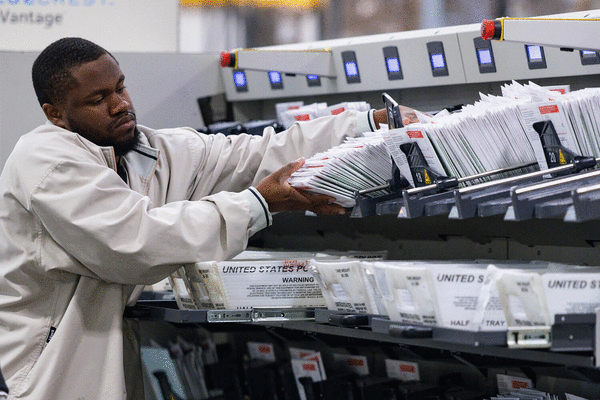
WASHINGTON — Less than 24 hours before a key deadline for mail-in voting in the U.S. midterm elections, states are bracing for late-breaking developments in a legal battle over federal control of the process, including possible intervention from the Supreme Court.
A judge in Boston is weighing Thursday whether to extend a short-term order preventing the U.S. Postal Service from enforcing new restrictions on election mail called for by President Donald Trump. The Justice Department has vowed to ask the Supreme Court to immediately intervene if the judge doesn’t lift the block soon.
The legal drama is playing out with officials in North Carolina planning to begin sending out their ballots on Friday, a milestone widely seen as launching the voting period nationwide. More than a dozen states are set to follow North Carolina’s move in the coming weeks.
While the Constitution gives states control over how elections are managed, the new Trump administration rules require states to comply with revised ballot envelope designs and submit the names of voters set to receive election mail to a new federal portal. The Postal Service would refuse to deliver ballots to voters if they don’t feature a barcode that matches the information on file.
The administration says it’s trying to prevent fraud, though studies have repeatedly shown an extremely low incidence of illegal voting in U.S. elections. Democratic state officials who sued the federal government warned judges of chaos if a court frees the postal agency to make “massive changes” on the eve of early voting.
“An error at any step threatens to deny ballots to many voters,” they said in a recent court filing. The Justice Department countered that the rules represent “modest requirements” and said the government has a stronger interest in “uniformly implementing beneficial practices for ballot mail.”
While North Carolina is pending, at least 10 states are scheduled to mail out ballots within about two weeks, including Arkansas, Delaware, Kentucky, Minnesota, New York and Wisconsin.
Election workers across the U.S. are bracing for last-minute turmoil, said Kathy Boockvar, a Democrat who served as Pennsylvania’s secretary of state. The timing of the current legal battle is a problem for state officials who spend months preparing for each voting cycle and could ultimately impede the ability of citizens to vote, she said.
“Changing the rules after the game has started is bad for everyone,” Boockvar said. “It’s bad for the officials. It’s bad for the voters. It’s bad for the public. It’s bad for trust.”
Fast-moving Fight
Last-minute changes could have far-reaching consequences for states that rely on mail-in ballots to reach large swaths of eligible voters.
In Alaska, where the U.S. Senate election could help decide control of Congress, much of the population isn’t connected to major cities by road. Alaskan voters can request absentee ballots for any reason by mail.
Michelle Sparck, director of Get Out the Native Vote, a nonpartisan advocacy group, said that even without a “manmade disaster” of new last-minute rules, casting a ballot from remote portions of Alaska in November faces logistical and environmental challenges.
“We have extreme weather and we have perilous flying conditions,” Sparck said. “There are so many complications and so many more question marks in our experience of voting than you would experience on the road system in Alaska.”
Earlier this week, lawyers for an anonymous federal government whistleblower released a letter claiming their client had “direct knowledge of potentially catastrophic problems” with the proposed Postal Service system. Batches of thousands of ballots mailed by states could be rejected in bulk if even a single envelope failed the verification process, the person alleged.
In response, the Postal Service released a statement saying it is reviewing the concerns.
“The United States Postal Service has spent months developing a U.S. Federal Ballot Mail Portal to provide election officials with a simple, secure, and efficient way to share lists of individuals receiving ballots by mail in their respective states,” the agency said. “This work has at all times been conducted in a manner consistent with court orders.”
Trump has repeatedly insisted, without evidence, that U.S. elections are rigged against him and the Republican Party. Over the past year, he’s pressed state lawmakers to redraw congressional boundaries to benefit the GOP and pushed Congress, so far unsuccessfully, to pass a new voter ID law that critics say will prevent eligible voters from casting ballots.
As elections officials across the country await a final decision, a range of court actions could unfold in the coming days. Heading into Thursday’s hearing in Boston before U.S. District Judge Indira Talwani, the Justice Department was pushing an appeals court to undo her 14-day order barring the Postal Service from enforcing the new rules. The appellate judges hadn’t acted yet, prompting the government to tell Talwani it was poised to take the fight to the Supreme Court.
Talwani told the Justice Department on Thursday that she would rule “as quickly as I can” on whether she would extend her block — a decision that could spur another round of appeals.
Ballot Preparations
In North Carolina, elections officials said that ballots are ready to be mailed, but they were waiting on the outcome of the pending court fight.
Mecklenburg County, one of the largest jurisdictions in the state and home to Charlotte, has about 5,000 absentee ballots that have been stuffed into envelopes and awaiting final postage, said elections director Michael Dickerson.
“I think it’s about $1.30 to mail each one, so we don’t want to waste that money,” Dickerson said of the potential for a last-minute change.
The costs don’t end there: If the administration is allowed to enforce the rule, thousands of precincts will be required to order new envelopes and compile voter information to provide the agency. If the courts rule in favor of new changes after ballots are mailed, the process could get more complicated.
Western Carolina University professor Chris Cooper said a disruption to absentee or mail-in ballots could determine the outcome of two close House races in the state in November. But he said he is cautiously optimistic that if ballots go out Friday it will be smooth sailing.
“Once they go out it will be very hard for any court to interfere,” Cooper said.
A spokesperson for the North Carolina State Board of Elections said they are operating under the assumption things will proceed as usual.
“We have no plans to engage with the USPS portal unless directed, explicitly, otherwise,” said Jason Tyson, director of external affairs for the board. “If anything changes, we’ll pivot.”
_____
(With assistance from Brian Dowling.)
©2026 Bloomberg L.P. Visit bloomberg.com. Distributed by Tribune Content Agency, LLC.
















































Comments