6th District candidates Kevin Kiley, Richard Pan debate for first time
Published in Political News
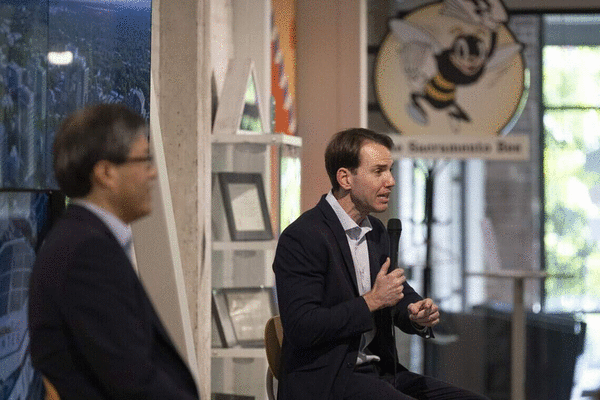
In their first general election debate Monday evening, U.S. Rep. Kevin Kiley, I-Rocklin, and former state Sen. Richard Pan offered competing explanations for the problems facing voters in California’s newly redrawn 6th Congressional District. Kiley pointed to Sacramento, while Pan pointed to Washington.
Their records in office became central ammunition throughout the debate. Kiley attacked Pan over policies he supported during his years in the California Legislature, particularly a 2017 vote to raise the state’s gas tax. Pan repeatedly pointed to Kiley’s congressional voting record, arguing it undercut his newly adopted independent identity and aligned him with President Donald Trump.
The debate, hosted at The Sacramento Bee, was moderated by opinion columnist Tom Philp, political reporter Mathew Miranda and Marcos Bretón, director of community outreach and opinion journalism.
Proposition 50, the redistricting measure voters approved last year, reshaped the 6th Congressional District and dismantled much of the 3rd District, which Kiley currently represents. Kiley’s Rocklin home was placed in the Democratic-leaning 6th, where he opted to seek reelection. He changed his registration from Republican to independent shortly afterward.
“What our area needs, what my hometown needs, is independent representation that works with both parties and opposes policies of both parties when they threaten our quality of life,” Kiley said in his opening remarks.
Pan challenged that claim throughout the debate, continually tying Kiley to Trump — who endorsed Kiley as a “MAGA champion” in 2022. Pan argued that Kiley’s congressional voting record remained overwhelmingly aligned with Republicans. Kiley turned the criticism around, contending that his willingness to work with both parties was a strength. He also said, if elected, Pan would simply “press every button” Democratic leaders wanted him to press.
Kiley pointed to Pan’s time in the Legislature to make his case, singling out his 2017 vote for a transportation package that raised the state gas tax by 12 cents per gallon.
When Kiley asked him whether he regretted the vote, Pan stood by it. Pan argued that the increase paid for necessary road repairs. He contrasted the tax with the roughly $1-per-gallon rise in gas prices since the war with Iran disrupted oil shipments through the Strait of Hormuz.
“There’s a trade-off when you have to pay for something. And yes, you need to pay for improving your infrastructure,” Pan said. “There’s another thing where you get dragged into a war that you don’t have a good plan for and get stuck in a quagmire, and in the meantime, all the prices are up.”
Pan drew a similar distinction in the candidates’ discussion of healthcare, arguing that government spending should be judged by the services it provides.
He criticized H.R. 1, the signature Trump-backed federal law Kiley voted for. Pan argued that its Medicaid changes would save money in part by causing some recipients to lose coverage under new work requirements, even as states spend money to administer those requirements.
Pan also pointed to Kiley’s opposition of congressional efforts to limit Trump’s war powers as evidence of his alignment with the president. Kiley dismissed the war powers resolutions as symbolic.
Kiley made his own attempts to tie Pan to his party’s ideological flank, particularly on immigration and Israel. He accused Pan of opposing immigration enforcement, which Pan denied.
When Kiley pressed him — “You never said abolish ICE?” — Pan repeated that he had never called for abolishing immigration enforcement. He said immigration enforcement was necessary, but must follow the law.
“That doesn’t mean that we don’t enforce immigration laws. In fact, we need a path to citizenship for people here in this country. That’s what I’ve always stood for,” Pan said.
On Israel, Kiley asked Pan whether he believed the country was committing genocide in Gaza. Pan did not adopt that characterization, instead describing it as a “humanitarian crisis” and calling for a two-state solution. Kiley rejected the genocide label, saying he believed the Oct. 7 attack on Israel by Hamas was a “more appropriate use of terminology like that.”
By the end of the debate, both candidates returned to the arguments that had defined much of the evening: Kiley blamed California’s Democratic leadership for making the state more expensive, while Pan blamed Trump and Republicans in Washington for raising costs and cutting services.
Kiley closed the debate by reiterating that he would like additional opportunities to debate Pan.
“I think voters deserve to hear from both candidates several times before we get on the ballots,” he said. “I think that today’s forum has really highlighted some key differences.”
_____
©2026 The Sacramento Bee. Visit sacbee.com. Distributed by Tribune Content Agency, LLC.















































Comments