Growing threat to free speech: Bogus copyright claims making political stories disappear
Published in Political News
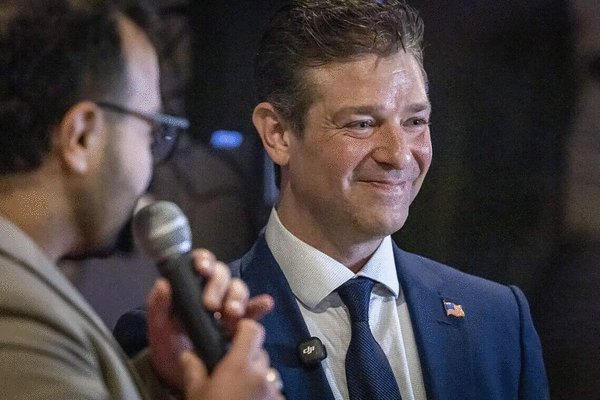
FORT LAUDERDALE, Fla. — In what media experts are calling a threat to free speech, bogus copyright complaints have resulted in the scrubbing of dozens of online stories that mention congressional candidate Michael Carbonara from Google search results weeks ahead of the Tuesday primary election.
The removal of these stories underscores mounting concern that federal copyright law is being used by people relying on automated, AI-driven and anonymous complaints to file fraudulent takedown notices, all in the name of suppressing headline news.
Stories targeted for takedown this election cycle — posted by the South Florida Sun Sentinel, WLRN, Florida Politics and other news outlets — included details on Carbonara, an entrepreneur running in the Republican primary for Florida’s 22nd Congressional District. Some of the stories mentioned his ties to a controversial data center in Michigan.
It is unclear who is behind all the copyright claims. A person filing a complaint can simply make up a name, experts say.
In early August, Carbonara said his campaign had nothing to do with the scrubbed stories, The Miami Herald reported. On Monday, a spokeswoman for Carbonara’s campaign told The South Florida Sun Sentinel he was not commenting on the topic.
The Sun-Sentinel received a notification from Google on July 29 that a report had been filed accusing the newspaper of copyright infringement. The article in question had details on Carbonara and other Republican candidates running in the 22nd Congressional District race. The story, headlined “3 Republican candidates pour $7M of their own cash into their South Florida congressional campaigns,” disappeared from search results.
The Sun Sentinel filed an appeal with Google challenging the copyright infringement claim in an effort to get the news article restored.
The Sun Sentinel then republished the story so it would reappear in Google search results. On Aug. 5, the newspaper got an alert from Google about a second copyright-claim notice.
Both bogus claims asserted that attempts were made to reach the Sun Sentinel to resolve the issue, but that was not the case, said David Schutz, managing editor at the Sun Sentinel.
“Federal copyright law exists for an important reason: to protect original work from being stolen. It was never intended to be weaponized as a loophole to suppress reporting or hide inconvenient truths,” Schutz said.
“Because current federal rules encourage tech platforms to act immediately upon receiving a notice, claims are often processed automatically without basic verification. That creates a system that is far too easy for bad actors to manipulate. That doesn’t just burden newsrooms that invest in original reporting — it directly undermines the public’s access to the news.”
Schutz argued for stronger oversight by Google and other search engines.
“We need platforms like Google and our lawmakers to carefully evaluate how these mechanisms are being abused,” he said. “There has to be stronger oversight so that a law designed to protect creativity isn’t turned into a tool for digital censorship.”
WLRN broke the news about the bogus copyright complaints after its stories on Carbonara were removed from Google search results. WLRN’s coverage included a story about Carbonara’s ties to a Michigan data center being sued by a nearby school.
The fact that legitimate news stories are getting scrubbed has made it difficult for voters to find information about Carbonara this election cycle through a basic Google search, WLRN stated in its reporting.
Sergio Bustos, WLRN’s vice president for news, said the trend is a direct attack on the outlet’s ability to share important information with voters as they hit the polls.
“Our stories and tweets promoting those stories have been targeted and disappeared from search results, and we have watched in shock as other outlets are affected as well,” Bustos told the Sun Sentinel. “We are deeply concerned about this censorship tactic, and even more so by the fact that it seems to have reached some level of success.”
“WLRN condemns the … manipulation of digital copyright laws intended to censor independent journalism and withhold vital information from voters,” Bustos said. “As journalists at WLRN, South Florida’s NPR affiliate, we will continue to push search providers and social media outlets to restore our published work and call for greater oversight of automated copyright removal processes that enable bad-faith censorship.”
Peter Schorsch, publisher of Florida Politics, said it’s disappointing that someone is using subterfuge to black out important reporting about a congressional candidate.
Schorsch said he looks forward to “modernizing election law to keep ahead of bad actors,” and has taken the “case to the Secretary of State’s Office and to Florida lawmakers.”
He added, “Unfortunately, nothing can be done in time for this election.”
A Google spokesman told the Sun Sentinel the search engine giant has robust tools and processes in place to fight fraudulent takedown attempts, including a combination of automated and human review to detect signals of abuse.
Anyone reporting a copyright complaint does so under penalty of perjury, Google warns in its copyright reporting form.
“Please note that you could be liable for damages (including costs and attorneys’ fees) if you falsely claim that content is copyright infringing,” the warning states. “Only the copyright holder or their authorized representative can submit a copyright removal request. Courts in the United States have found that you must consider copyright defenses, limitations or exceptions before submitting a copyright removal request. If you are not sure whether material available online infringes your copyright, we suggest that you first contact an attorney.”
The warning goes on to state: “The information in this notification is accurate and I swear, under penalty of perjury, that I am the copyright owner or am authorized to act on behalf of the owner of an exclusive right that is allegedly infringed.”
Tens of millions of copyright takedown complaints can be found through the Lumen database, an online database maintained by the Berkman Klein Center for Internet & Society at Harvard University. Lumen tracks who sends takedown requests, who receives them, and what online URLs are targeted.
Its database grows by more than 200,000 notices per week — compared to 20,000 per week in 2019.
“The number of these sent daily keeps rising,” said Adam Holland, manager of Partnerships and Products at the Harvard Law School Library. “Several hundred thousand of these are sent to Google alone on a daily basis. Are you going to assign a human being to read and review every one of these?”
In the meantime, fraudulent claims are on the rise, Holland said. In many cases, the person filing the complaint makes up a name.
“When it comes to the space of what’s your name and your company’s name, you can put in whatever you want,” Holland said. “You can pretend you are a rival. You can pretend you are someone random. If you can get something taken down, you’re going to try.”
A news site accused of copyright infringement can deny the claim and ask that the online story be restored.
Under U.S. copyright law, online service providers are required to restore removed content 10 to 14 business days after receiving a valid counter-notice from the content provider — unless the original claimant files a lawsuit.
Political stories are always at risk for takedown, but the risk is even greater at election time.
“An election is very time sensitive,” Holland said. “And you can suppress information for 10 to 14 days before the story can be put back. I can send a notice and it’s taken out of search results. Google probably receives more of these than any company on earth. It’s become so easy to send them.”
A Sun Sentinel review of the Lumen database shows more than 100 news articles that mention Carbonara, or the District 22 race, had been removed over a three-week period.
The takedown requests are made possible under the Digital Millennium Copyright Act, passed by Congress in 1998 in an attempt to update the country’s copyright law for the Internet age.
The law aims to stop digital piracy and give copyright owners an easy way to demand that websites remove stolen content. It also protects online service providers from liability for copyright violations, provided they act quickly to remove copyrighted content.
But experts say the law is being exploited to make bogus copyright infringement claims. Those claims are triggering the censorship of legitimate news stories.
“If you want something down, you just send a whole bunch of these (bogus copyright claims),” Holland said. “The penalties for maliciously sending one are basically nonexistent. Because someone would have to spend a lot of resources going after them.”
Lumen has seen a rise in the number of people claiming copyright infringement in the past year alone — and Holland says AI is behind that trend.
They’ll just ask AI to send a slew of takedown notices to make a story they don’t like disappear from Google search results, Holland said.
“People say, then they should change the law,” he added. “Then the question becomes, what do you want to change it to?”
Changing the law could have unintended consequences, including the end of the internet as we know it, Holland said.
“If a company has to have a human being check everything posted on Instagram because of copyright infringement laws, then we’re not going to let anyone post anything on Instagram,” Holland said.
The U.S. copyright law was perfectly written — for 1998, said Bob Jarvis, a law professor at Nova Southeastern University.
“It’s not that it’s badly written,” Jarvis said. “It’s just a law that’s outdated. It was written at a time when AI did not exist. The problem is that technology outruns the law. The law is always playing catch-up.”
Google accounts for up to 92% of web searches in the U.S.
Google and other websites quickly remove flagged content to avoid liability and maintain their safe harbor immunity under the DMCA, Jarvis said.
If Google gets a complaint about copyrighted material, the easiest thing to do is take it down, Jarvis said. “For Google to do its own investigation every time it gets one of these notices would be incredibly expensive. They’d have to use teams and teams of lawyers to get to the bottom of this. It’s a real problem. And I don’t know what the solution is.”
The advent of AI is only exacerbating the problem, creating a growing wave of censorship that was never foreseen in 1998 when the copyright laws were last revised, Jarvis said.
“I personally think we’re heading toward a very dystopian world,” he said. “AI is being used by lots of bad actors with bad agendas. And nowhere is that more clearly seen than in the political arena.”
_____
©2026 South Florida Sun-Sentinel. Visit sun-sentinel.com. Distributed by Tribune Content Agency, LLC.

















































Comments