Cori Bush got 4,600 fewer votes in Tuesday's primary than two years ago. What happened?
Published in Political News
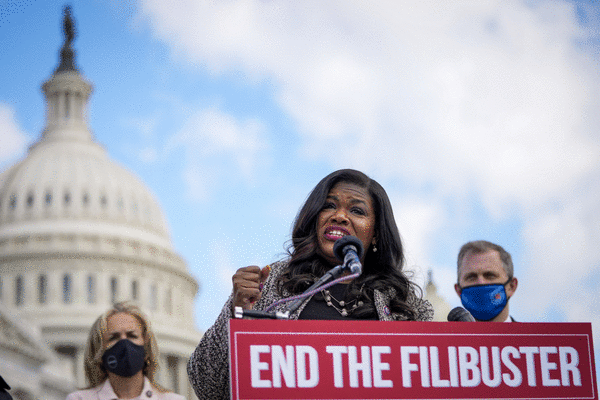
U.S. Rep. Wesley Bell defeated Cori Bush in Tuesday's Democratic primary to continue representing Missouri's 1st Congressional District — the second time in two years he has bested the former two-term congresswoman.
This time he won by a much wider margin. The final, unofficial totals show Bell winning with 59% of the vote, compared to Bush's 37%. In 2024, Bell unseated incumbent Bush by a 5.5% margin.
For all of its contentiousness, the race's conclusion was anti-climatic with the Associated Press calling it in Bell's favor about an hour after the polls closed Tuesday night.
While Bush carried over from last election her main attack on Bell — that he was a "bought and paid for" tool of the pro-Israel lobby — Bell focused on how he had improved on Bush's record of serving her constituents.
"It's not enough to say nice words and get attention," Bell said in his victory speech. "Progressives are supposed to make progress."
On the campaign trail, Bell homed in on several moves Bush made in her last term, including her vote against a $1.2 trillion infrastructure bill championed by the Biden administration. The bill included several big-ticket projects in the 1st District.
That infrastructure vote lost Bush support from a number of industrial, construction and trade unions, support Bell maintained during this race.
Bell also noted repeatedly that Bush missed more than 200 votes in the House and seemed more interested in generating publicity than in serving the district.
Phyllis Troupe, a Bell supporter from north St. Louis County, specifically mentioned Bush's opposition to the infrastructure bill when asked why she supported Bell.
"She failed the people" of the district, Troupe said, adding that Bell "listened to the people. And I like his vision for St. Louis."
Several political experts, including political science professor Anita Manion of the University of Missouri, St. Louis, said before the election that issues about Bush's questionable campaign spending during her House tenure could lose her votes.
For the last several years, Bush was dogged with questions about campaign finances, especially her spending on security personnel, and for paying herself and her husband salaries from her campaign fund.
Missouri Attorney General Catherine Hanaway recently said she was investigating a nonprofit Bush formed last year that solicited tornado-relief funds.
On Wednesday, Manion said her previous point seemed to have played some role in Bell's easy victory.
She said for Americans concerned about basic issues such as affordability, "they don't want scandal and drama; they're just tired of it."
"They just want (politicians) to go to work and do their jobs," she said.
St. Louis Alderman Rasheen Aldridge, a longtime Bush supporter, called the outcome "disappointing" and said he "was a little shocked" by Bell's winning margin.
Aldridge and Manion pointed out that Bell had a substantial advantage in campaign funds.
According to federal campaign finance reports covering the period through June 30, Bell took in $3.3 million, compared to $1.2 million for Bush.
"Money played a role, no doubt," Aldridge said, saying the funding advantage allowed Bell to swamp Bush in advertising spots.
"People believe what they see on TV," he said.
Political scientist Ken Warren, a professor emeritus at St. Louis University, agreed with the argument that Bell's edge in funding was a factor. "Bell had so much more money," he said.
When talking about money, Bush supporters consistently mentioned the American Israel Public Affairs Committee, or AIPAC, a powerful lobby that was tied to more than half of the money Bell took in this campaign.
In a statement Wednesday, AIPAC said, "In Congress and throughout this race, Bush demonized AIPAC's members, attacked Israel and refused to condemn Hamas terrorism — and voters made sure she did not make it back to Congress."
In addition to the money edge, Bell likely benefited from the large turnout generated by two controversial state constitution issues and a heated race for St. Louis County Executive, Manion said.
"We know Cori Bush has an energized core of voters who will always turn out," she said. "But with a wider base (going to the polls), the advantage is with the incumbent."
While about 16,000 more people voted in the District 1 race on Tuesday than two years ago, Bush actually received about 4,600 fewer votes than she did in 2024.
The final totals on Tuesday, Bell garnered 83,663 votes and Bush tallied 52,083, a margin of more than 21,000 votes. Two years ago, Bell's margin of victory was about 7,000 votes.
This time around, Bell carried the city and county portions of the 1st District. In 2024, Bush won the popular vote in the city.
Warren also thought Bell would win because Bush could not sustain the momentum she had two years ago.
"She wore out the enthusiasm (some supporters) had for her," Warren said.
In Bush's fiery concession speech Tuesday night — "People were bamboozled again, deceived by lies," she said — the challenger veered away from the subject of Israel and instead contended that Bell had not taken care of constituent services.
"He was elected and didn't even speak to most of you all. He didn't even show up for you," she told supporters.
As he did during the campaign, Bell told his supporters Tuesday night about the improvements he made in constituent services and getting funding for improvements in the district.
Specifically, he noted that in the wake of the May tornado, he had sponsored four separate bills to improve federal disaster services.
He also pointed to his sponsorship of a bill to improve operations at the Gateway Arch.
On a national scale, Bell said he will continue to oppose the Trump administration. He told his supporters he is "willing to work with anyone who puts working people before politics or party."
Bell will be the favorite to win the Nov. 3 general election, where he will face Republican Paul Berry III, Libertarian Tom Schmitz and independent Xavier Phillips. The heavily Democratic district covers St. Louis city and parts of north, central and west St. Louis County.
(Coby Rinke of the Post-Dispatch contributed to this story.)
© 2026 the St. Louis Post-Dispatch. Visit www.stltoday.com. Distributed by Tribune Content Agency, LLC.

















































Comments