Politics
/ArcaMax
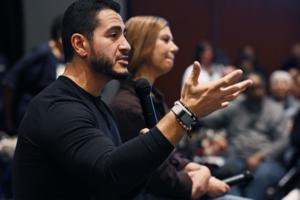
President Trump calls Abdul El-Sayed 'Mohammed,' post labeled racist
LANSING, Mich. — Republican President Donald Trump called Democratic U.S. Senate candidate Abdul El-Sayed "Mohammed El-Sayed" in an Oct. 7 social media post that was quickly denounced as racist by Arab-American leaders in Michigan.
Trump's message on Truth Social came a day before El-Sayed, who is Muslim and a former public health official, ...Read more
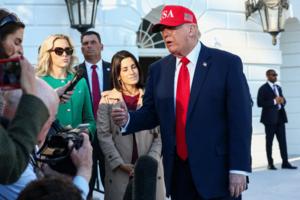
Trump says US won't attack Iran before midterm election
President Donald Trump said the U.S. would not attack Iran ahead of November’s midterm elections, citing what he said were “productive discussions” with the Islamic Republic.
“We will not be attacking Iran at any time prior to the Midterm Elections to be held in the United States on November 3rd,” Trump said in a social media post ...Read more

NFL asks Supreme Court to let states regulate prediction markets
The National Football League urged the U.S. Supreme Court to allow state regulation of prediction markets in a stance putting it at odds with the Trump administration in a high-stakes clash.
In a court filing Thursday, the NFL told the justices that the “laissez-faire” approach federal regulators are taking toward prediction markets could ...Read more

Trump, stadiums, and a presidential run: Takeaways from the Pa. governor's debate
HARRISBURG, Pa. — Gov. Josh Shapiro and state Treasurer Stacy Garrity on Wednesday sparred over President Donald Trump's leadership, soaring gas prices, the state budget deficit, and other top issues facing Pennsylvania in their only scheduled debate before Election Day.
And at one point, the gloves came off.
In the wide-ranging and mostly ...Read more

US probes Harvard, Stanford over scholar exchange visas
The Trump administration is launching investigations into foreign exchange visa holders at nine top colleges including Harvard University, Stanford University and MIT, in its latest broadside against international students and scholars at elite schools.
The sweeping fraud probe is focused specifically on J-1 visa holders, who at universities ...Read more

US suspends visa program for tech firms including Microsoft
The Trump administration said it would suspend an immigration program for multiple tech firms, including Microsoft Corp., alleging widespread abuse of a worker visa system.
“There has been no company in the United States, unfortunately, that has abused this system more than Microsoft,” Vice President JD Vance said Thursday during a briefing...Read more
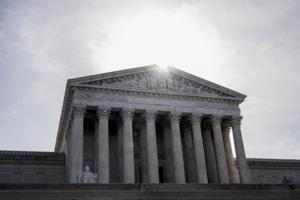
Supreme Court asked to weigh political ad rates
The Trump administration asked the Supreme Court on Thursday to step into a lower court dispute over television advertising rates paid by political candidates and joint fundraising committees weeks before the midterm elections.
The application asked the justices to set aside a 2-1 ruling issued Wednesday by the U.S. Court of Appeals for the 4th...Read more
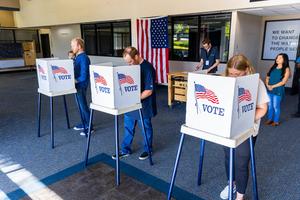
Meet the ‘independent voters’ who will likely decide which party triumphs in the 2026 midterm elections
As midterm elections near, Democrats enjoy advantages in national “generic ballot” polling, suggesting they may secure majorities in the House of Representative or Senate, if not both chambers.
But the reality is that partisan control on Capitol Hill will be determined by just a handful of competitive House and Senate contests. ...Read more
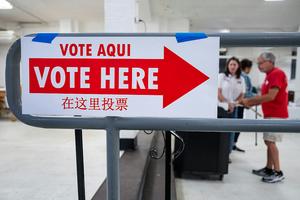
What the law says about armed officers at polling places
After high-level Trump administration officials said they might send armed officers to the polls during the upcoming midterm elections, and after months of administration efforts to wrest control of some aspects of voting from state officials and limit how people vote, there’s a lot of fear that armed federal officials will disrupt voting ...Read more

Why the assault weapons debate is a culture debate
In June 2026, the U.S. Supreme Court agreed to hear appeals of two lower court rulings that challenged assault weapons restrictions. The high court will decide whether the Second and 14th amendments protect the right to possess semi-automatic rifles like the AR-15. This marks a reversal for the court, which for years has declined to consider ...Read more
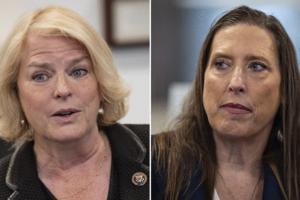
Illinois' 8th District: Melissa Bean seeks comeback vs. newcomer Republican Jennifer Davis
CHICAGO — Former U.S. Rep. Melissa Bean, a centrist Democrat whose 2004 upset helped begin the northwest suburbs’ shift to the left, is seeking a comeback in Illinois’ 8th Congressional District against Republican Jennifer Davis, a tech entrepreneur running for office for the first time.
The two are vying in the Nov. 3 general election to...Read more
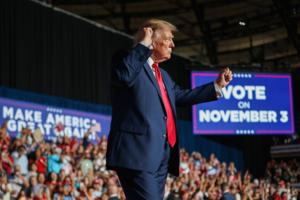
Trump says he won't let Iran strike L.A. or San Diego: 'Not going to let that happen'
President Trump told a crowd in Texas on Wednesday night that he would not allow Iran to attack San Diego or Los Angeles, a comment that came two days after he made off-the-cuff remarks suggesting the West Coast cities could be struck.
"You want to see a horror show? You want to see problems? Let them hit San Diego, let them hit Los Angeles," ...Read more
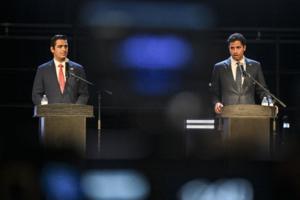
Barbed comments, and sharper rejoinders, dominate debate in Colorado's 8th District
BERTHOUD, Colo. — The candidates vying to represent Colorado’s 8th Congressional District clashed on stage Wednesday night, with U.S. Rep. Gabe Evans calling his opponent the “most radical candidate” while former state lawmaker Manny Rutinel claimed Evans “seeks the approval of one man” — Donald Trump.
The debate, which drew ...Read more
Trump defends border policies in Texas as Senate race heats up
President Donald Trump defended his immigration policies during a visit to Texas on Wednesday as he sought to boost struggling GOP Senate candidate Ken Paxton ahead of November’s midterm elections.
“The only thing standing between you and the migrant conquest, the invasion that you had just two years ago — for four years you suffered — ...Read more
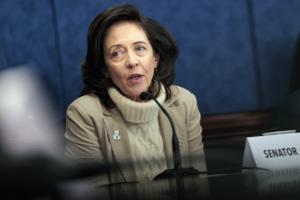
Sen. Maria Cantwell looks to federal testing role in AI safety framework
Senate Commerce Committee ranking member Maria Cantwell, D-Wash., released a framework for artificial intelligence regulation Wednesday that includes a major role for the federal government in setting safety standards and testing models for catastrophic risk.
The six-point framework, which does not include legislative text, stands in contrast ...Read more
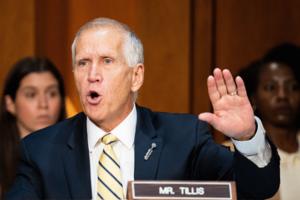
Thom Tillis is joining a new Davidson College initiative after leaving Senate
U.S. Republican Sen. Thom Tillis is set to take on a new role at Davidson College after his time in the Senate.
Tillis will serve as a leader-in-residence with Davidson’s new D.G. and Harriet Wall Martin Institute for Public Good, the college announced Wednesday. Former U.N. Ambassador Susan Rice and Arab American Institute President James ...Read more
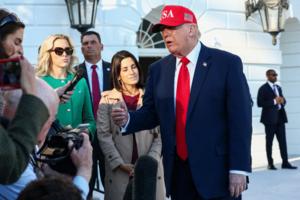
Trump sued by Democratic Party over taxpayer-funded TV ads
The Democratic National Committee filed a lawsuit accusing the Trump administration of unlawfully using government money to pay for advertisements lauding the president that have been airing on cable and broadcast television stations across the U.S. in recent weeks.
The complaint filed Wednesday in federal court in Washington by the Democratic ...Read more
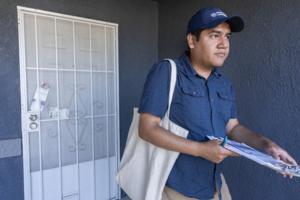
Valadao and Villegas clash in Central Valley debate over gas prices, war in Iran
SACRAMENTO, Calif. — In their first and only debate of the campaign Tuesday night, Rep. David Valadao, R-Hanford, and progressive challenger Randy Villegas laid out sharply different strategies for winning over Central Valley voters.
Villegas repeatedly attacked Valadao’s record, calling it a failure for working families while pushing for a...Read more

Rogers shifts gears, calls for end to Trump's 'tariff war' with Canada
WASHINGTON — Republican U.S. Senate candidate Mike Rogers appears to be breaking with President Donald Trump on another key issue less than a month before Election Day.
"Drinking a Labatt and watching the Red Wings, man, it just doesn't get any more Michigan than that," Rogers said in a new ad released Oct. 7. "Here in Michigan, we know that ...Read more
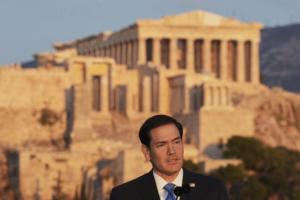
Rubio says US 'unapologetic' about power in warning to Europe
Secretary of State Marco Rubio used a dramatic backdrop in Greece to remind the world of the Trump administration’s focus on the “unapologetic” pursuit of power, and issued another warning to Europe about the dangers of Western decline.
In a speech on a hill in front of the Acropolis in Athens, the top U.S. diplomat invoked Renaissance ...Read more
Popular Stories
- Rogers shifts gears, calls for end to Trump's 'tariff war' with Canada
- Rubio says US 'unapologetic' about power in warning to Europe
- Trump on ensuring 'dividend' dollars spent at home: 'It's not going to be a big problem'
- Barbed comments, and sharper rejoinders, dominate debate in Colorado's 8th District
- Cantwell unveils AI safety framework as Congress stalls ahead of election
Related Channels

ACLU
By The ACLU

Amy Goodman
By Amy Goodman

Armstrong Williams
By Armstrong Williams

Austin Bay
By Austin Bay

Betsy McCaughey
By Betsy McCaughey

Bill Press
By Bill Press

Bonnie Jean Feldkamp
By Bonnie Jean Feldkamp

Cal Thomas
By Cal Thomas

Clarence Page
By Clarence Page

Danny Tyree
By Danny Tyree

David Harsanyi
By David Harsanyi

Dick Polman
By Dick Polman

Erick Erickson
By Erick Erickson

Froma Harrop
By Froma Harrop

Jacob Sullum
By Jacob Sullum

Jamie Stiehm
By Jamie Stiehm

Jeff Robbins
By Jeff Robbins

Jessica Johnson
By Jessica Johnson

Jim Hightower
By Jim Hightower

Joe Conason
By Joe Conason

John Stossel
By John Stossel

Josh Hammer
By Josh Hammer

Judge Andrew Napolitano
By Judge Andrew P. Napolitano

Laura Hollis
By Laura Hollis

Marc Munroe Dion
By Marc Munroe Dion

Michael Barone
By Michael Barone

Mona Charen
By Mona Charen

Rachel Marsden
By Rachel Marsden

Rich Lowry
By Rich Lowry

Robert B. Reich
By Robert B. Reich

Ruben Navarrett Jr
By Ruben Navarrett Jr.

Ruth Marcus
By Ruth Marcus

S.E. Cupp
By S.E. Cupp

Salena Zito
By Salena Zito

Star Parker
By Star Parker

Stephen Moore
By Stephen Moore

Susan Estrich
By Susan Estrich

Ted Rall
By Ted Rall

Terence P. Jeffrey
By Terence P. Jeffrey

Tim Graham
By Tim Graham

Tom Purcell
By Tom Purcell

Veronique de Rugy
By Veronique de Rugy

Victor Joecks
By Victor Joecks

Wayne Allyn Root
By Wayne Allyn Root
Comics