Stephen L. Carter: Alito's retirement plans are his to make
Published in Op Eds
There’s an episode of "The West Wing" where the White House tries to get the ailing chief justice of the United States, a liberal firebrand, to step down so that President Josiah Bartlet can appoint a younger replacement. Otherwise, as one staffer puts it, the chief might “be replaced by a paleo Republican.”
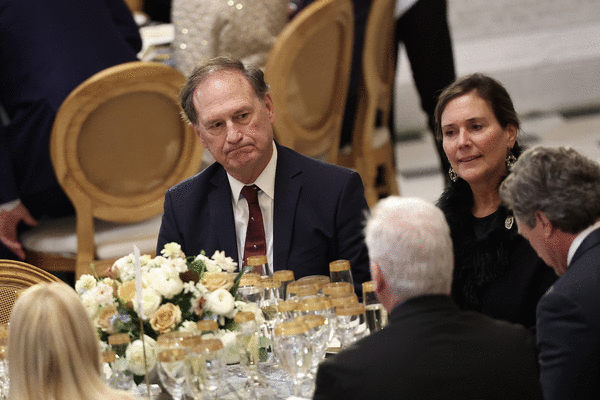
The episode comes to mind in light of the panicky voices on the right begging Justice Samuel Alito to step down so that President Donald Trump might have the opportunity to make one more Supreme Court appointment before January, when the Senate turns deep blue. Nothing at all new: Similar cries for early retirement have been heard in the past, when Democrats have seen red waves rising toward the political shores.
But for me as a constitutional romantic — my fellow scholars might call me a dreamer, or worse — the alarums and excursions incident upon such occasions are troubling. Pressuring a justice to resign so a sitting president might nominate a replacement seems to me every bit as big a threat to the separation of powers as court-packing, mandatory retirement ages, and all the rest of the bundle of cheap theatrical gimcracks carried joyfully onto the stage of politics and opened with great fanfare as each generation seeks afresh to bring the court to heel. (1)
Still, one must be honest enough to admit that it happens all the time. Think Barack Obama’s famous lunch with Justice Ruth Bader Ginsburg, where, so the story goes, she gently deflected his gentle hints that it was time to go, lest a Republican appoint her successor. Or, for that matter, the tale that Obama was advised that he might lever open Justice Stephen Breyer’s seat by dangling the ambassadorship to France.
That particular tactic had been used before, when Lyndon Johnson lured Arthur Goldberg from the court by asking him to become ambassador to the United Nations — a transparent ploy to open a seat for Johnson’s crony, Abe Fortas. Fortas lasted only three and a half years, forced from the bench not only by scandal but — speaking of pressure — by the Nixon Justice Department’s leaks about its investigation into Johnson’s old friend.
The Oval Office isn’t alone in getting up to this stuff. Although the data set is admittedly small, we can at least say that it’s far from unheard of for justices to try to time their retirements to allow presidents of their own parties to appoint their successors. Perhaps the best-known example is Earl Warren, who announced his retirement in 1968 in the hope that Johnson would appoint his successor. Later on, Warren would admit that had he known how sharply the court would change, “They would have had to carry me out of here on a plank.”
So it’s not unusual to try. Wrong, but not unusual.
In the aforementioned West Wing episode, the administration makes its approach through one of the chief justice’s former law clerks, now working in the White House counsel’s office. At first the clerk says no: “The White House can’t be seen as pressuring a Supreme Court justice to change his breakfast order, let alone resign.”
The constitutional romantic in me loved that response. The judicial branch will never, of course, be entirely beyond political control, but that control has a defined constitutional form: the powers of the president to nominate and of the Senate to confirm or not confirm. The rest is murky, governed not by formal rules but by various norms of conduct. The norms exist, in a sense, to keep friction out of the system, to allow us to tell each other that the court has a status outside of — not above, but outside of — the give and take of everyday politics. One of those norms is that politicians and activists don’t get to choose when a justice should leave.
In the West Wing episode, the chief justice’s determination to cling to his seat turns out to have nothing to do with constitutional norms. His concern is that should he step down, no similarly inclined firebrand could be confirmed. The West Wing was one of the finest shows in the history of television, but that reason was wrong. The right reason is the one his law clerk gave: that the separation of powers means when he leaves the bench is none of the president’s business. Which is why Alito’s reported insistence that he’s not going anywhere should be the end of the matter.
I argued long ago, have frequently repeated, and still fervently believe that the charade of independence, elaborate as it might appear, is crucial to the court’s authority. If we prefer to abandon it — to declare, as so many evidently believe, that the judiciary is independent only when it rules the way we want — then our sudden preference for honesty should include putting potential justices to popular vote.
If we’re not prepared to go that far, we should stop treating the justices as though their tenure is limited by fealty to party or cause.
____
(1) Those clamoring for mandatory retirement today might consider that a constitutional amendment that would have accomplished just that was seriously debated in Congress in the 1950s with the goal of overturning Brown v. Board of Education.
____
This column reflects the personal views of the author and does not necessarily reflect the opinion of the editorial board or Bloomberg LP and its owners.
Stephen L. Carter is a Bloomberg Opinion columnist, a professor of law at Yale University and author of “Invisible: The Story of the Black Woman Lawyer Who Took Down America’s Most Powerful Mobster.”
©2026 Bloomberg L.P. Visit bloomberg.com/opinion. Distributed by Tribune Content Agency, LLC.














































Comments