Commentary: Blue wave, blue economy -- but not black and blue
Published in Op Eds
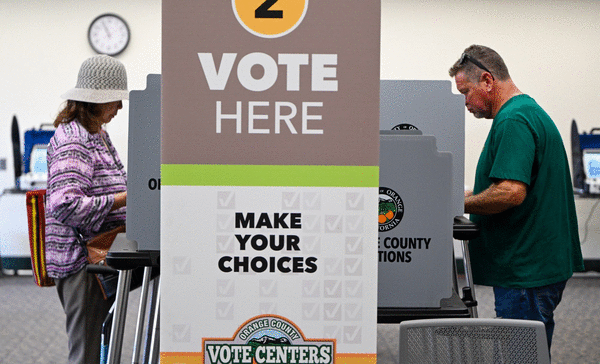
Wall Street delivered its verdict on the blue-wave midterms 48 hours later in the form of a red wave—red ink, that is.
After a brief relief rally the day after the election, the Dow shed more than 1,800 points, the tech-heavy Nasdaq fell more than 5% and into correction territory, and roughly $2.5 trillion in market value vanished in a single session. Nvidia alone dropped more than 8%.
Market participants watched the collapse of the AI trade in real time—the bet that a massive buildout of data centers, chips, and software would power faster growth, higher productivity and rising wages for years to come. That theory hit the brick wall of an incoming Congress that has AI and data centers on their blacklist.
Democrats, who will comfortably control the Senate and hold their largest House majority in nearly two decades, have been far more hostile to data centers and AI than Republicans have. Several of their biggest wins came in places such as Texas, where local opposition to new data centers had been building.
Investors can read the writing on the wall: more regulation and taxation, slower permitting, and lower profits for AI and AI-adjacent companies. Since equity prices are ultimately justified by future earnings, adjusting those future expectations down also drove down equity prices.
The fallout goes well beyond Silicon Valley. AI investment has been a key component of recent growth, and tens of millions of ordinary Americans own these companies through their 401(k)s. A slower buildout means fewer construction jobs, less demand for electricians and engineers, and slower productivity gains that drive real wage growth.
The fiscal picture is dimmer, too. With Democrats running both chambers, there is no chance of further tax reform or meaningful spending cuts for at least two years. If a Republican Congress couldn't bring itself to enshrine the DOGE savings into law, a Democratic one certainly won't.
Instead, Democrat leaders are already promising to restore cost-increasing Obamacare subsidies and unwind recently implemented work-requirement reforms for welfare, all of which will layer new commitments on top of deficits already running at levels once seen only in wartime or recession.
Aside from burdening future generations with debt, these perpetual deficits have consequences for Americans today. The government is crowding out borrowing in the private sector, competing with families and businesses for loanable funds, thereby driving up interest rates on everything from mortgages to student loans to credit cards.
Those higher borrower costs fall especially hard on those Americans that are already in debt and behind financially. The flood of government debt issuance also puts pressure on the Federal Reserve to help finance the debt by creating money to pay for perpetual deficits—a recipe for more inflation.
Unfortunately, a Democratic Congress will also likely offer no help on permitting reform, which is badly needed to build the pipelines, transmission lines and reliable power plants a growing economy requires.
So the outlook is clearly worse, but why isn’t it terrible? Much of the consequential economic public policy changes of the past two years didn't depend on Congress, and it won’t go forward either. And while the tax-reform legislation passed last year obviously did require Congress, most of its provisions are permanent and won’t need reauthorization.
The administration retains broad authority to issue executive orders and roll back burdensome regulations. Cutting that red tape, on everything from energy production to banking, reduces compliance costs for Americans without a single vote on Capitol Hill.
Democrats will certainly try to slow that good work. Their leaders are already planning a wave of made-for-cable show trials that will drain time and attention from officials who should be dismantling the bureaucracy. But investigations can only delay regulatory reform, not stop it.
The president’s veto is another silver lining that will likely prevent the Democratic Congress from enacting sweeping tax hikes or new regulatory regimes. The worst ideas will hopefully die in committee or an Oval Office waste basket.
The economy has weathered worse than a hostile Congress. Ongoing deregulation and existing tax reform are still tailwinds for economic growth while the veto pen is there to stop headwinds as they arise. The outlook might be blue, but it’s not black and blue.
____
E.J. Antoni, Ph.D., is chief economist and the Richard Aster fellow at the Heritage Foundation and a senior fellow at Unleash Prosperity.
_____
©2026 Tribune Content Agency, LLC.














































Comments