Aaron Brown: As Tesla ends the oddball Cybertruck, let's pull the plug on the EV culture war
Published in Op Eds
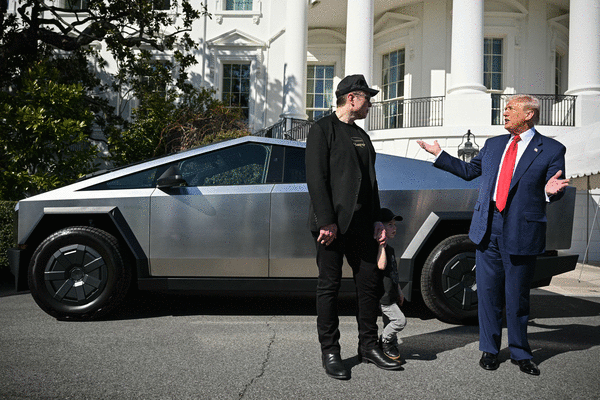
I saw my first picture of a Tesla Cybertruck at the big wooden table of our family’s northern Minnesota hunting shack. Except for myself, a soft-handed writer with a minivan, this was a gathering of men who drove pickup trucks their whole lives.
We passed around someone’s phone displaying the glistening stainless steel prototype while the motorheads among us marveled at the angular truck’s horsepower and torque. Sure, it looked dumb, but we were certain this was just a rendering they hadn’t finished. There’s no way they’d actually make a truck that looked like that.
We, and the world, would learn otherwise when Tesla CEO Elon Musk unveiled the Cybertruck on Nov. 21, 2019. It would be 2023 before customers began receiving the first models and only last year that I saw one near my rural home. My wife remarked that it looks like a child’s drawing of a truck brought to life at great expense.
Last week, Musk announced that Tesla would end production of the Cybertruck in 2027.
Sales for the Cybertruck fell short of expectations and had dropped from the previous year. Tesla will now convert the Cybertruck production lines to the Cybercab, a fully autonomous passenger vehicle.
The Cybertruck was always more than a truck. It was a manifestation of Musk’s ambition and stark aesthetic. As Musk became more political in 2020, he became a lightning rod of controversy just as he was asking EV enthusiasts to order Cybertrucks. In subsequent years, Musk became the biggest single donor in U.S. politics, spending almost half a billion dollars on behalf of Republican candidates in last week’s midterm election.
That’s relevant because EV adoption has been stymied, in part, by partisan politics.
I learned this in February 2024 when I attended an electric vehicle demonstration at the Ely Winter Festival in northern Minnesota. The event was planned for the coldest part of winter to show off the ability of EVs to drive in subzero conditions. Unfortunately for organizers, it was a sunny, warm afternoon that left nearby snow sculptors performing the slushy equivalent of plastic surgery on their creations.
I drove my first Tesla, a Model X, marveling at its rapid acceleration and smooth ride. They’re good cars. One of my sons drove a Ford F-150 Lightning, an all-electric version of America’s top selling pickup truck. He saw little difference from driving his grandpa’s F-150, other than that this one was newer and fancier.
But when I wrote a column for the local newspaper talking about this experience, I experienced the biggest online blowback I’ve ever seen. One man said if he saw me on the side of a road with my electric vehicle he would flip me off rather than stop to help. That seemed harsh, given that I don’t own an electric vehicle and said in the column I wasn’t ready to buy one.
This was 2024, and in retrospect I should have recognized it as evidence of political peril facing former President Joe Biden, then still a candidate for re-election. Weighing the pros and cons of electric vehicles was less important to online critics than winning the culture war that surrounded them.
Then, something funny happened. President Donald Trump won that November and brought Musk into his second administration. Suddenly, electric cars weren’t as dangerous to society as they had been a few months earlier. Most people still weren’t buying EVs, but the mood shifted. It’s around this time that I saw that first Cybertruck driving around in my very red neighborhood of rural Itasca County.
Political motives make for bad engineering and poor judgment.
Electric vehicles are fast and maneuverable, with rapid acceleration. Their range is a concern only for long drives. They lose range in cold weather, but so do gas vehicles. More charging stations would help.
They are not, however, some kind of panacea for the environment. They save gas, but they’re heavy and take lots of critical minerals to make. Their real advantage is that you can charge them with any electrons you want, including those derived from renewable energy.
Simple facts. No politics needed. EVs work well for some drivers, while others might prefer a different choice. They are going to become more common as electricity becomes the primary fuel of homes and industry.
Electric vehicles remain a small part of the U.S. automotive mix. About 2.5% of vehicles on national roadways are fully electric, and only 1.6% in Minnesota, according to the U.S. Energy Department.
Though overall EV sales slowed significantly last year, largely because of the expiration of federal energy credits, they increased slightly during the third quarter of 2026.
This brings us back to our mortally wounded friend, the Cybertruck. The death of the Cybertruck should not be confused with declining potential of EVs in general, or even electric trucks. Rather, these rolling refrigerators were a living, and now dying, reminder that basic infrastructure and functionality are what sells new technology to a skeptical public.
We run our off-grid hunting shack on solar energy and gas-powered generators because both technologies have pros and cons. Eventually, we’ll run all solar. In my lifetime, many of us will arrive in EVs.
I can assure you that the one I drive will be designed with the customer in mind, rather than the ego of the manufacturer’s CEO. Until then, the minivan is paid for, and good enough for me.
___
©2026 The Minnesota Star Tribune. Visit at startribune.com. Distributed by Tribune Content Agency, LLC.

















































Comments