Andreas Kluth: US allies are afraid, very afraid, of those American F-35s
Published in Op Eds
Countries from North America to Europe and East Asia know that trying to “de-couple” from this powerful but predatory nation would be ruinously expensive, if not futile; but also, for the sake of their security and sovereignty, that they at least need to “de-risk.” But is this even possible?
For years, that predatory nation was understood to be authoritarian China. These days, though, the superpower that America’s allies want to de-risk from is America itself.
Their concern has become no less urgent after the U.S. midterm elections. The lame-duck American president, having been repudiated and chastened, will now be livid and resentful, and foreign policy is the domain in which a Democratic Congress has the least power to restrain him. Besides, any effort by America’s allies to de-risk will outlast the era of Donald Trump by decades, because that’s how long de-risking would take.
Allies are most worried, even aside from their trade exposures, about their military entanglements with the United States. A recent episode involving Ukraine and SpaceX, the American company led by the mercurial Trump frenemy Elon Musk, made those fears concrete.
When SpaceX temporarily throttled its satellite services Starlink and Starshield over Ukraine, it forced Ukrainian drones to fly too slowly to intercept incoming Russian drones and missiles. That cost Ukrainian lives. Musk and Trump’s government shifted blame, but the damage was done.
The incident “very much shook NATO allies,” Philippe Lagassé told me. He’s a professor at Carleton University in Ottawa who has advised the Canadian government on its military procurement, most of which involves, as it has for decades, buying weapons from the U.S.
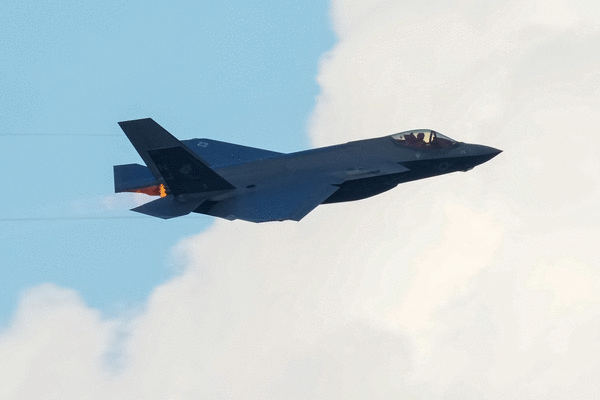
For example, Canada has an aging fleet of (American) F-18 fighter jets, which it has long planned to replace with newer (and equally American) F-35s. One apocryphal fear is that those F-35s have a “kill switch,” which the Americans could flick, rather as SpaceX throttled its satellites, if it ever needed to hamper any foreign country flying the jets.
“I don’t think there’s any evidence for or against” such a kill switch, Lagassé says, but the point is that the U.S. “doesn’t need a kill switch to impair the operations of the F-35” or any of the other advanced weapons it exports to allies. It could simply stop supplying them with the parts and, more importantly, the proprietary data connections that make them work.
In that way, modern weapons, which are embedded in fancy networks that integrate intelligence from sensors to satellites, are similar to iPhones and Android phones: In this analogy, an allied force running on Apple’s ecosystem could decide to add a few Samsungs; but it would quickly discover that those gadgets can’t do much, because they’re cut off from other units, allies and command chains.
This problem bedevils most American allies. (A notable exception is France, which has a tradition of maintaining its own supply chains, from tanks all the way to nuclear weapons.) For example, Denmark, after Trump threatened to seize Greenland, considered backing out of its F-35 order, but so far hasn’t. Portugal is also waffling.
Canada, which Trump has threatened to annex, is constantly slamming into this limitation. Its prime minister, Mark Carney, wants “middle powers” to band together with the goal of becoming more resilient against American pressure. But in the military realm that is hard, because the U.S. is ubiquitous.
In September, for instance, Canada signed a deal with the Swedish company Saab to buy its GlobalEye surveillance aircraft, largely to avoid buying an alternative plane made by America’s Boeing. But the GlobalEye systems have the same data-syncing problem.
The integration specter looms even larger in the “review” that Carney has launched of Canada’s F-35 order. The alternative jets would be Gripens, also made by Saab (although they could be manufactured in Canada). But even the government preceding Carney’s concluded that the F-35s are technologically more advanced. Above all, the Gripens wouldn’t “play well” with all that American kit the Canadians already have.
That’s a particular hurdle for Canada, because it needs to sync with the U.S. not only within NATO but also within NORAD (the North American Aerospace Defense Command), the binational operation that defends the skies over North America. If the Americans thought that third-party jets compromised their data standards, they might stop including the Canadians in their defense plans altogether.
Canada illustrates a dilemma facing allies from Germany to South Korea. “We’ve spent roughly 80 years building our armed forces to be increasingly interoperable with the United States military,” David Perry, the boss of the Canadian Global Affairs Institute, told me. “President Trump, in his highly unique way, has actually illustrated how dependent the Western allies are on American military technology.”
The allies lack good options. If relations with the White House ever became as tense as those between Washington and Kyiv recently, America’s partner countries could impose costs on the U.S. — many parts of those F-35s, for instance, are made in allied nations and could be withheld. But “once you start going down that escalatory path, the whole alliance just falls apart,” says Lagassé.
Weaning allied forces from American vulnerabilities by becoming more dependent on France, say, is similarly fraught: What if Marine Le Pen becomes its next president and cozies up to Russian President Vladimir Putin even faster than Trump?
So de-risking cannot mean simply declaring independence. It must come about gradually — for instance, by investing in domestic drones and autonomous weapons, so that today’s dependencies don’t get replicated in tomorrow’s systems. But that would take enormous sums of money, just as most allies (notably including France) are already far too indebted.
Beyond the rhetoric, Lagassé told me, the plan is to “white-knuckle it through the next two years until you end up with an administration that realizes, oh my God, we need to totally rebuild the trust that we just destroyed. But you never forget.”
Not forgetting will mean, among other things, that allies gradually spend less on American weapons and more on alternatives, even if those are inferior. American power will continue to wane and alliances will fray. Adversaries, from Moscow to Beijing and Pyongyang, will pay close attention. And everybody will be less safe.
____
This column reflects the personal views of the author and does not necessarily reflect the opinion of the editorial board or Bloomberg LP and its owners.
Andreas Kluth is a Bloomberg Opinion columnist covering U.S. diplomacy, national security and geopolitics. Previously, he was editor-in-chief of Handelsblatt Global and a writer for the Economist.
©2026 Bloomberg L.P. Visit bloomberg.com/opinion. Distributed by Tribune Content Agency, LLC.
















































Comments