Danny Westneat: Election Day wasn't a blue wave so much as a '100-year flood'
Published in Op Eds
SEATTLE — In the end it was obvious the election was going to come down to just one big thing.
He asked to be on the ballot. Was he ever.
You can’t have a president this historically unpopular, who also excels at sucking up all the oxygen, and expect to get election results much more nuanced than a wipeout.
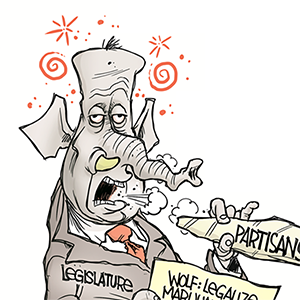
Just two years after many in the political classes said there had been a permanent political realignment, shifting Hispanic and working-class voters to Donald Trump and the GOP, those same voters turned tail and fled on Tuesday — back toward the Democrats.
It’s “a 100-year flood,” said Sean Trende, an elections analyst at Real Clear Politics and the center-right American Enterprise Institute. “Easily the worst election for a party since 1974. This is a complete collapse of the Republican coalition.”
The year 1974 was the backlash election from the Watergate scandal. So the rebuke of Trump, six years into his presidency, now sits on that historic scale.
Democrats won back control of both the U.S. House and Senate in Tuesday’s returns.
Here in Washington state, all the Congressional Democrats were winning reelection in early returns. U.S. Rep. Marie Gluesenkamp Perez, who was believed to be endangered representing a district that Trump has won three times, was instead surfing the blue wave to easy reelection, up by 11 percentage points.
One Republican incumbent, U.S. Rep. Michael Baumgartner in Spokane, was locked in a near tie with a Democratic challenger, Carmela Conroy. It could take days of vote-counting to resolve that one — in a district Baumgartner won in 2024 by 21 points.
At the state level, Democrats also looked to be scoring a huge win in the “millionaires tax” vote. It’s the first positive vote for any income tax in Washington in more than 90 years. The tax must still survive court challenges early next year.
The blue wave washed down-ballot into some of Washington’s red nooks and crannies. Local Democrats were leading in races to flip eight to 10 Republican legislative seats — including in some Eastern Washington districts where they haven’t won even one time throughout the MAGA years.
Democrats looked on track to gain a supermajority in the Washington state House and just shy of it in the state Senate.
The exit polls offered up a pretty good accounting for this trouncing. It wasn’t that the Democrats or their policies are all that popular. It was Trump.
Voters said they disapproved of the victorious Democratic Party by 8 percentage points, with 46% approval and 54% disapproval. Kind of “meh” numbers to fuel the biggest blue wave in more than 50 years.
But Trump was at -24 points, with just 38% approval and 62% disapproval. In Washington state Trump was clocking -43 point approval on Election Day. A political party can’t overcome that much drag from its own leader.
The biggest group to peel away was Hispanic voters. They've shifted toward the Democrats by 22 points since 2024, the exit polls by a consortium of news organizations showed. Hooded ICE agents roving around like paramilitary gangs likely had something to do with that. More than three-quarters of Latino voters cited immigration enforcement as a major factor in their votes for Congress.
But in an echo of Watergate, nine in 10 of all voters cited “government corruption” as a major issue. Eight in 10 also said Congress hasn’t done enough to “provide checks and balances on the presidency.” Those two categories signaled game over for this version of Republican rule.
U.S. Sen. Ron Wyden, D-Ore., channeled that with a one-word victory statement: Subpoenas. Whether Democrats follow that aggressive course, the sweeping election rebuke clearly marks the end of the maximalist era of Trump’s presidencies. He’s going to have to try to get along with others for the final two years.
The black hole theory of politics, in which Trump was pulling his party down past a point of no return, proved to be correct.
Local issues do still matter — see how the statewide issue initiatives didn’t all rise or fall together.
But in the party races, the story of 2026 is that if you had an R after your name, no matter what you were running for, it might as well have been a T.
©2026 The Seattle Times. Visit seattletimes.com. Distributed by Tribune Content Agency, LLC.
















































Comments