Nolan Finley: GOP hopefuls can't win the race carrying Trump on their backs
Published in Op Eds
John James and Mike Rogers, while both Republicans, are two very different political candidates running markedly different campaigns against two very different opponents. Yet after months of campaigning, James and Rogers find themselves in nearly the exact same place.
James, according to the latest Detroit News-WDIV-TV (Channel 4) poll, trails Democrat Jocelyn Benson in the race for governor by seven percentage points. Rogers is six points behind Democrat Abdul El-Sayed.
Neither race is over. The Republican vote tends to close late, and this poll conducted by Glengariff Group came out of the field on Oct. 22. But if the numbers do hold until Election Day on Tuesday, Nov. 3, it will be confirmation that this election had little to do with issues, policies, personalities, or even spending.
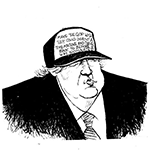
From the beginning, this election has been all about Donald Trump. No other consideration has truly mattered; whether it's affordability or antisemitism, data centers or health care, it all boils down to the inability of the Republican candidates to separate themselves from the Republican president.
On paper, the GOP stood candidates who should have been positioned to beat flawed Democratic opponents. Secretary of State Benson is running against Michigan history ― no governor has succeeded a governor from the same party in six decades. James, a two-term congressman, also should be able to exploit Benson's role in the state's collapse under Democratic control.
Likewise, Rogers, a former congressman and successful businessman, should be a lock against El-Sayed, whose far-left positions and associations with some very unsavory characters frighten many voters.
But voters aren't weighing the candidates' individual strengths and weaknesses.
"Democrats could have put a toadstool on the ballot," says Richard Czuba, CEO of Glengarrif. "The individual candidates don't matter as much as Trump matters."
And he matters a lot, particularly among young voters, who overwhelmingly say they'll definitely vote in the election. A clear majority say they're voting for Democrats.
"These young voters have wholesale rejected Donald Trump," Czuba says. "If young voters come in at much bigger numbers, it could be very bad for Republicans."
Who knows if they'll actually fill out a ballot ― the youth vote is notoriously unreliable. But when motivated, it can make the difference.
Czuba sees parallels to the 2022 election, which came just after Roe v. Wade was overturned by the U.S. Supreme Court. The abortion issue was a driver of the youth vote that year, with Democrats as the beneficiary.
Using Trump to attack El-Sayed in this Senate race was a mistake. When the president went after Gov. Gretchen Whitmer in his first term, he made the governor a political folk hero and vaulted her onto the national stage. He could be doing El-Sayed the same favor.
Should the top-of-the-ticket races go as this poll predicts, down-ballot contests will inevitably be impacted. A surprising number of Michigan congressional seats have become competitive.
If the blue wave crests high enough in Michigan, the state could send a delegation to Congress that favors Democrats by a 10-3 margin, matching the seven-seat advantage Democrats enjoyed from 1979 to 1981, the widest for either party in the modern era. The current breakdown is six Democrats and seven Republicans.
Republicans are desperate to hold onto at least one chamber of the state Legislature as a block against a Democratic monopoly in Lansing. They've deployed former Gov. Rick Snyder to shore up GOP House candidates.
But this latest poll reflects a fierce anti-Trump sentiment among Michigan voters. I haven't seen anything to suggest that it isn't real, or that it isn't sticking with his fellow Republicans.
_____
©2026 www.detroitnews.com. Visit at detroitnews.com. Distributed by Tribune Content Agency, LLC.













































Comments