LZ Granderson: Trump's fits of pique explain his lifetime of failure
Published in Op Eds
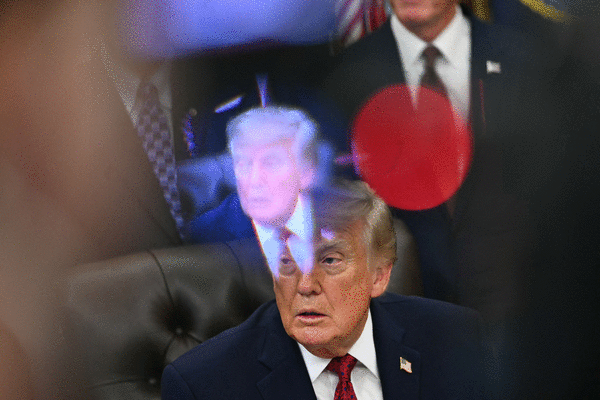
Ideally, the screams of infancy and the insolence of toddlerhood fade as a person grows and the scalpel of life begins sculpting away. Yes, problems still persist, but part of maturing is understanding that "he that is slow to wrath is of great understanding but he that is hasty of spirit exalteth folly." As the Bible story goes, King Solomon asked God for wisdom, and that proverb was among the things he told him.
Of course it's not necessary to be a Bible follower to understand the drawbacks of hot-headedness as an adult. Social media is filled with clips of adults beating each other up for no good reason. Emotional outbursts may temporarily change a situation or cadence, but they are not a habit associated with the word "leadership" unless preceded by the phrase "a lack of."
That's why President Trump's tendency to erupt at journalists and others is more than embarrassing or unprofessional. It's informative. A decade ago, his supporters romanticized the lack of decorum as "authenticity" or "telling it like it is." Ten years later and it's become clear that the octogenarian suffers from a degree of arrested development, and he childishly uses outbursts the way a civil engineer uses dynamite to blast a path for new roads. The key difference being in the case of the latter, there's a plan being executed. Trump's two terms in office largely feature him indiscriminately blowing up situations he doesn't like or appreciate — press conferences, ceasefire negotiations, trade discussions.
That mindset explains why the president feels comfortable placing his own name on a memorial for President Kennedy; and blowing off longstanding traditions such as attending the Armistice Day ceremony in France to honor American troops (he skipped in 2018 because of bad weather) or being at the World Trade Center for the 9/11 ceremony (organizers wouldn't let him speak, so the New Yorker went to the Pentagon instead).
And his impulse to push for illegal bans on the media is the same impulse we see in his failed negotiations with Iran. The mindset of a world leader matters. Not just in this country but to the world.
Case in point: After World War I, President Wilson introduced a 14-point plan in 1918 that he believed, if followed, would avoid another global war. During negotiations, Japan introduced an amendment stating that all races were created equal. Wilson, a white supremacist who gave the KKK cover during his time in the White House, rejected those calls. In fact, the 28th president was forced to make compromises on all 14 of his points, but when it came to Japan's amendment, he didn't budge. That character flaw not only undermined the effectiveness of his peace plan — the League of Nations — but also, many historians believe, Wilson's racism contributed to Japan's decision to side with the Axis in World War II (not that Nazis were paragons of equal rights).
Or consider that Ho Chi Minh tried in 1919 with Wilson and again in 1946 with President Truman to get the so-called leader of the free world to acknowledge Vietnam's sovereignty and his people's humanity.
Could the carnage from World War II and the Vietnam War have been avoided had the U.S. presidents not been blinded by prejudice? Bob Marley certainly thought so. In 1976, the reggae singer performed four sold-out shows at the Hammersmith Odeon in London, the epicenter of colonialism. This summer a 90-minute live album from that residency was released for the first time. The centerpiece of the recording is the song "War." It is the only song Marley begins a cappella, and it starts with a denouncement of racism before prophetically stating that until imperialism is abandoned "the dream of lasting peace, world citizenship, rule of international morality, will remain but a fleeting illusion to be pursued, but never attained."
That song is based on a speech at the United Nations, the successor to the League of Nations, given by Ethiopia's Haile Selassie in 1963. Selassie actually came to Wilson's League in 1936 asking for help against fascist Italy, before World War II: "I pray to Almighty God that He may spare nations the terrible sufferings that have just been inflicted on my people."
The enlightened leaders ignored him 90 years ago and "now, everywhere there' s war," to quote the Marley song that was paraphrasing Selassie's warning.
The mindset and temperament of leadership matters. Character matters. Not only in a philosophical way but in tangible ways — on matters of healthcare, welfare, foreign and domestic policy. Trump's outbursts are not a form of entertainment. They are glimpses into how he handles difficulties and very well could be the reason he started the war with Iran and why he's struggling to end it.
____
YouTube: @LZGrandersonShow
©2026 Los Angeles Times. Visit at latimes.com. Distributed by Tribune Content Agency, LLC.













































Comments