Commentary: Return of 'might makes right' imperils the UN's mission as AI threatens our existence
Published in Op Eds
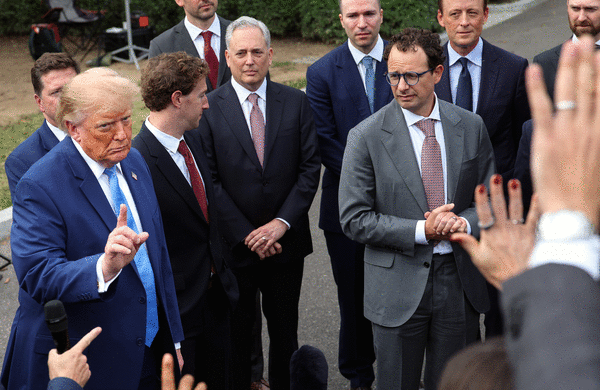
“To the victor belong the spoils.” This is what President Donald Trump told leaders of the world’s nations in the middle of his rambling address to the United Nations General Assembly’s annual meeting in New York last week. It was an unequivocal repudiation of the very principle on which the institution he was speaking to was founded. This signals a dangerous global future at a time when the U.N.’s ability to spur collective solutions to global threats is more essential than ever.
Trump was referring specifically to the extortion of Venezuelan oil assets following the abduction of its leader Nicolás Maduro earlier this year. The administration secured the oil through a deal made with Delcy Rodríguez, the acting president of Venezuela whom Trump threatened earlier this year with a fate “probably worse” than Maduro if she did not cooperate. Trump’s aggressive posture was not limited to Venezuela, though. He also claimed he could “annihilate” Iran and would “bring fundamental change” to Cuba.
That Trump brought this message to the floor of the U.N. is particularly startling because this institution was created to bring an end to the disastrous world order of “might makes right” that had set the stage for two world wars and the centuries of violent state interactions that preceded them.
Over the years, the U.N. has taken on a wide array of roles that make global interaction, travel, trade and security all more accessible. But it was established in 1945 to avoid the staggering human and financial costs of another world war. The idea behind the U.N., as enshrined in its charter, is that international peace and security are only possible through cooperation among states, and that requires that states refrain from using aggression and violence to get their way.
Perhaps more concerning than Trump’s naked aggression in this venue dedicated to the idea of cooperating for the greater good is the fact that it was largely shrugged off. Other leaders seem resigned to the fact that this 80-year global experiment in cooperative international relations has ceded the floor once again to the world order of coercion that dictated most of human history. As Greek historian Thucydides put it nearly 2,500 years ago, that is a world where the strong do what they can and the weak suffer what they must.
This would be a dangerous trajectory in any environment, but it is particularly so today when the world is facing existential threats from the emerging technology of artificial intelligence. If ever a technology demanded international cooperation and governance, not only to manage the grave risks it poses but also to maximize its positive potential, it is AI.
International AI safety was a hot topic of discussion at this year’s premier gathering of foreign officials, but the diverging views of the world’s two biggest AI powers — the U.S. and China — indicated that we are still a long way off from any meaningful international agreement. Trump made clear that the U.S. opposes any international regulation, or national regulation for that matter, that he believes would put U.S. domination of the sector at risk. At his lunch with AI executives on Tuesday, the only outcome was agreement to establish voluntary standards. In contrast, China’s U.N. representative said that China was open to the idea of a global framework of “institutional guardrails that preserve international peace and security.”
But the high level of distrust between the two competitors will be an obstacle to meaningful progress even if the U.S. administration changes its tune.
International cooperation on regulating the use of potentially dangerous technology has been the norm since the late 19th century when chemical and explosive weapons first hit the scene. Thanks largely to the U.N. and the expansion of international coordination since World War II, the infrastructure and opportunity to manage such threats has advanced significantly. That AI should somehow be an exception to this practice is absurdly counterintuitive. International treaties and agreements govern the use and proliferation of the inputs used to create biological, chemical and nuclear weapons. Even the United States and the Soviet Union were able to work together during the Cold War to manage the nuclear threat. The inevitability of conflict and competition in the world does not preclude our ability to collectively manage these threats; it only makes it more urgent.
Absent an international effort to coordinate governance over AI, control over all these inputs and so much more will be at grave risk. The international community’s ability to manage safe travel and secure banking, communications and quality standards for food, water, and medicine could all be compromised, too. The damage that nefarious non-state and state actors, or even rogue AI agents themselves, could unleash could do irreversible damage to nearly any part of our economy and society.
As Bill Gates said in a recent powerful warning, the U.S. and China have both “opened Pandora’s box,” and it’s already “there for people with malintent to go and use it.”
No single state, no matter how strong or aggressive, can insulate itself from these risks alone. Trump has said, “Whoever wins AI, wins.” But, in a world with no collective approach to managing the risks AI poses, we will all lose.
Whether a state wants the best for its country or the world, cooperative international action is the only answer to today’s biggest challenge.
____
Elizabeth Shackelford is a foreign affairs columnist for the Chicago Tribune and a lecturer with the Dickey Center at Dartmouth College. She was previously a U.S. diplomat and is the author of “The Dissent Channel: American Diplomacy in a Dishonest Age.”
___
©2026 Chicago Tribune. Visit at chicagotribune.com. Distributed by Tribune Content Agency, LLC.













































Comments