Editorial: The flawed logic of Medicare for All
Published in Op Eds
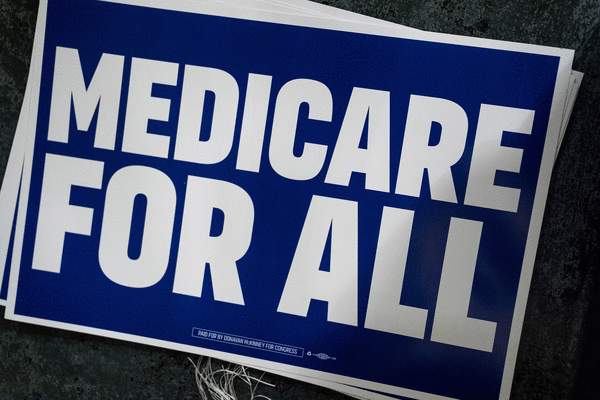
Abdul El-Sayed, the Democratic candidate for Senate in Michigan, has a simple pitch to voters. Imagine, he says, a health-insurance plan with “no premium, no copay, no deductible — just healthcare when you need it.” El-Sayed and other proponents call the idea Medicare for All.
Free, on-demand care for everyone sure sounds good. Legislation to establish Medicare for All nationwide has more than 100 cosponsors in the House, with many progressives campaigning on the idea this fall.
There’s just one wrinkle: The proposal bears little resemblance to how Medicare actually works. Even under generous assumptions, it would shift trillions of dollars in healthcare spending onto the federal budget while potentially slashing quality and restricting access to care.
No doubt, the current system — beset by soaring costs, corporate misconduct, opaque pricing and perverse incentives — needs fixing. Yet a more pragmatic reform agenda would serve Democrats better in the midterms and serve Americans better over the long term.
It isn’t hard to see why Medicare for All has appeal. Traditional Medicare covers nearly all Americans 65 and over, along with millions of people with disabilities. Most services are offered without restriction, and more than 95% of physicians participate. The program’s immense popularity should come as little surprise.
And yet, even when limited to this relatively targeted population, Medicare is fiendishly complex and costly. By one estimate, it will comprise more than half of government borrowing in a decade. The program also can leave seniors with hefty bills, with average out-of-pocket costs, including premiums and services, exceeding $6,000 annually. As things stand, more revenue will be needed to care for an older, sicker population; extending Medicare to all 343 million Americans will hugely increase those demands. Doing so without premiums, copays or deductibles implies an unprecedented surge in spending.
It also bears emphasizing that hospital visits are often cross-subsidized by generous commercial plans. A system that eliminates such payers either will need to spend vastly more to maintain current standards or significantly reduce benefits. And while a government-run system might reduce rent-seeking, it would also remove incentives for the very innovations proponents want — from the latest cancer treatments to weight-loss drugs.
In practice, then, El-Sayed’s proposal is likely to look more like Medicaid. The health program for the poor, with its low reimbursement rates, is notoriously unpopular among doctors. “Healthcare when you need it” might thus more accurately be described as rationing and longer wait times. Good luck selling that to voters, most of whom want to keep their employer coverage.
Clearer goals would be salutary. In the past, champions of Medicare for All emphasized universal coverage. Proponents now appear to be seeking a universal sense of financial security — that is, protection against shock medical bills or abrupt changes to coverage and networks among the insured. These are much narrower problems, and they can be addressed with more direct and practical solutions.
The No Surprises Act, for one, largely ended unexpected bills from out-of-network doctors during medical emergencies. It nonetheless falls short of addressing the opacity of private coverage. Giving employees more flexibility to choose a plan with narrower but steadier networks — which often better reflect patients’ demand for services — would make sense. (Most workers are bound by their employers’ choices.) Already, such plans are gaining traction.
Another approach involves a universal guarantee against catastrophic financial losses after an income-based deductible. Such coverage would protect consumers from financial ruin while scaling back insurance for routine care — with the goal of creating a genuine market to lower costs. In some versions of the idea, preventative care and other services are funded by pretax accounts.
Neither idea is free of opposition, but both seek to give consumers peace of mind while realistically balancing trade-offs. That’s a less extravagant ambition than Medicare for All. It’s also far more likely to help.
----
The Editorial Board publishes the views of the editors across a range of national and global affairs.
©2026 Bloomberg L.P. Visit bloomberg.com/opinion. Distributed by Tribune Content Agency, LLC.














































Comments