Mark Gongloff: Black lung disease is the only true comeback for coal
Published in Op Eds
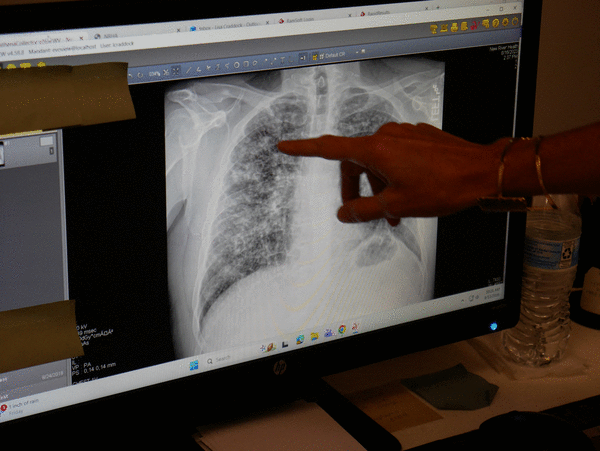
President Donald Trump has vowed to return America’s declining coal industry to its glory days. But the only real revival of trying to put this polluting fuel back at its peak is its ability to destroy the health of its miners.
U.S. coal miners are suffering from the highest rate of lung disease since 1978 in the mining heartland of central Appalachia, even as U.S. coal production is less than half its all-time high in the late 2000s. If Trump were to somehow magically restore coal demand to full life, he would risk dooming new generations of workers to an incurable, agonizing sickness at an unprecedented scale.
Among all U.S. coal miners with 25 years or more of experience, the rate of pneumoconiosis, the broad class of diseases that includes black lung, a product of inhaling coal dust, was 19.6%, on average, in the five years through 2024, according to a recent report from the National Institute for Occupational Safety and Health, part of the Centers for Disease Control and Prevention. That was the highest rate since 1990. The five-year average dipped below 19% last year, but the point remains: Nearly 1 in every 5 veteran coal miners in the U.S. today has an illness that seemed mostly tamed at the turn of the century.
The disease is strongest in the central Appalachian states of Kentucky, Virginia and West Virginia. There, 32.5% of coal miners with 25 or more years of experience have pneumoconiosis, the highest rate since 1978. Even younger miners in central Appalachia, with just 15 to 19 years of experience, have the disease at a rate of nearly 9%, higher than what 25-year veterans suffered a generation ago.
At black lung’s lowest ebb, in 1999, just 4% of veteran miners in the U.S. had the illness. It seemed to be a triumph of government regulation on par with closing the ozone layer. Public outcry had led Congress to pass first the Coal Mine Health and Safety Act of 1969 and then the Mine Safety and Health Act of 1977. That law created, as part of the Labor Department, the Mine Safety and Health Administration (MSHA), which set limits on how much coal dust miners could breathe. The law also gave miners the right to report work hazards without repercussion and made mine companies submit to inspections.
As a result, black lung rates fell steadily until the turn of the century, even as total coal production kept climbing to records. By 1999, the country was producing nearly twice as much coal as it did in 1974 but with drastically lower rates of black lung. Those improvements started slipping away after the turn of the century, with disease rates rising again. More alarmingly, they kept rising even as coal production plummeted with the fracking revolution that helped gas replace coal as the nation’s primary fuel.
What accounts for black lung’s revival? The quest to dig more coal out of increasingly difficult ground. Over time, mining exhausts the richest and most accessible seams of coal, forcing miners to drill through solid rock to reach more. Mining technology has improved to help that process along. But all of that drilling produced silica dust, which is as poisonous to human lungs as coal dust. Silicosis, as the resulting form of pneumoconiosis is known, is devastating the workforce that makes stone countertops, as Bloomberg News recently noted. Worse than lung cancer, as one doctor described it, silicosis is inflicting similar misery on coal workers.
Coal is generally considered the dirtiest fossil fuel because it releases so much planet-heating carbon into the atmosphere when burned and because it so thoroughly pollutes its surroundings with mercury and other toxins (though fossil gas is a strong contender when you consider all the methane released in its production, storage and use). Replacing coal with cleaner energy sources helps explain why governments have made so much progress toward avoiding the most apocalyptic climate-change scenarios.
Trump’s government has tried to reverse that progress, attacking clean energy and climate science and boosting fossil fuels, with particular emphasis on what he calls “beautiful clean coal.” Fortunately, though the data-center boom has given the dirty fuel a bit of a second wind, coal’s relatively high operating costs will keep it from ever truly reviving. If we went back to producing a billion tons of the stuff a year under current conditions, we would end up with unprecedented numbers of ruined lungs.
Most of these miners voted for Trump, but he keeps kicking them when they’re down. Thousands of sick miners rely on a federal black-lung program to help with medical costs, but benefits are often delayed for years by coal-company lawsuits, Mother Jones reported recently. And the administration has given up trying to carry out a 2024 MSHA rule change that would have cut silica-exposure limits in half.
The mining industry has claimed it supports tighter limits but doesn’t like how the new rule would be enforced. By doing nothing, the Trump administration has sided with the industry over the miners. A hypothetical Democratic Congress in 2027 wouldn’t be able to do much about this situation. That means the last hope for these workers is the very industry that seems fine with making them sick.
“The quickest thing that can happen is self-regulation on the part of the mining industry,” Sharona Hoffman, co-director of The Law-Medicine Center at Case Western Reserve University’s law school, told me. “Instead of suing over efforts to protect miners, they should be doing so themselves.”
Meanwhile, this profound regulatory failure continues, completely undoing the gains of earlier regulatory success, all in the name of supporting a fuel that should be nothing but a fossil at this point in history. Nostalgia trips are never productive. Rarely are they this deadly.
____
This column reflects the personal views of the author and does not necessarily reflect the opinion of the editorial board or Bloomberg LP and its owners.
Mark Gongloff is a Bloomberg Opinion editor and columnist covering climate change. He previously worked for Fortune.com, the Huffington Post and the Wall Street Journal.
©2026 Bloomberg L.P. Visit bloomberg.com/opinion. Distributed by Tribune Content Agency, LLC.
















































Comments